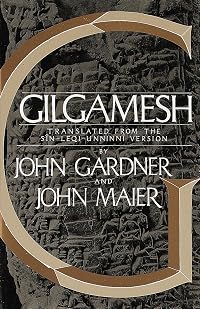
Gilgamesh
by John Gardner, John Maier (Translator)
On This Page
Description
The story of Gilgamesh, an ancient epic poem written on clay tablets in a cuneiform alphabet, is as fascinating and moving as it is crucial to our ability to fathom the time and the place in which it was written. Gardner's version restores the poetry of the text and the lyricism that is lost in the earlier, almost scientific renderings. The principal theme of the poem is a familiar one: man's persistent and hopeless quest for immortality. It tells of the heroic exploits of an ancient ruler show more of the walled city of Uruk named Gilgamesh. Included in its story is an account of the Flood that predates the Biblical version by centuries. Gilgamesh and his companion, a wild man of the woods named Enkidu, fight monsters and demonic powers in search of honor and lasting fame. When Enkidu is put to death by the vengeful goddess Ishtar, Gilgamesh travels to the underworld to find an answer to his grief and confront the question of mortality. A totally new translation of the classic Mesopotamian epic--with lengthy introduction and annotations--is presented in such a way as to reflect the appearance and arrangement of the original stone tablets. show lessTags
Recommendations


















Member Reviews
Six-word review: Ancient epic hero futilely seeks immortality.
Extended review:
I read this work immediately following The Buried Book: The Loss and Rediscovery of the Great Epic of Gilgamesh, by David Damrosch, which not only narrates the discovery and first efforts at translation of this epic poem of ancient Mesopotamia but sets a historical context for the story itself. The background reading enlarged and enriched my appreciation of the epic, as well as being an absorbing history in its own right.
The verse occupies only about one-third of the pages of this book. The rest consists of detailed scholarly explication and notes on the translation, including extensive reference to other sources and painstaking elaboration on the language and show more the process of decoding the cuneiform script. If I were not so fascinated by language as both an art and a medium, I might have found many parts of this book borderline unreadable, but as it was they held my attention fast.
The story itself concerns the adventures of King Gilgamesh of Uruk (in what is now Iraq), who sets out first to make a name for himself as a hero and then to learn the secret of immortality. The gods have fashioned as his counterpart a primal man called Enkidu. While Gilgamesh has enjoyed--and at times abused--all the power and privileges of the ruler of a great city, Enkidu has grown up in the wilderness among the animals and never known civilization or the touch of a woman. Enkidu is a kind of Doppelgänger who comes to be the bosom companion of Gilgamesh. Together they take on the conquering of a monster named Humbaba and then slay a divinely created beast called the Bull of Heaven.
The death of Enkidu causes Gilgamesh great mourning and also dread of his own future death. He goes in search of Utnapishtim, the only man to survive the Great Flood, to learn how he too can defeat mortality. From this Noah-figure, he learns secrets, but not the one he wants to hear.
The themes pertaining to the interactions of gods and humans and the motifs related to love, heroism, loss, submission to the gods and defiance of them, life, death, and much more recall similar strains in the Homeric tales and the Hebrew Bible. I read portions of Genesis alongside the Flood story in Gilgamesh just for the sake of comparison. An interesting note is that the Flood of Gilgamesh's story is not conceived as punishment for anything but is simply the will of a god who acts without consulting his fellow members of the pantheon; they later reprimand him for his misuse of power.
To me a great part of the wonder of it is how the words of a poet of some three or four thousand years ago, retelling legends that were already ancient in his own time, still have the power to hold, to move, and to enlighten the reader of today. It's hard to think of history of any kind--the history of so-called fact or the history of myth and lore--in the same way after dwelling for a time within the edifice of its own words. show less
Extended review:
I read this work immediately following The Buried Book: The Loss and Rediscovery of the Great Epic of Gilgamesh, by David Damrosch, which not only narrates the discovery and first efforts at translation of this epic poem of ancient Mesopotamia but sets a historical context for the story itself. The background reading enlarged and enriched my appreciation of the epic, as well as being an absorbing history in its own right.
The verse occupies only about one-third of the pages of this book. The rest consists of detailed scholarly explication and notes on the translation, including extensive reference to other sources and painstaking elaboration on the language and show more the process of decoding the cuneiform script. If I were not so fascinated by language as both an art and a medium, I might have found many parts of this book borderline unreadable, but as it was they held my attention fast.
The story itself concerns the adventures of King Gilgamesh of Uruk (in what is now Iraq), who sets out first to make a name for himself as a hero and then to learn the secret of immortality. The gods have fashioned as his counterpart a primal man called Enkidu. While Gilgamesh has enjoyed--and at times abused--all the power and privileges of the ruler of a great city, Enkidu has grown up in the wilderness among the animals and never known civilization or the touch of a woman. Enkidu is a kind of Doppelgänger who comes to be the bosom companion of Gilgamesh. Together they take on the conquering of a monster named Humbaba and then slay a divinely created beast called the Bull of Heaven.
The death of Enkidu causes Gilgamesh great mourning and also dread of his own future death. He goes in search of Utnapishtim, the only man to survive the Great Flood, to learn how he too can defeat mortality. From this Noah-figure, he learns secrets, but not the one he wants to hear.
The themes pertaining to the interactions of gods and humans and the motifs related to love, heroism, loss, submission to the gods and defiance of them, life, death, and much more recall similar strains in the Homeric tales and the Hebrew Bible. I read portions of Genesis alongside the Flood story in Gilgamesh just for the sake of comparison. An interesting note is that the Flood of Gilgamesh's story is not conceived as punishment for anything but is simply the will of a god who acts without consulting his fellow members of the pantheon; they later reprimand him for his misuse of power.
To me a great part of the wonder of it is how the words of a poet of some three or four thousand years ago, retelling legends that were already ancient in his own time, still have the power to hold, to move, and to enlighten the reader of today. It's hard to think of history of any kind--the history of so-called fact or the history of myth and lore--in the same way after dwelling for a time within the edifice of its own words. show less
This review is for the translation by John Gardner and John Maier.
So Akkadian cuneiform is, apparently, very difficult to translate (who would have guessed?). It's intriguing to think that there are 90,000 tablets safely tucked away in storage at museums that modern translators have never worked on. It almost makes me want to become a linguist specializing in it so that I could, maybe, discover the next big epic from ancient times that people don't even know exists anymore. Anyway, the point I'm attempting to make is that this translation is, above all else, a work of scholarship. The reader should know that beforehand. It's still entertaining, but there's more to the process of reading it than plot and characters. Footnotes and show more explanations abound. It's better than reading a textbook, and more like reading a biography of the clay tablets that "Gilgamesh" was written on.
I'm walking away from this with two major impressions. First, that ancient Mesopotamia is utterly fascinating. It was a bilingual society, speaking Akkadian and Sumerian. I'd like to check out several other titles on the subject now.
The second impression is that the previous "Gilgamesh" translation I read, the one by N. K. Sandars, is flawed. John Maier doesn't call that translator out by name, but based on publication dates, the limited number of English translations available, and the matching description that Maier provides, I'm certain that it's the Sandars he's referring to when he mentions another translator swapping out the authentic Akkadian twelfth clay tablet for a Sumerian story (p. 6). Imagine if, three millennia from now, a translation of T. H. White's The Once and Future King were ended with a chapter from The Mists of Avalon because the translator thought it would be more satisfying. Essentially, that's what I now know N. K. Sandars did with his translation, because the conclusion to that work is entirely different from the conclusion of the Akkadian tablets that these authors have so meticulously worked with.
5 stars. Nice work, Professor Gardner. RIP. Even though you died so many years ago, it's still a sad story that we readers lost you in that accident. show less
So Akkadian cuneiform is, apparently, very difficult to translate (who would have guessed?). It's intriguing to think that there are 90,000 tablets safely tucked away in storage at museums that modern translators have never worked on. It almost makes me want to become a linguist specializing in it so that I could, maybe, discover the next big epic from ancient times that people don't even know exists anymore. Anyway, the point I'm attempting to make is that this translation is, above all else, a work of scholarship. The reader should know that beforehand. It's still entertaining, but there's more to the process of reading it than plot and characters. Footnotes and show more explanations abound. It's better than reading a textbook, and more like reading a biography of the clay tablets that "Gilgamesh" was written on.
I'm walking away from this with two major impressions. First, that ancient Mesopotamia is utterly fascinating. It was a bilingual society, speaking Akkadian and Sumerian. I'd like to check out several other titles on the subject now.
The second impression is that the previous "Gilgamesh" translation I read, the one by N. K. Sandars, is flawed. John Maier doesn't call that translator out by name, but based on publication dates, the limited number of English translations available, and the matching description that Maier provides, I'm certain that it's the Sandars he's referring to when he mentions another translator swapping out the authentic Akkadian twelfth clay tablet for a Sumerian story (p. 6). Imagine if, three millennia from now, a translation of T. H. White's The Once and Future King were ended with a chapter from The Mists of Avalon because the translator thought it would be more satisfying. Essentially, that's what I now know N. K. Sandars did with his translation, because the conclusion to that work is entirely different from the conclusion of the Akkadian tablets that these authors have so meticulously worked with.
5 stars. Nice work, Professor Gardner. RIP. Even though you died so many years ago, it's still a sad story that we readers lost you in that accident. show less
(This review refers to the John Gardner/John Maier edition). This is an interesting take on Gilgamesh. Texts relating to Gilgamesh are known from Sumerian, Akkadian (with Assyrian, neo-Assyrian, Old Babylonian, Ugaritic and Neobabylonian variants), and Hittite; date over a time span of about 2000 years; and come from places as far apart as Bogazkhoy, Meggido, and Susa. There is no complete version in any language; what scholars traditionally do is take the bits and pieces, regardless of language and date, and string them together into a continuous narrative.
What novelist John Gardner and archaeologist John Maier have done instead is take a single version (albeit the most complete one) and translated it as a single text, without show more reference to other versions (except in footnotes). This is the Sîn-leqi-unninnĩ version, after the Assyrian priest who transcribed it for the library of Asshurbanipal. The main value here is you can see exactly how much is interpolated in other translations; of secondary interest is Gardner’s literary interpretation. Other translations bowdlerize the encounters between Enkidu and the temple courtesan and between Gilgamesh, Enkidu, Ishtar and the Bull of Heaven; Gardner and Maier go for an “Akkadian You Never Learned in School” tactic and are rather more graphic. Since I don’t know a word of Akkadian (well, not quite – “gypsum” is Akkadian) I have no idea whether the text actually justifies this, but I assume Maier wouldn’t allow Gardner to get too fanciful. There’s a long appendix which details translation problems and the approach the authors used.
I wouldn’t get this for your first version of Gilgamesh because the gaps in the text diminish readability but it’s definitely valuable if you’ve already read a more traditional version. show less
What novelist John Gardner and archaeologist John Maier have done instead is take a single version (albeit the most complete one) and translated it as a single text, without show more reference to other versions (except in footnotes). This is the Sîn-leqi-unninnĩ version, after the Assyrian priest who transcribed it for the library of Asshurbanipal. The main value here is you can see exactly how much is interpolated in other translations; of secondary interest is Gardner’s literary interpretation. Other translations bowdlerize the encounters between Enkidu and the temple courtesan and between Gilgamesh, Enkidu, Ishtar and the Bull of Heaven; Gardner and Maier go for an “Akkadian You Never Learned in School” tactic and are rather more graphic. Since I don’t know a word of Akkadian (well, not quite – “gypsum” is Akkadian) I have no idea whether the text actually justifies this, but I assume Maier wouldn’t allow Gardner to get too fanciful. There’s a long appendix which details translation problems and the approach the authors used.
I wouldn’t get this for your first version of Gilgamesh because the gaps in the text diminish readability but it’s definitely valuable if you’ve already read a more traditional version. show less
The great John Gardner knew what was needed to seduce Enkidu. In the “Gilgamesh” scene where primal man is pussy-whipped into becoming civilized, Gardner translates with words relevant to Enkidu’s mindset. The more well-known translations of hoary Assyriologists tend to be demure by comparison.
A hunter-trapper discovers feral man Enkidu running with gazelles. A plot is hatched. A prostitute (If you will forgive the idiom, academic knickers are knotted in a debate about this woman: Was she an official temple-courtesan, a love-priestess? or merely a whore?) is used to lure the wild-man away from his herd. Once he has mated with his own kind, a human, then the animals will no longer accept him.
The hunter-trapper takes this prostitute show more into the wild, to a water hole where Enkidu hangs out with the gazelles, and gives her instructions:
The woman saw him, the man-as-he-was-in-the-beginning,
the man-and-killer from the deep wilderness.
‘Here he is, courtesan; get ready to embrace him.
Open your legs, show him your beauty.
Do not hold back, take his wind away.
Seeing you, he will come near.
Strip off your clothes so he can mount you.
Make him know, this-man-as-he-was, what a woman is.
His beasts who grew up in his wilderness will turn from him.
He will press his body over your wildness.’
The courtesan untied her wide belt and spread her legs,
and he struck her wildness like a storm.
She was not shy; she took his wind away.
Her clothing she spread out, and he lay upon her.
She made him know, that man-as-he-was, what a woman is.
His body lay on her;
six days and seven night Enkidu attacked, fucking the priestess. show less
A hunter-trapper discovers feral man Enkidu running with gazelles. A plot is hatched. A prostitute (If you will forgive the idiom, academic knickers are knotted in a debate about this woman: Was she an official temple-courtesan, a love-priestess? or merely a whore?) is used to lure the wild-man away from his herd. Once he has mated with his own kind, a human, then the animals will no longer accept him.
The hunter-trapper takes this prostitute show more into the wild, to a water hole where Enkidu hangs out with the gazelles, and gives her instructions:
The woman saw him, the man-as-he-was-in-the-beginning,
the man-and-killer from the deep wilderness.
‘Here he is, courtesan; get ready to embrace him.
Open your legs, show him your beauty.
Do not hold back, take his wind away.
Seeing you, he will come near.
Strip off your clothes so he can mount you.
Make him know, this-man-as-he-was, what a woman is.
His beasts who grew up in his wilderness will turn from him.
He will press his body over your wildness.’
The courtesan untied her wide belt and spread her legs,
and he struck her wildness like a storm.
She was not shy; she took his wind away.
Her clothing she spread out, and he lay upon her.
She made him know, that man-as-he-was, what a woman is.
His body lay on her;
six days and seven night Enkidu attacked, fucking the priestess. show less
I loved the analysis passages after a given tablet or line on a tablet. It offers thoroughly researched context, but also is written in a way that's easy to read and not SO academic as to make your eyes glaze over! There are various theories presented as optional ways the text can be read, and also archaeological circumstances that affect our ability to read the text today.
This is a book that isn't necessarily read for literary value. Its a story/poem written for a ritual or a religious reason - and doesn't have the makings of a full story. It also doesn't help that we don't have a full copy of the story - this is pieced together from different editions of Sumerian, and even the order of the story is sometimes to be guessed at.
However, this edition is written for people not familiar with ancient Sumerian Culture - the explanations of what is happening, and why, are well done with thoughtfulness. The translation is very clear on what is guessed at, what came from different sources and reasoning for their choices.
However, this edition is written for people not familiar with ancient Sumerian Culture - the explanations of what is happening, and why, are well done with thoughtfulness. The translation is very clear on what is guessed at, what came from different sources and reasoning for their choices.
The last work which Garner completed before his untimely death in a motorcycle accident. Ironically, this translation work develops the coiled truth: that death is inevitable, but works may gain a kind of immortality.
Henshaw and Meier had worked on the project for 10 years, lifting the story from the Akkadian cuneiform and comparing other translations of the fragmented Ashurbanipal Library materials.
Gilgamesh is a man searching for meaning, against constant remonstrations that the search is futile. After losing his close friend, Enkidu, to an arbitrary death, he compares and interviews men with alternative possibilities -- a Heraklion "heroic" figure, a Noah-like flood-spared "pious" figure, and an Odesseian "cunning" character. By show more the end of the quest, Gilgamesh is confronted by the fact that Enkidu will not return, and death cannot be escaped. Even though mankind is saved from extermination in the Flood, he must live in a hostile place-- facing immediate threat from wolf and lion, famine, and plague. Gilgamesh, does, however, cast off his primitive skins and returns to civilization to don the raimants of King. He gives obeisance to his goddess Ishtar.
The Gilgamesh Epic dates back to 2600 B.C. Writing had not developed until 3000 B.C. This is the rich poetry of the first Epic, with subtleties, lullabies, riddles, and a strong story. The religion is dominated by the Queen of Heaven, a consort of Yahweh [23; compare Jeremiah 44:16-19, Revelation 17:3-6]. Gilgamesh is The One Who Saw the Abyss. show less
Henshaw and Meier had worked on the project for 10 years, lifting the story from the Akkadian cuneiform and comparing other translations of the fragmented Ashurbanipal Library materials.
Gilgamesh is a man searching for meaning, against constant remonstrations that the search is futile. After losing his close friend, Enkidu, to an arbitrary death, he compares and interviews men with alternative possibilities -- a Heraklion "heroic" figure, a Noah-like flood-spared "pious" figure, and an Odesseian "cunning" character. By show more the end of the quest, Gilgamesh is confronted by the fact that Enkidu will not return, and death cannot be escaped. Even though mankind is saved from extermination in the Flood, he must live in a hostile place-- facing immediate threat from wolf and lion, famine, and plague. Gilgamesh, does, however, cast off his primitive skins and returns to civilization to don the raimants of King. He gives obeisance to his goddess Ishtar.
The Gilgamesh Epic dates back to 2600 B.C. Writing had not developed until 3000 B.C. This is the rich poetry of the first Epic, with subtleties, lullabies, riddles, and a strong story. The religion is dominated by the Queen of Heaven, a consort of Yahweh [23; compare Jeremiah 44:16-19, Revelation 17:3-6]. Gilgamesh is The One Who Saw the Abyss. show less
Members
- Recently Added By
Lists

Books in the Bibliography of The History of Hell by Alice K. Turner
155 works; 1 member
Author Information

47+ Works 15,779 Members
Classifications
- Genres
- Poetry, Fiction and Literature
- DDC/MDS
- 892.1 — Literature & rhetoric Literatures of other languages Afro-Asiatic literatures Akkadia, Babylon, Mesopotamia, and Sumer
- LCC
- PJ3771 .G5 .E5 — Language and Literature Oriental languages and literatures Oriental philology and literature Assyriology. Akkadian Literature. Inscriptions
- BISAC
Statistics
- Members
- 429
- Popularity
- 71,849
- Reviews
- 9
- Rating
- (4.05)
- Languages
- Akkadian, English
- Media
- Paper, Ebook
- ISBNs
- 1
- ASINs
- 1