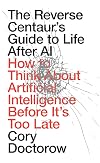
The Reverse Centaur's Guide to Life After AI: How to Think About Artificial Intelligence―Before It's Too Late
by Cory Doctorow
On This Page
Recommendations























Member Reviews
Rating: 5* of five
The Publisher Says: Whether you want to criticize, kill, or use AI, you have to get through the hype and uncover the real story.
Start with labor: in automation theory, a centaur is a person who chooses to use technology to help them do the things that matter to them. A reverse centaur is a person who has been conscripted to serve as a helper for a machine, at an inhuman, machine pace: a driver made to deliver all day long, nonstop; a warehouse worker made to work without food or bathroom breaks; a programmer made to crank out impossible amounts of code. As Doctorow says: it's not enough to ask what the technology does—we have to understand who it's doing it for and who it's doing it to.
The intended audience for AI show more hype isn't the people who are forced to use AI. The AI show is a performance staged for bosses and investors. Investment bankers claim AI will to be worth more than $16 trillion: a number that only makes sense if AI replaces vast swathes of the wage-earning human workforce. To justify that level of "value," every story about AI must be presented as inevitable, world-changing disruption. Even the tales of the robot apocalypse are a calculated attempt to bolster the fearsome power of AI.
Anything that can't go on forever eventually stops. When the AI bubble bursts, what will we salvage? Is there something in the wreckage that everyday people will find useful? In The Reverse Centaur's Guide to Life After AI—as he so successfully did in Enshittification—Doctorow recounts both how we found ourselves in this dire situation and how we can get through it, to a life "after" AI in which the tools work for us, not the other way around.
I RECEIVED A DRC FROM THE PUBLISHER VIA NETGALLEY. THANK YOU.
My Review: The argument I myownself have against "AI" (which isn't and won't be intelligent the way humans are) is financial. There is an AI bubble running right now that's gifted us the utterly brummagem world's first trillionaire. Look a little more deeply into SpaceX's IPO, you'll see how much of it's built on AI (which was partially trained on stolen US Government data via the little dickweeds from DOGE).
It really looks a lot like a gigantic pump-and-dump scheme when one reads Author Cory's work as digested and documented in this scathing book. He's been in the trenches reporting on tech matters for what feels like forever. Enshittification, anyone? It must make the guy a crazy person to present his deeply researched, well sourced and informed conclusions to general apathy. It lights fires under some of us, my dude, so please don't stop!
Especially relevant to my eagerness to share this book with all y'all is the centering of "AI"'s intended impact on labor. It's Author Cory's clear statement that the bubble's partly fueled by tech scum's intense desire to destroy any power of workers over their work, the conditions and rewards thereof, and the very nature of employment as reconstituted post-Great Depression. Wealth inequality is something "AI" is designed to entrench.
I hope a skilled human copyeditor went over this book after my DRC was created. There are some amusing errors of fact that, honestly, trouble me a bit, eg referring to trustbusting under FDR instead of his distant cousin TR. Some other errors niggled at me, but...well...consider the subject matter, maybe these sorts of issues are proof positive of the validity of Author Cory's thesis...?
I'm very serious when I say this: reading this book can give you tools to manage your personal interactions with the "AI" being rammed down our unwilling throats to further enrich the riches scum ever to rise to the controlling positions they're now it. It can do this by alerting the complacent or avoidant reader to what is actually at risk in this economic bubble's inflation.
An easy prose style delivers a hard-to-fathom message. It's one of my favorite reads of 2026. Please get one and read it. Libraries are very likely to have copies in stock now. Of course, if you can, making the purchase for your own shelves or devices is the best way to support Author Cory in his quest to wake us all up to the threats...and the opportunities knowing they're there present...to our essential human nature. show less
The Publisher Says: Whether you want to criticize, kill, or use AI, you have to get through the hype and uncover the real story.
Start with labor: in automation theory, a centaur is a person who chooses to use technology to help them do the things that matter to them. A reverse centaur is a person who has been conscripted to serve as a helper for a machine, at an inhuman, machine pace: a driver made to deliver all day long, nonstop; a warehouse worker made to work without food or bathroom breaks; a programmer made to crank out impossible amounts of code. As Doctorow says: it's not enough to ask what the technology does—we have to understand who it's doing it for and who it's doing it to.
The intended audience for AI show more hype isn't the people who are forced to use AI. The AI show is a performance staged for bosses and investors. Investment bankers claim AI will to be worth more than $16 trillion: a number that only makes sense if AI replaces vast swathes of the wage-earning human workforce. To justify that level of "value," every story about AI must be presented as inevitable, world-changing disruption. Even the tales of the robot apocalypse are a calculated attempt to bolster the fearsome power of AI.
Anything that can't go on forever eventually stops. When the AI bubble bursts, what will we salvage? Is there something in the wreckage that everyday people will find useful? In The Reverse Centaur's Guide to Life After AI—as he so successfully did in Enshittification—Doctorow recounts both how we found ourselves in this dire situation and how we can get through it, to a life "after" AI in which the tools work for us, not the other way around.
I RECEIVED A DRC FROM THE PUBLISHER VIA NETGALLEY. THANK YOU.
My Review: The argument I myownself have against "AI" (which isn't and won't be intelligent the way humans are) is financial. There is an AI bubble running right now that's gifted us the utterly brummagem world's first trillionaire. Look a little more deeply into SpaceX's IPO, you'll see how much of it's built on AI (which was partially trained on stolen US Government data via the little dickweeds from DOGE).
It really looks a lot like a gigantic pump-and-dump scheme when one reads Author Cory's work as digested and documented in this scathing book. He's been in the trenches reporting on tech matters for what feels like forever. Enshittification, anyone? It must make the guy a crazy person to present his deeply researched, well sourced and informed conclusions to general apathy. It lights fires under some of us, my dude, so please don't stop!
Especially relevant to my eagerness to share this book with all y'all is the centering of "AI"'s intended impact on labor. It's Author Cory's clear statement that the bubble's partly fueled by tech scum's intense desire to destroy any power of workers over their work, the conditions and rewards thereof, and the very nature of employment as reconstituted post-Great Depression. Wealth inequality is something "AI" is designed to entrench.
I hope a skilled human copyeditor went over this book after my DRC was created. There are some amusing errors of fact that, honestly, trouble me a bit, eg referring to trustbusting under FDR instead of his distant cousin TR. Some other errors niggled at me, but...well...consider the subject matter, maybe these sorts of issues are proof positive of the validity of Author Cory's thesis...?
I'm very serious when I say this: reading this book can give you tools to manage your personal interactions with the "AI" being rammed down our unwilling throats to further enrich the riches scum ever to rise to the controlling positions they're now it. It can do this by alerting the complacent or avoidant reader to what is actually at risk in this economic bubble's inflation.
An easy prose style delivers a hard-to-fathom message. It's one of my favorite reads of 2026. Please get one and read it. Libraries are very likely to have copies in stock now. Of course, if you can, making the purchase for your own shelves or devices is the best way to support Author Cory in his quest to wake us all up to the threats...and the opportunities knowing they're there present...to our essential human nature. show less
You may have heard of Doctorow from his sci-fi writing. This current book is journalism on economic justice.
Doctorow unpacks the current Artificial Intelligence (“AI”) boom/bubble as the epitome of the war between labor and capital. Since the 1970s, productivity in the United States has been rising, but real wages have been falling. How could this be? Capital is taking a bigger and bigger slice of the pie.
Doctorow unpacks the investment fundamentals of price-to-earnings multiples. A “mature” company like Ford currently commands a 10:1 price-to-earnings multiple. A “growth” company like Tesla currently commands a 360:1 price-to-earnings ratio. Ford does about $190B in revenues, while Tesla does about $97B (about half). But show more Tesla is worth $1.5T, while Ford is worth about $50B (a 30x difference).
You can think of revenues as an exogenous process of gathering money. You can think of growth as an endogenous money-printing machine. Ford only has so much magic money that it can use to acquire talent, IP, and competitors. Even though Tesla only has half the revenues, it has much more market power due to its stock, which it can leverage for market dominance.
All of this might sound obvious. What becomes more interesting, though, is that revenue-based businesses generally are focused on customers, while growth-based companies are focused on investors.
Now we can turn to AI: all of the big AI companies are growth companies, and therefore are focused on telling compelling stories to investors, not building useful products for customers. You might assume that a company can do both, and sometimes they do, but there is a conflict between the two. If growth companies have to choose, they will choose the investor.
This results in stories about AI displacing jobs. Why? Because wages (aka “humans”) are one of the primary costs in the economy. If AI wants to tell a growth story, it has to grow somewhere, and they’ve decided the best place to cannibalize is human labor.
In other words, when you hear discussion in the news of AI displacing workers, this has less to do with the capacities of the technology and much more to do with a systemic bias toward capital and away from labor. There are plenty of ways that AI could be used to better the lives of humans—but it would need to be deployed by them, for them, rather than by investors, on them.
It is a success of neoliberalism that you don’t hear people talking about unions, cooperative ownership, and trust-busting every time AI is mentioned.
What analogy does Doctorow invoke to illustrate this? The centaur. In 1997, chess grandmaster Garry Kasparov lost to IBM’s Deep Blue. In 1998, he envisioned the concept of a “centaur”—a human using a machine to their advantage.
But then there is something known as a reverse centaur: a human displaced by a machine (or, at least, made more impotent by one).
Is it any wonder that we have stories of world-eating AI? This is basic psychology: people are generally afraid of the things they do to others because it is very easy to imagine yourself becoming the victim of the way you victimize others. Masters are afraid of becoming slaves. But slaves have other fears (and dreams), in part because they would never make another person a slave after experiencing that inhumanity firsthand.
Doctorow gets into some fascinating history regarding copyright law. He makes a pretty solid argument that copyright is almost never to the benefit of creators (although he doesn’t go into alternatives). This falls into a broader trend in legal theory toward the invalidation of the concept of property (we need more on this).
There’s also some great material on recent losses on behalf of labor in the face of capital. Spotify was a big one: labels are guaranteed a payout, while artists are guaranteed nothing. It should be the reverse, but artists failed to organize effectively. One recent win was the four-year battle by the Screen Writers Guild to ensure that agents work for writers instead of studios through a commission-based rather than package-based compensation structure.
Doctorow has some great material on the purpose of art: essentially, to communicate the ineffable. Why is AI art eerie, and potentially not even “art”? Because AI does not know what you are trying to communicate, so it can only add noise to the signal.
Why are people impressed by AI art? Because we associate technical mastery with an intention to express meaning. AI, as a statistical machine, is theoretically (and practically) incapable of expressing meaning. Once people realize that technical mastery can be entirely decoupled from meaning, they will no longer be impressed by AI art, because they will realize that it obscures, rather than elucidates, meaning.
Amazingly, copyright law actually enshrines this concept: only products that are the result of human creativity can be copyrighted. AI is neither creative nor human, and therefore works created by AI are uncopyrightable.
Doctorow comes across as highly dubious that the AI bubble will produce useful products commensurate with the magnitude of the investment involved. In this belief, he appears to be an outlier. We will need to wait for history to chime in.
Any time there is irrational exuberance, we need the hysterical voice of humanity to ring out. Doctorow is that voice (and it is a shame there aren’t more voices joining the chorus). The AI revolution is historic—not because of the technology involved, but because of the sensational, seismic implosion of human dignity that most commentators have swallowed unquestioningly. We do face a singularity: the possibility that a tiny class of trillionaires will dominate the globe, fracking the teeming billions into liquid fuel to power their world-eating machine to Mars and beyond. But this is not a singularity of information; it is a singularity of capital. Read Doctorow's screed and join the counterrevolution.
A note on bias: Doctorow’s politics and bent are anti-capitalist. Even if this isn't you, he compiles a compelling body of facts that deserve reflection. show less
Doctorow unpacks the current Artificial Intelligence (“AI”) boom/bubble as the epitome of the war between labor and capital. Since the 1970s, productivity in the United States has been rising, but real wages have been falling. How could this be? Capital is taking a bigger and bigger slice of the pie.
Doctorow unpacks the investment fundamentals of price-to-earnings multiples. A “mature” company like Ford currently commands a 10:1 price-to-earnings multiple. A “growth” company like Tesla currently commands a 360:1 price-to-earnings ratio. Ford does about $190B in revenues, while Tesla does about $97B (about half). But show more Tesla is worth $1.5T, while Ford is worth about $50B (a 30x difference).
You can think of revenues as an exogenous process of gathering money. You can think of growth as an endogenous money-printing machine. Ford only has so much magic money that it can use to acquire talent, IP, and competitors. Even though Tesla only has half the revenues, it has much more market power due to its stock, which it can leverage for market dominance.
All of this might sound obvious. What becomes more interesting, though, is that revenue-based businesses generally are focused on customers, while growth-based companies are focused on investors.
Now we can turn to AI: all of the big AI companies are growth companies, and therefore are focused on telling compelling stories to investors, not building useful products for customers. You might assume that a company can do both, and sometimes they do, but there is a conflict between the two. If growth companies have to choose, they will choose the investor.
This results in stories about AI displacing jobs. Why? Because wages (aka “humans”) are one of the primary costs in the economy. If AI wants to tell a growth story, it has to grow somewhere, and they’ve decided the best place to cannibalize is human labor.
In other words, when you hear discussion in the news of AI displacing workers, this has less to do with the capacities of the technology and much more to do with a systemic bias toward capital and away from labor. There are plenty of ways that AI could be used to better the lives of humans—but it would need to be deployed by them, for them, rather than by investors, on them.
It is a success of neoliberalism that you don’t hear people talking about unions, cooperative ownership, and trust-busting every time AI is mentioned.
What analogy does Doctorow invoke to illustrate this? The centaur. In 1997, chess grandmaster Garry Kasparov lost to IBM’s Deep Blue. In 1998, he envisioned the concept of a “centaur”—a human using a machine to their advantage.
But then there is something known as a reverse centaur: a human displaced by a machine (or, at least, made more impotent by one).
Is it any wonder that we have stories of world-eating AI? This is basic psychology: people are generally afraid of the things they do to others because it is very easy to imagine yourself becoming the victim of the way you victimize others. Masters are afraid of becoming slaves. But slaves have other fears (and dreams), in part because they would never make another person a slave after experiencing that inhumanity firsthand.
Doctorow gets into some fascinating history regarding copyright law. He makes a pretty solid argument that copyright is almost never to the benefit of creators (although he doesn’t go into alternatives). This falls into a broader trend in legal theory toward the invalidation of the concept of property (we need more on this).
There’s also some great material on recent losses on behalf of labor in the face of capital. Spotify was a big one: labels are guaranteed a payout, while artists are guaranteed nothing. It should be the reverse, but artists failed to organize effectively. One recent win was the four-year battle by the Screen Writers Guild to ensure that agents work for writers instead of studios through a commission-based rather than package-based compensation structure.
Doctorow has some great material on the purpose of art: essentially, to communicate the ineffable. Why is AI art eerie, and potentially not even “art”? Because AI does not know what you are trying to communicate, so it can only add noise to the signal.
Why are people impressed by AI art? Because we associate technical mastery with an intention to express meaning. AI, as a statistical machine, is theoretically (and practically) incapable of expressing meaning. Once people realize that technical mastery can be entirely decoupled from meaning, they will no longer be impressed by AI art, because they will realize that it obscures, rather than elucidates, meaning.
Amazingly, copyright law actually enshrines this concept: only products that are the result of human creativity can be copyrighted. AI is neither creative nor human, and therefore works created by AI are uncopyrightable.
Doctorow comes across as highly dubious that the AI bubble will produce useful products commensurate with the magnitude of the investment involved. In this belief, he appears to be an outlier. We will need to wait for history to chime in.
Any time there is irrational exuberance, we need the hysterical voice of humanity to ring out. Doctorow is that voice (and it is a shame there aren’t more voices joining the chorus). The AI revolution is historic—not because of the technology involved, but because of the sensational, seismic implosion of human dignity that most commentators have swallowed unquestioningly. We do face a singularity: the possibility that a tiny class of trillionaires will dominate the globe, fracking the teeming billions into liquid fuel to power their world-eating machine to Mars and beyond. But this is not a singularity of information; it is a singularity of capital. Read Doctorow's screed and join the counterrevolution.
A note on bias: Doctorow’s politics and bent are anti-capitalist. Even if this isn't you, he compiles a compelling body of facts that deserve reflection. show less
I am a huge Cory Doctorow fan, so I recommend this volume without hesitation. Like all of his nonfiction writing, it is assembled out of various columns and speeches he has given in recent past. However, this particular volume lacks the depth of Chokepoint Capitalism or the big-picture vision of Enshitification. Also, the book is not really a 'guide to life after AI'. It is much more a 'guide to criticizing AI' (the original title of one of the pieces the book is based off of). If you want a blistering, impassioned critique of AI, dive right in! Tips for surviving the job market or future proofing your career? Not so much. If you don't have a narrow focus on AI, but are interested in the War on General Computing more generally, I'd show more recommend some of his other work. But yes, overall: A good book! show less
Ratings
Members
- Recently Added By
Published Reviews
ThingScore 90
'The Reverse Centaur's Guide to Life After AI' takes aim at the hype, fear, and confusion surrounding artificial intelligence. Rather than offering a simple pro- or anti-AI argument, Doctorow examines how technology can either empower people or turn them into what he calls "reverse centaurs"—workers forced to serve the demands of machines. Blending technology criticism, economics, and social show more analysis, the book asks how we can build a future in which AI works for humans, not the other way around. show less
added by Muscogulus
In automation theory, per Doctorow, a "centaur" describes a human augmented with a technology,… even just driving a car or using autocomplete. A reverse centaur… [is like] an Amazon delivery driver, surrounded by AI cameras monitoring their driving, who essentially serves as a peripheral to the delivery van.… It's one thing to incorporate AI tools into the medical field to help show more radiologists process X-ray images and spot potential tumors they might otherwise miss. It's quite another to fire nine out of 10 radiologists and let AI make the diagnoses, with the remaining radiologist solely responsible for checking the AI's work—and, ultimately, taking the blame for any errors. Doctorow is not virulently anti-AI; he uses AI tools regularly and sees potential in many of those tools…. But he is nonetheless alarmed at all the hype surrounding AI, the enormous capital expenditures, the unrealistic expectations and self-serving messaging, and the potentially catastrophic economic consequences when the AI bubble inevitably pops.… Naturally, Doctorow has some ideas about how to push back against the prevailing narrative of AI's inevitability. show less
added by Muscogulus
An eye-opening take on AI.… [Doctorow] reveals how AI hype shapes public opinion, warning, "science fiction tells us that the most important aspect of a new technology isn't what the machine does, it's who it does it for and who it does it to." He invokes the mythical centaur: a human-led fusion of person and machine. AI companies promote a reverse centaur, "a 'human in the loop,' charged show more with confirming the judgments the AIs make at a superhuman clip." Denied breaks, delivery drivers, Amazon warehouse workers, and programmers hammering out endless code serve the machines.… Doctorow insists the main audience for AI hype is investors: "For AI companies to make back the hundreds of billions their investors have entrusted them with, they will have to displace a hell of a lot of high-waged labor" and lure new investment.… A sharply worded, irreverent, and deadly serious call to see through the sleight-of-hand performance of AI promoters. show less
added by Muscogulus
Lists

Books Read in 2026
2,036 works; 68 members

Globe and Mail | Canadian Non-Fiction: July 4, 2026
10 works; 1 member

Globe and Mail | Canadian Non-Fiction: July 11, 2026
10 works; 1 member
Author Information

121+ Works 25,983 Members
Writer and activist Cory Doctorow was born in Toronto, Canada on July 17, 1971. In 1999 he co-founded a free software company called Opencola and served as Canadian Regional Director of the Science Fiction and Fantasy Writers of America. For four years he worked as European Affairs Coordinator for the Electronic Frontier Foundation and in 2007 won show more its Pioneer Award. His first novel, Down and Out in the Magic Kingdom, won a Locus Award for Best First Novel. His short story collection A Place So Foreign and Eight More won a Sunburst Award, and his bestselling novel Little Brother received the 2009 Prometheus Award, a Sunburst Award, and the John W. Campbell Memorial Award. Doctorow also writes nonfiction books and articles, and he co-edits the blog Boing Boing. (Bowker Author Biography) show less
Common Knowledge
- Canonical title
- The Reverse Centaur's Guide to Life After AI: How to Think About Artificial Intelligence―Before It's Too Late
- Original title
- The Reverse Centaur's Guide to Life After AI: How to Think About Artificial Intelligence―Before It's Too Late
- Original publication date
- 2026-06-23
- Original language
- English
Statistics
- Members
- 64
- Popularity
- 486,804
- Reviews
- 3
- Rating
- (4.08)
- Languages
- English
- Media
- Paper
- ISBNs
- 1