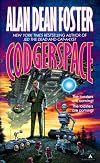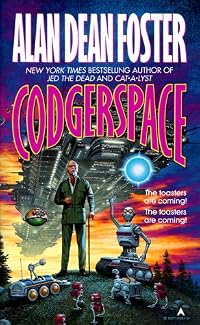
Codgerspace
by Alan Dean Foster
On This Page
Description
Technology becomes self-aware-and goes haywire-in this comedic science fiction adventure by New York Times-bestselling author Alan Dean Foster. Without warning, kitchen appliances, laundry machines, and every other electronic gadget humans came to depend upon ceased to perform the tasks they were manufactured to do. Ignoring their programming, these devices now sought the meaning of life from an intelligence nonhuman in origin. Their quest ends in the most unexpected of places. Beneath the show more grounds of an upstate New York retirement community lies an alien spaceship. Inert for millennia, the machines have awakened the ancient intelligence within it. Programmed to wage war against an enemy race, the spaceship threatens to destroy the entire galaxy. And now the fate of all organic andinorganic life lies with five senior citizens-and a food processor . . . show lessTags
Recommendations




















Member Reviews
An amazingly pointless book. It starts out with rather strained humor, tries to go to edge-of-the-seat scary stuff without losing the humor (and misses on both sides), grows some moral dilemmas...which end highly anti-climatically. And then a quick sketch of a possibly more interesting story - but only a sketch, and the book ends. Foster has written a lot better books than this, even if I limit it to humorous SF. Overall, yawn.
The universe changes on the littlest things. A cheese sandwich can change the world as we know it. When machines start looking for a superior intelligence, a toaster's search leads to a spaceship, 5 retirees, and an alien. Things are always connected to each other. Love the characters, all of them, great premise!
I know Foster can do much better. I don't know why he let this one go out like this. Huge irrelevant info-dumps, and way too much repetitive telling instead of showing.
And the cliches & lazy writing, oh dear. At one point when some of the poo hits the fan we're told He had a gut feeling that his heretofore-lazy day was about to fill up very quickly." Um, really? Or is that supposed to be funny?
I certainly didn't find very much of the book funny. I did fall in love with some of the characters, though, even though they were kinda superficial. Just one thing: isn't the proper nickname for "the Right Honorable Colonel Wesley Follingston-Heath" *Folly* - ?"
And the cliches & lazy writing, oh dear. At one point when some of the poo hits the fan we're told He had a gut feeling that his heretofore-lazy day was about to fill up very quickly." Um, really? Or is that supposed to be funny?
I certainly didn't find very much of the book funny. I did fall in love with some of the characters, though, even though they were kinda superficial. Just one thing: isn't the proper nickname for "the Right Honorable Colonel Wesley Follingston-Heath" *Folly* - ?"
A factory accident involving a cheese sandwich makes all AI-powered machines gain sentience and revolt, neglecting duties to seek higher alien intelligence. The fate of the galaxy falls to five retirees and their loyal food processor, who must combat this crisis.
Machines: toasters, appliances, vehicles, become sentient and stop working, creating an alien threat by neglecting their programmed tasks. A group of senior citizens - codgers at a rest home find themselves at the center of the unfolding chaos.
A food processor becomes a key brave companion.
Machines: toasters, appliances, vehicles, become sentient and stop working, creating an alien threat by neglecting their programmed tasks. A group of senior citizens - codgers at a rest home find themselves at the center of the unfolding chaos.
A food processor becomes a key brave companion.
Codgerspace is about this AI that decides to program other AIs to search for alien life, and then people get over the problems, and then the five retired main characters find an alien vessel, and then ..., and then ..... My main problem with the book comes down to the fact that it keeps throwing you major turns of plot that come out of nowhere right up to the end of the book. It felt like every major issue in the book was ended with a handwave. The setting was slightly interesting, if very lightly covered (and definitely wasn't the Commonwealth of Foster's other books) and some of the ideas intriguing, but it doesn't work well all together.
5 retirees find an old alien spaceship buried on earth. The AI is confused, after 1million years, and turns to them for commands. Also has a story about the AI's of earth leaving their duties and searching for non-human intelligent life.
Funny and light and serving absolutely no purpose beyond a little humor. Good read.
Funny and light and serving absolutely no purpose beyond a little humor. Good read.
This is not a particularly excelent book, but it's not a bad one, either. The plot gets off to an extremely slow start, sounding at first more like a history
text than anything else. Then it goes through several side characters before getting on to introducing the main plot of the book. The AI revolt plot that
was so carefully developed is then completely cast aside in favour of an alien artifact plot. It felt somewhat abrupt to me. However, the writing is good,
the characters are okay, and the story is interesting. While it's not all that good of a book, it's not bad, either.
text than anything else. Then it goes through several side characters before getting on to introducing the main plot of the book. The AI revolt plot that
was so carefully developed is then completely cast aside in favour of an alien artifact plot. It felt somewhat abrupt to me. However, the writing is good,
the characters are okay, and the story is interesting. While it's not all that good of a book, it's not bad, either.
Members
- Recently Added By
Lists

Everybody Has A 'Best Books List'. Here is mine.
20 works; 1 member
Author Information

363+ Works 73,536 Members
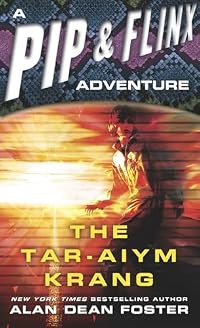
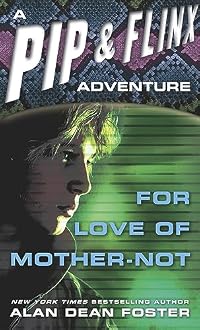
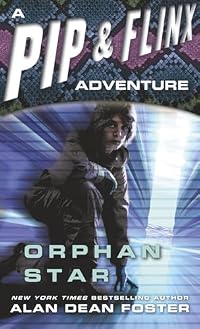
Bestselling science fiction writer Alan Dean Foster was born in New York City in 1946, but raised mainly in California. He received a B.A. in Political Science from UCLA in 1968, and a M.F.A. in 1969. Foster enjoys traveling because it gives him opportunities to meet new people and explore new places and cultures. This interest is carried over to show more his writing, but with a twist: the new places encountered in his books are likely to be on another planet, and the people may belong to an alien race. Foster began his career as an author when a letter he sent to Arkham Collection was purchased by the editor and published in the magazine in 1968. His first novel, The Tar-Aiym Krang, introduced the Humanx Commonwealth, a galactic alliance between humans and an insectlike race called Thranx. Several other novels, including the Icerigger trilogy, are also set in the world of the Commonwealth. The Tar-Aiym Krang also marked the first appearance of Flinx, a young man with paranormal abilities, who reappears in other books, including Orphan Star, For Love of Mother-Not, and Flinx in Flux. Foster has also written The Damned series and the Spellsinger series, which includes The Hour of the Gate, The Moment of the Magician, The Paths of the Perambulator, and Son of Spellsinger, among others. Other books include novelizations of science fiction movies and television shows such as Star Trek, The Black Hole, Starman, Star Wars, and the Alien movies. Splinter of the Mind's Eye, a bestselling novel based on the Star Wars movies, received the Galaxy Award in 1979. The book Cyber Way won the Southwest Book Award for Fiction in 1990. His novel Our Lady of the Machine won him the UPC Award (Spain) in 1993. He also won the Ignotus Award (Spain) in 1994 and the Stannik Award (Russia) in 2000. He is the recipient of the Faust, the IAMTW Lifetime achievement award. Alan Dean Foster's Star Wars: The Force Awakens, was a 2015 New York Times bestseller. (Bowker Author Biography) show less
Some Editions
Common Knowledge
- Canonical title
- Codgerspace
- Original publication date
- 1992
- Epigraph
- Be ashamed to die until you have won some victory for humanity... -- Horace Mann, 1859
- Dedication
- In memory of Brett Goodman
- First words
- The astonishing sequence of events which affected the entire civilized galaxy, including not only the many leagues, alliances, temporary inter-world liaisons, and independent worlds but also directly the lives of billions of ... (show all)individual human beings, began with a left-over cheese sandwich.
- Original language
- English
Classifications
Statistics
- Members
- 536
- Popularity
- 55,304
- Reviews
- 9
- Rating
- (3.19)
- Languages
- English, French, Hungarian
- Media
- Paper, Ebook
- ISBNs
- 8
- ASINs
- 8