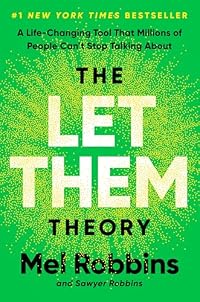
The Let Them Theory: A Life-Changing Tool That Millions of People Can't Stop Talking About
by Mel Robbins
On This Page
Tags
Recommendations

























Member Reviews
Best for:
No one. Seriously. The concept - the very very basic, simple, concept, is something I think many people could find helpful. But the other 299 pages of this 300 page book don’t make up for it.
In a nutshell:
Professional self-help writer Mel Robbins claims to have discovered a concept that her daughter is responsible for specifically (and that various philosophical and religious groups have been pitching for centuries) and then spends a lot of time providing some okay and some awful examples of how to incorporate it into life.
Worth quoting:
“Adults are allowed to think whatever they want to think. So are you.”
Why I chose it:
I find it challenging to let people do their own thing when I (nearly always mistakenly) think it is show more affecting me. Or, I let it stress me when it doesn’t need to. I saw this book mentioned on TikTok and thought I’d check it out. Oh how I wish I’d done more research.
Review:
I haven’t felt such a negative visceral reaction since I read Cinderella’s Lost Diary as part of Cannonball Read 5 (my review seems to have been lost to the ages, which is probably for the best, as I think the author found it and was less than pleased). This is the type of book that I assume the great pod cast “If Books Could Kill” might take a crack at. It’s something Oprah recommends. And it’s written by someone who I now know has made her living as a sort of motivational speaker, and has previously written another pop psychology / vaguely therapy-speak book (the 5-4-3-2-1 theory, which I gather is just … count to five and then do things?) that was apparently wildly popular.
Look, I didn’t know, okay?
I should have stopped after the introduction, which Robbins calls “My Story,” and which is all about how she was in debt and unemployed and managed to claw her way out. By page three she’s basically discounting the entire concept of community support. By the end she’s talking about all the companies that have invited her to speak to them - very few of which are ones I’d be keen to brag about.
This book is full of phrases like ‘I was willing to do what most people won’t’ and ‘is supported by scientific research’ and ‘proven method’ yet contains not a single footnote. There is a bibliography, but it’s not connected to any of the claims she makes throughout the book. I probably wrote and underlined ‘citation needed’ dozens of times throughout, because even if what she was saying was supported by evidence, I couldn’t know because she refused to do the basic courtesy of provided proper citations. Ugh.
What absolutely defies belief is that the author didn’t even come up with the concept at a basic level - her daughter did. Robbins tells the story about being controlling during the lead up to her son’s prom, and her daughter tell her to just let them be. Repeatedly. And this is some epiphany for Robbins, which, fine, I get that, but then multiple times during the rest of the book she talks about how she discovered the Let Them theory. What? No she didn’t. I mean, aside from the fact that it’s a concept that’s been around forever, she literally told us that it was her daughter who told her about it. Come on.
A frustrating thing about this book for me is that the very basic underlying concept is sound in some circumstances, and something I definitely needed to be reminded of. When people are doing things interpersonally that I cannot control, I really need to just let them. I can have conversations about the behaviors that I’m finding frustrating, but I need to not let it be the thing that stresses me out or frustrates me to the extent that it is beyond my control. But the book is so bad that I had to keep reminding myself that there were some nuggets of usefulness in there.
The theory does sort of suck when it comes to actions other people take that negatively impact the world. Like, I’m not just cool with ‘letting them’ take away all the rights and protections for people who are not white, or male, or straight, or cis, for example (the ‘them’ in this instance being the US republican party). But I think the author would say that is where the ‘let me’ part of things comes in. Let them try to do shitty things, let me fight back. I guess? I don’t know. I think the theory really does fall apart outside of pretty straightforward interpersonal interactions, but even then it’s not great because she says things like ‘maybe you’ve let comments from your family ruin an entire holiday together’ - like, what comments? Are you thinking one should just ignore it when someone is racist or sexist or homophobic?
The author also seems very interested in the concept of ‘personal responsibility,’ which for me is just another way to say pull ones’ self up by one’s bootstraps. It ignores the reality in which we live, and pretends that just by not taking it personally when people are shitty, and focusing on one’s self, people can overcome anything, including hundreds of thousands of dollars of debt.
SureJan.gif.
At this point in the review I’ve only gotten about 1/6 of the way through the book, and I’ve just turned the page to where she has an epigraph. You know, that quote from someone wiser than one’s self that authors will sometimes put in books? Robbins quotes … herself for her epigraphs. I mean, bold but also I’m already reading her words in the rest of the book, could she not maybe quote someone else if she was going to have epigraphs?
As a writer, Robbins is not good. The book uses some outdated ableist language throughout, and also is often a collection of words that don’t really say anything. I know, that’s a lot of what the self-help genre is, but good grief. It is bad here. She also has a warped sense of reality, as she repeatedly uses leaving a job as an example of something anyone can do. Like, what? People can definitely be trapped in jobs because they, you know, need the money to live. What world is she living in? I’m so confused. She also actually typed out the words ‘winning the game of life,’ which is a completed out of pocket idea. It’s not a game, and one can’t ‘win’ it. The hell?
She also uses the theory to sort of … excuse away manipulative behavior that others have employed on her? She talks about Frame of Reference (not sure why it’s capitalized), which I think it sort of like trying to understand other perspectives, which I’m all for, but then her conclusions are often ‘oh, they just care about you and you should understand their perspective,’ instead of recognizing that some perspectives are harmful.
The chapter on friendship and making new friends wasn’t the worst, though it seemed a bit shoehorned into the book - like trying to get this one neat trick to be applicable to all of life’s challenges. It isn’t.
StopMakingFetchHappen.gif
But the absolute grossest chapters are the ones where Robbins tries to teach us how to manipulate the people we care about, and uses a gross example where Robbins equates weight with health and just repeatedly sympathizes with a wife who wants her husband to lose weight. It’s just awful overall, but what I found strangest was that in this example, her suggestion might work, but it doesn’t really work in other instances. Her idea is basically model the behavior you want to see. If you work out a bunch, and show you’re happy, then your husband will want to be happy like you too. Yay! Except, I mean, no. And also, what if the thing you hope will change is not something you can model? Like, if I’m worried a person needs to, say, quit their job because it is unhealthy, if I’m not in an unhealthy job, I can’t quit mine to show them how good it can be. And presumably they already see I’m working a healthy job and that hasn’t ‘motivated’ them to quit their job. I don’t know, it feels really gross and manipulative and creepy.
She also has this ABC loop that for all I can tell is just meant to help you have difficult conversations by purposefully making the other person feel bad. Like, she literally says the point is to ‘create discomfort that they feel internally.’ That is manipulative, that’s mean, and that seems actively dangerous. She also equates money with power, and recommends using money to control people. I’m sure she’d disagree, but her chapter called ‘how to provide support the right way’ really reads as putting conditions on love and support, and that’s so, so gross.
I mostly skimmed the chapters on how to find love because they seemed pretty boilerplate (I think one could get the same from the movie ‘He’s Just Not That Into You,), but I was struggling to finish this book because I really wanted to review it and also to be done with it, so it’s possible I missed some other really not good advice in there, too.
This is probably the longest review I’ve written in while, so if you stuck with me, thank you!
Now Let Me never read anything by this author again. show less
No one. Seriously. The concept - the very very basic, simple, concept, is something I think many people could find helpful. But the other 299 pages of this 300 page book don’t make up for it.
In a nutshell:
Professional self-help writer Mel Robbins claims to have discovered a concept that her daughter is responsible for specifically (and that various philosophical and religious groups have been pitching for centuries) and then spends a lot of time providing some okay and some awful examples of how to incorporate it into life.
Worth quoting:
“Adults are allowed to think whatever they want to think. So are you.”
Why I chose it:
I find it challenging to let people do their own thing when I (nearly always mistakenly) think it is show more affecting me. Or, I let it stress me when it doesn’t need to. I saw this book mentioned on TikTok and thought I’d check it out. Oh how I wish I’d done more research.
Review:
I haven’t felt such a negative visceral reaction since I read Cinderella’s Lost Diary as part of Cannonball Read 5 (my review seems to have been lost to the ages, which is probably for the best, as I think the author found it and was less than pleased). This is the type of book that I assume the great pod cast “If Books Could Kill” might take a crack at. It’s something Oprah recommends. And it’s written by someone who I now know has made her living as a sort of motivational speaker, and has previously written another pop psychology / vaguely therapy-speak book (the 5-4-3-2-1 theory, which I gather is just … count to five and then do things?) that was apparently wildly popular.
Look, I didn’t know, okay?
I should have stopped after the introduction, which Robbins calls “My Story,” and which is all about how she was in debt and unemployed and managed to claw her way out. By page three she’s basically discounting the entire concept of community support. By the end she’s talking about all the companies that have invited her to speak to them - very few of which are ones I’d be keen to brag about.
This book is full of phrases like ‘I was willing to do what most people won’t’ and ‘is supported by scientific research’ and ‘proven method’ yet contains not a single footnote. There is a bibliography, but it’s not connected to any of the claims she makes throughout the book. I probably wrote and underlined ‘citation needed’ dozens of times throughout, because even if what she was saying was supported by evidence, I couldn’t know because she refused to do the basic courtesy of provided proper citations. Ugh.
What absolutely defies belief is that the author didn’t even come up with the concept at a basic level - her daughter did. Robbins tells the story about being controlling during the lead up to her son’s prom, and her daughter tell her to just let them be. Repeatedly. And this is some epiphany for Robbins, which, fine, I get that, but then multiple times during the rest of the book she talks about how she discovered the Let Them theory. What? No she didn’t. I mean, aside from the fact that it’s a concept that’s been around forever, she literally told us that it was her daughter who told her about it. Come on.
A frustrating thing about this book for me is that the very basic underlying concept is sound in some circumstances, and something I definitely needed to be reminded of. When people are doing things interpersonally that I cannot control, I really need to just let them. I can have conversations about the behaviors that I’m finding frustrating, but I need to not let it be the thing that stresses me out or frustrates me to the extent that it is beyond my control. But the book is so bad that I had to keep reminding myself that there were some nuggets of usefulness in there.
The theory does sort of suck when it comes to actions other people take that negatively impact the world. Like, I’m not just cool with ‘letting them’ take away all the rights and protections for people who are not white, or male, or straight, or cis, for example (the ‘them’ in this instance being the US republican party). But I think the author would say that is where the ‘let me’ part of things comes in. Let them try to do shitty things, let me fight back. I guess? I don’t know. I think the theory really does fall apart outside of pretty straightforward interpersonal interactions, but even then it’s not great because she says things like ‘maybe you’ve let comments from your family ruin an entire holiday together’ - like, what comments? Are you thinking one should just ignore it when someone is racist or sexist or homophobic?
The author also seems very interested in the concept of ‘personal responsibility,’ which for me is just another way to say pull ones’ self up by one’s bootstraps. It ignores the reality in which we live, and pretends that just by not taking it personally when people are shitty, and focusing on one’s self, people can overcome anything, including hundreds of thousands of dollars of debt.
SureJan.gif.
At this point in the review I’ve only gotten about 1/6 of the way through the book, and I’ve just turned the page to where she has an epigraph. You know, that quote from someone wiser than one’s self that authors will sometimes put in books? Robbins quotes … herself for her epigraphs. I mean, bold but also I’m already reading her words in the rest of the book, could she not maybe quote someone else if she was going to have epigraphs?
As a writer, Robbins is not good. The book uses some outdated ableist language throughout, and also is often a collection of words that don’t really say anything. I know, that’s a lot of what the self-help genre is, but good grief. It is bad here. She also has a warped sense of reality, as she repeatedly uses leaving a job as an example of something anyone can do. Like, what? People can definitely be trapped in jobs because they, you know, need the money to live. What world is she living in? I’m so confused. She also actually typed out the words ‘winning the game of life,’ which is a completed out of pocket idea. It’s not a game, and one can’t ‘win’ it. The hell?
She also uses the theory to sort of … excuse away manipulative behavior that others have employed on her? She talks about Frame of Reference (not sure why it’s capitalized), which I think it sort of like trying to understand other perspectives, which I’m all for, but then her conclusions are often ‘oh, they just care about you and you should understand their perspective,’ instead of recognizing that some perspectives are harmful.
The chapter on friendship and making new friends wasn’t the worst, though it seemed a bit shoehorned into the book - like trying to get this one neat trick to be applicable to all of life’s challenges. It isn’t.
StopMakingFetchHappen.gif
But the absolute grossest chapters are the ones where Robbins tries to teach us how to manipulate the people we care about, and uses a gross example where Robbins equates weight with health and just repeatedly sympathizes with a wife who wants her husband to lose weight. It’s just awful overall, but what I found strangest was that in this example, her suggestion might work, but it doesn’t really work in other instances. Her idea is basically model the behavior you want to see. If you work out a bunch, and show you’re happy, then your husband will want to be happy like you too. Yay! Except, I mean, no. And also, what if the thing you hope will change is not something you can model? Like, if I’m worried a person needs to, say, quit their job because it is unhealthy, if I’m not in an unhealthy job, I can’t quit mine to show them how good it can be. And presumably they already see I’m working a healthy job and that hasn’t ‘motivated’ them to quit their job. I don’t know, it feels really gross and manipulative and creepy.
She also has this ABC loop that for all I can tell is just meant to help you have difficult conversations by purposefully making the other person feel bad. Like, she literally says the point is to ‘create discomfort that they feel internally.’ That is manipulative, that’s mean, and that seems actively dangerous. She also equates money with power, and recommends using money to control people. I’m sure she’d disagree, but her chapter called ‘how to provide support the right way’ really reads as putting conditions on love and support, and that’s so, so gross.
I mostly skimmed the chapters on how to find love because they seemed pretty boilerplate (I think one could get the same from the movie ‘He’s Just Not That Into You,), but I was struggling to finish this book because I really wanted to review it and also to be done with it, so it’s possible I missed some other really not good advice in there, too.
This is probably the longest review I’ve written in while, so if you stuck with me, thank you!
Now Let Me never read anything by this author again. show less
Frustrating barely begins to describe my experience with The Let Them Theory. My primary concern is that the author presents her advice without adequately acknowledging the role of professional mental health care. There is no meaningful discussion of clinical depression, anxiety, or other conditions that may require therapy, medication, or structured support before any “mindset shift” is even possible. As a healthcare provider, I find this omission irresponsible. Personal determination has value, but this book dangerously implies that ongoing struggle is simply a failure of effort.
Much of the book relies on anecdote rather than evidence. The author makes sweeping claims about the impact of her “theory,” suggesting it has helped show more resolve everything from PTSD to substance use disorders—without citations, data, or engagement with established research. The core idea itself feels less like a novel insight and more like a repackaging of familiar concepts: the serenity prayer, “let go and let God,” “don’t sweat the small stuff,” even bootstraps-style self-reliance—rebranded and heavily marketed.
At nearly 400 pages, the book is padded with repetitive, slogan-like language and an uncritical confidence in the author’s own framework. While some of the tools may be superficially appealing, they overlook complex social, psychological, and structural realities, placing the full burden of change squarely on the individual.
In the end, this felt less like meaningful guidance and more like an oversimplified, tone-deaf, and privileged approach to personal growth. There is perhaps a half-star’s worth of useful material here—but it could have been conveyed in a blog post. I wish I had stopped sooner. show less
Much of the book relies on anecdote rather than evidence. The author makes sweeping claims about the impact of her “theory,” suggesting it has helped show more resolve everything from PTSD to substance use disorders—without citations, data, or engagement with established research. The core idea itself feels less like a novel insight and more like a repackaging of familiar concepts: the serenity prayer, “let go and let God,” “don’t sweat the small stuff,” even bootstraps-style self-reliance—rebranded and heavily marketed.
At nearly 400 pages, the book is padded with repetitive, slogan-like language and an uncritical confidence in the author’s own framework. While some of the tools may be superficially appealing, they overlook complex social, psychological, and structural realities, placing the full burden of change squarely on the individual.
In the end, this felt less like meaningful guidance and more like an oversimplified, tone-deaf, and privileged approach to personal growth. There is perhaps a half-star’s worth of useful material here—but it could have been conveyed in a blog post. I wish I had stopped sooner. show less
What a disappointment. After hearing rave reviews from some luminaries (Thanks, Oprah) and from several friends who generally share my literary preferences, I can honestly say this was one of the least helpful self-help books I’ve read in years — and folks who are kind enough to read my reviews, know how much I like personal growth books.
Don’t get me wrong. Robbins’ work contains some worthy “life-lessons.” What’s more, several of her anecdotes — while a tad self-absorbed — provide glimmers of insights. But there isn’t a single groundbreaking concept that hasn’t been covered in other works. What’s more, if this slickly marketed book was stripped of its repetitive anecdotes and wordy passages, every valuable show more concept could be adequately summed up in a 3,000-word article in “Psychology Day” (perhaps 2,000 words with the help of a diligent editor).
Yes, Mel, most of us who have pondered our life decisions understand the benefits of giving up the need to control the thoughts and deeds of others. Furthermore, readers of personal growth books are well aware of “detachment theories” that can provide valuable distance between themselves and situations that “trigger” negative outcomes.
I finally called it quits about two-thirds of the way through the book. My surrender “triggered” minor pangs of guilt given the positive reception this book has received. That is, until I talked with a friend who is also a fan of self-help books. It turns out she gave up about halfway through.
I can just hear Mel Robbins now: “Let them.” show less
Don’t get me wrong. Robbins’ work contains some worthy “life-lessons.” What’s more, several of her anecdotes — while a tad self-absorbed — provide glimmers of insights. But there isn’t a single groundbreaking concept that hasn’t been covered in other works. What’s more, if this slickly marketed book was stripped of its repetitive anecdotes and wordy passages, every valuable show more concept could be adequately summed up in a 3,000-word article in “Psychology Day” (perhaps 2,000 words with the help of a diligent editor).
Yes, Mel, most of us who have pondered our life decisions understand the benefits of giving up the need to control the thoughts and deeds of others. Furthermore, readers of personal growth books are well aware of “detachment theories” that can provide valuable distance between themselves and situations that “trigger” negative outcomes.
I finally called it quits about two-thirds of the way through the book. My surrender “triggered” minor pangs of guilt given the positive reception this book has received. That is, until I talked with a friend who is also a fan of self-help books. It turns out she gave up about halfway through.
I can just hear Mel Robbins now: “Let them.” show less
A practical, digestible guide to proactively creating positive change in your life. The behavioral concepts presented aren't particularly earth-shattering--especially for older readers--but the author does cover them in a way that is plain-spoken, focused, and motivational. For an author with plenty of publishing resources available to her, the text editing was a bit disappointing (missing articles, words running together etc.) as well as the exceptionally heavy reliance on experts from one educational institution (Harvard). The tattoo pics were a fun and welcome additional though, as was the interesting bibliography. I just picked it up on a whim, but I'm glad to have read it.
My husband regularly meets with a highly skilled APRN for his mental health. After one of their sessions, he enthusiastically recommended a book called The Let Them Theory by Mel Robbins. I was familiar with the book, and since the APRN had recommended it, I decided to read it. I ended up purchasing it through my Audible membership during one of their fantastic buy one get one sales.
The Let Them Theory by Mel Robbins (co-authored with her daughter Sawyer Robbins) introduces a powerful mindset tool that helps individuals reclaim personal peace, energy, and control over their lives. The central concept revolves around two simple words: “Let Them.” Robbins explains that much of our stress, frustration, and emotional exhaustion stem show more from our attempts to control others’ opinions, actions, choices, drama, judgments, or behaviors—things that are ultimately beyond our control. By consciously adopting the “Let Them” approach, we release the need to manage or change others, allowing them to be themselves, think their own thoughts, and act in their own ways. This shift frees us from endless cycles of overthinking, people-pleasing, or conflict.
The theory complements the “Let Them” approach by emphasizing a complementary focus on “Let Me.” This shift of attention allows us to focus on what we can control: our own responses, boundaries, goals, happiness, and personal growth. Robbins supports this theory with scientific insights (including information from neuroscience, psychology, and ancient wisdom traditions like Stoicism), relatable personal stories, and practical examples. She demonstrates how to apply this concept in various aspects of life, such as relationships, friendships, work dynamics, family expectations, self-doubt, stress management, and pursuing our dreams.
As a retired therapist and someone who believes in applying personal growth tools to myself and not just my clients, I was thoroughly impressed by how much this book resonated with me. In the beginning, Mel introduces the concept of the Let Them Theory and its connection to Buddhism, which aligns perfectly with my beliefs. Moreover, the Let Them Theory is evidence-based, which is crucial in the field of psychology. This book provided a wonderful opportunity to reflect on my past career and rekindle the use of some valuable tools I’ve discovered over the years. It was both personally enlightening and a refreshing step back into my professional life.
Mel offers numerous personal anecdotes that I either related to or easily illustrated her points, making me eager to read every word of the book. The Let Them Theory has a wide range of applications. She summarizes the key takeaways at the end of each section, which is incredibly helpful. I was particularly excited when she discussed the Motivational Interviewing technique, which I frequently used when working with individuals struggling with change. It’s an incredibly effective approach to facilitating conversations about behavioral change.
Personally, I found the section on understanding friendships and how to make new friends particularly insightful. Since entering retirement, a new chapter in my life, my friendships have evolved, and it’s become challenging to meet new people. I anticipated this change and prepared for it as I transitioned into retirement. I appreciate Mel’s numerous suggestions for fostering new friendships naturally with minimal effort. While I tend to be an introverted person, easily content being alone and often engaging in solitary hobbies, I recognize the importance of connecting with others. I’m already enjoying the small efforts I’ve made to build new friendships.
Coincidentally, an intriguing aspect has emerged recently, prompting me to seek therapy. I’ve noticed a significant increase in my anxiety levels since retiring. My usual coping mechanisms proved less effective, and I couldn’t comprehend the underlying causes. Subsequently, I discovered that my nervous system did not retire when my body did. As a former therapist in a high-stress environment, my brain developed a heightened state of vigilance and a constant scanning for potential threats. Now, in a daily routine characterized by calmness and a slower pace, my amygdala remains on high alert, finding danger in the most trivial of situations. Through this self-discovery, which has been immensely enlightening, I’ve come to realize that I’m also experiencing layered grief due to my decision to retire from my dream job. One suggestion I received was to occasionally read information related to my field.
This experience further illustrates the benefits of the Let Them Theory. Firstly, it contributes to my personal growth by addressing my desire for control, which aligns with some of the areas I’m currently working on in therapy. Additionally, it aids me in processing my layered grief. Mel’s insightful comments in the book brought a smile to my face and reminded me of the work I’ve done. I often told my clients, “You can’t control other people; you can only control your response.” Or, “You don’t have to participate in every argument you’re invited to.” These are powerful reminders that serve as both a source of comfort and a nostalgic journey down memory lane.
However, certain aspects of my life and relationships with others make applying this theory challenging. I realized I needed the help of a therapist to apply this theory to a recent event. I took responsibility for my part, but I struggled with the fact that relationships require at least two people. I acknowledge my role and am making necessary changes to my behavior, yet I still experience frustration when others disappoint me. I’m grateful for the book and my therapist who helped me process this situation more quickly and effectively than I would have on my own. I understand that applying the Let Them Theory requires consistent effort and is a challenging task.
As I mentioned earlier, I purchased the audiobook of The Let Them Theory through my Audible membership. Mel’s narration is exceptional. It’s exactly what I would imagine her podcast to sound like. I appreciate the emotional depth she conveyed during the acknowledgments.
I have photos and additional information that I'm unable to include here. It can all be found on my blog, in the link below.
A Book And A Dog show less
The Let Them Theory by Mel Robbins (co-authored with her daughter Sawyer Robbins) introduces a powerful mindset tool that helps individuals reclaim personal peace, energy, and control over their lives. The central concept revolves around two simple words: “Let Them.” Robbins explains that much of our stress, frustration, and emotional exhaustion stem show more from our attempts to control others’ opinions, actions, choices, drama, judgments, or behaviors—things that are ultimately beyond our control. By consciously adopting the “Let Them” approach, we release the need to manage or change others, allowing them to be themselves, think their own thoughts, and act in their own ways. This shift frees us from endless cycles of overthinking, people-pleasing, or conflict.
The theory complements the “Let Them” approach by emphasizing a complementary focus on “Let Me.” This shift of attention allows us to focus on what we can control: our own responses, boundaries, goals, happiness, and personal growth. Robbins supports this theory with scientific insights (including information from neuroscience, psychology, and ancient wisdom traditions like Stoicism), relatable personal stories, and practical examples. She demonstrates how to apply this concept in various aspects of life, such as relationships, friendships, work dynamics, family expectations, self-doubt, stress management, and pursuing our dreams.
As a retired therapist and someone who believes in applying personal growth tools to myself and not just my clients, I was thoroughly impressed by how much this book resonated with me. In the beginning, Mel introduces the concept of the Let Them Theory and its connection to Buddhism, which aligns perfectly with my beliefs. Moreover, the Let Them Theory is evidence-based, which is crucial in the field of psychology. This book provided a wonderful opportunity to reflect on my past career and rekindle the use of some valuable tools I’ve discovered over the years. It was both personally enlightening and a refreshing step back into my professional life.
Mel offers numerous personal anecdotes that I either related to or easily illustrated her points, making me eager to read every word of the book. The Let Them Theory has a wide range of applications. She summarizes the key takeaways at the end of each section, which is incredibly helpful. I was particularly excited when she discussed the Motivational Interviewing technique, which I frequently used when working with individuals struggling with change. It’s an incredibly effective approach to facilitating conversations about behavioral change.
Personally, I found the section on understanding friendships and how to make new friends particularly insightful. Since entering retirement, a new chapter in my life, my friendships have evolved, and it’s become challenging to meet new people. I anticipated this change and prepared for it as I transitioned into retirement. I appreciate Mel’s numerous suggestions for fostering new friendships naturally with minimal effort. While I tend to be an introverted person, easily content being alone and often engaging in solitary hobbies, I recognize the importance of connecting with others. I’m already enjoying the small efforts I’ve made to build new friendships.
Coincidentally, an intriguing aspect has emerged recently, prompting me to seek therapy. I’ve noticed a significant increase in my anxiety levels since retiring. My usual coping mechanisms proved less effective, and I couldn’t comprehend the underlying causes. Subsequently, I discovered that my nervous system did not retire when my body did. As a former therapist in a high-stress environment, my brain developed a heightened state of vigilance and a constant scanning for potential threats. Now, in a daily routine characterized by calmness and a slower pace, my amygdala remains on high alert, finding danger in the most trivial of situations. Through this self-discovery, which has been immensely enlightening, I’ve come to realize that I’m also experiencing layered grief due to my decision to retire from my dream job. One suggestion I received was to occasionally read information related to my field.
This experience further illustrates the benefits of the Let Them Theory. Firstly, it contributes to my personal growth by addressing my desire for control, which aligns with some of the areas I’m currently working on in therapy. Additionally, it aids me in processing my layered grief. Mel’s insightful comments in the book brought a smile to my face and reminded me of the work I’ve done. I often told my clients, “You can’t control other people; you can only control your response.” Or, “You don’t have to participate in every argument you’re invited to.” These are powerful reminders that serve as both a source of comfort and a nostalgic journey down memory lane.
However, certain aspects of my life and relationships with others make applying this theory challenging. I realized I needed the help of a therapist to apply this theory to a recent event. I took responsibility for my part, but I struggled with the fact that relationships require at least two people. I acknowledge my role and am making necessary changes to my behavior, yet I still experience frustration when others disappoint me. I’m grateful for the book and my therapist who helped me process this situation more quickly and effectively than I would have on my own. I understand that applying the Let Them Theory requires consistent effort and is a challenging task.
As I mentioned earlier, I purchased the audiobook of The Let Them Theory through my Audible membership. Mel’s narration is exceptional. It’s exactly what I would imagine her podcast to sound like. I appreciate the emotional depth she conveyed during the acknowledgments.
I have photos and additional information that I'm unable to include here. It can all be found on my blog, in the link below.
A Book And A Dog show less
Audiobook-There is nothing new here, we've all heard or read most of the processes before. I've read a lot of self help books, most I have never thought about after finishing them. This one I haven't stoped thinking about. What is different is how the theories are presented, in an easy to relate to conversation with a confidant. Mel Robbins talks to us like we are friends sitting down to ruminate on the crappy life sucking everyday thoughts going on in our heads/lives. She hangs her hat with the rest of us and gets real about her life and her lessons over the years. There is no superiority complex being thrown around, you know those authors ! K.I.S.S.
I related to the author, enjoyed her stories, got some peace in my life from using show more these theories, for me that's a winner. show less
I related to the author, enjoyed her stories, got some peace in my life from using show more these theories, for me that's a winner. show less
I love this book! The Let Them Theory by Mel Robbins is a refreshing take on letting go of control and focusing on what truly matters. Robbins’ style is direct, relatable, and motivating, her stories and examples make the concepts easy to understand and apply. I found myself reflecting on the ways I overthink or try to please others, and the book gave me a practical mindset shift.
That said, some chapters felt a bit repetitive, and a few ideas could have been expanded with more concrete examples. It’s not a deep-dive self-help text, but more of a motivational guide.
Still, the simplicity and clarity of the approach make it impactful. It’s one of those books that sticks with you, reminding you to stop worrying about others’ show more expectations and focus on your own path. A quick, energizing read for anyone looking to regain perspective and confidence in their daily life. show less
That said, some chapters felt a bit repetitive, and a few ideas could have been expanded with more concrete examples. It’s not a deep-dive self-help text, but more of a motivational guide.
Still, the simplicity and clarity of the approach make it impactful. It’s one of those books that sticks with you, reminding you to stop worrying about others’ show more expectations and focus on your own path. A quick, energizing read for anyone looking to regain perspective and confidence in their daily life. show less
Members
- Recently Added By
Lists

If Books Could Kill Podcast
51 works; 1 member

Healing resources for women
587 works; 1 member
Author Information

17 Works 2,412 Members
Classifications
Statistics
- Members
- 1,057
- Popularity
- 24,180
- Reviews
- 16
- Rating
- (3.65)
- Languages
- English
- Media
- Paper
- ISBNs
- 1