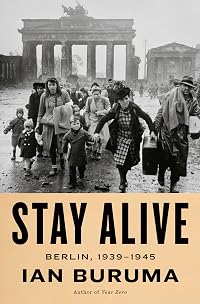
Stay Alive: Berlin 1939-1945
by Ian Buruma
On This Page
Description
An astonishing account of the human capacity for survival amid a great city's descent into utter annihilation.Tags
Recommendations









Member Reviews
This is an immersive, deeply human, and meticulously researched social history. Published in early 2026, the book explores how ordinary people navigated the moral catastrophe of the Third Reich. It derives its title from the wartime greeting Berliners used as the city collapsed into rubble: “Bleiben Sie übrig” (“Stay alive”). The book's core themes, structure, and critical approach are presented clearly. Instead of focusing on military strategy or top-tier Nazi commanders, Buruma chronicles the everyday survival of Berlin’s diverse wartime population. The book is organized year-by-year from 1939 to 1945. This structure tracks Berlin's transition from a thriving cultural redoubt to a battered, desperate hellscape. Buruma show more pieces together letters, diaries, memoirs, and rare interviews with aging survivors. He features a wide cast of characters: resistance fighters, swing dancers, movie stars, hiding Jews, and ordinary citizens. The narrative is anchored by the letters of Buruma’s own Dutch father, Leo Buruma. Leo was one of 400,000 foreign workers conscripted into forced labor in the German war economy. The result is an informative and well-written history of a specific time and place. show less
Ratings
Members
- Recently Added By
Published Reviews
ThingScore 100
In December 1941, the Nazi authorities received a letter from a soldier complaining that, on his recent leave in Berlin, he had been thoroughly disgusted by what he saw. While his comrades were dying at the front, plenty of young men appeared to have dodged military duty and were now to be found carousing in Berlin’s packed bars. The women were no better: husbandless but flush with ration show more coupons purloined from soldiers on leave, they were busy gorging themselves. “If Berlin were Germany,” huffed the complainant, “we would have lost this war years ago.”
Berlin had always been a case apart. The legacy of the wild Weimar years – all that artistic and political radicalism, not to mention louche living – had continued under the Third Reich. The city remained defiantly itself and, despite the efforts of high command, mulish about being told what to do. That, at least, had been the situation in 1941.
By the time Ian Buruma’s father, a conscripted labourer from the Netherlands, arrived two years later Berlin had begun grudgingly to toe the line. The war was going badly now, with the Russians pushing in from the east, and American and British bombs dropping from the skies. Food was scarce, Jewish citizens were being disappeared daily and Hitler and Goebbels, both frequently in the city, were getting more anxious and crueller by the day. Now whenever Berliners met each other in a food queue or a bomb shelter their most likely greeting was Bleiben sie übrig – “Stay alive”.
Nonetheless, argues Buruma, wherever you looked you could still find pockets of resistance. He isn’t referring here to well organised underground networks, but rather to ordinary men and women, not especially brave but still capable of doing the right thing. When Jews were ordered to start wearing identifying insignia, plenty of their fellow Berliners made a point of going up to them in the street and shaking hands. Young Leo Buruma, drafted in to work at a heavy engineering factory, took up with a Ukrainian girlfriend, pointedly ignoring the Nazis’ dictum that, as a “Germanic” Dutchman, he had no business consorting with an “inferior race”. It might not sound like much but, as Buruma puts it, “not everyone is cut out to be a hero”.
These small acts of grace from 80 years ago can be hard to research. Buruma starts with his own father’s letters home, which he began to go through systematically after Leo’s death in 2020. The young man clearly didn’t want to frighten his family – he reports the after-effects of a heavy bombing as merely “quite a sight” – and was careful not to fall foul of the German censor. Reading between the lines, though, Ian Buruma pieces together an existence of outward conformity (Leo signs up to be an air raid warden) and inner protest (on Saturday nights he plays piano with the widow of a wealthy Jewish lawyer, an act that could have got them both locked up or worse).
Other witnesses, such as journalists Ursula von Kardorff and Ruth Andreas-Friedrich, were careful to keep only scrappy and coded memos during the war, but subsequently reconstructed these into coherent narratives for publication. Von Kardorff could never be described as a resister, yet her memoir shows someone trying hard to remain decent in a criminal state. Her father, a successful portrait painter, had lost his teaching job thanks to his opposition to the regime yet her mother, a textile designer, continued to kit out the homes of the Nazi grandees. Ursula herself delivers warm clothes to Jewish homes but wonders if she is merely doing it to salve her conscience. Her real anguish is reserved for her brother who is fighting for Germany on the eastern front.
None of this is morally coherent and yet, suggests Buruma in this wonderfully nuanced book, it was necessary if you wanted to stay alive, and knew yourself to be neither brave nor craven – but somewhere in the muddled in-between. show less
Berlin had always been a case apart. The legacy of the wild Weimar years – all that artistic and political radicalism, not to mention louche living – had continued under the Third Reich. The city remained defiantly itself and, despite the efforts of high command, mulish about being told what to do. That, at least, had been the situation in 1941.
By the time Ian Buruma’s father, a conscripted labourer from the Netherlands, arrived two years later Berlin had begun grudgingly to toe the line. The war was going badly now, with the Russians pushing in from the east, and American and British bombs dropping from the skies. Food was scarce, Jewish citizens were being disappeared daily and Hitler and Goebbels, both frequently in the city, were getting more anxious and crueller by the day. Now whenever Berliners met each other in a food queue or a bomb shelter their most likely greeting was Bleiben sie übrig – “Stay alive”.
Nonetheless, argues Buruma, wherever you looked you could still find pockets of resistance. He isn’t referring here to well organised underground networks, but rather to ordinary men and women, not especially brave but still capable of doing the right thing. When Jews were ordered to start wearing identifying insignia, plenty of their fellow Berliners made a point of going up to them in the street and shaking hands. Young Leo Buruma, drafted in to work at a heavy engineering factory, took up with a Ukrainian girlfriend, pointedly ignoring the Nazis’ dictum that, as a “Germanic” Dutchman, he had no business consorting with an “inferior race”. It might not sound like much but, as Buruma puts it, “not everyone is cut out to be a hero”.
These small acts of grace from 80 years ago can be hard to research. Buruma starts with his own father’s letters home, which he began to go through systematically after Leo’s death in 2020. The young man clearly didn’t want to frighten his family – he reports the after-effects of a heavy bombing as merely “quite a sight” – and was careful not to fall foul of the German censor. Reading between the lines, though, Ian Buruma pieces together an existence of outward conformity (Leo signs up to be an air raid warden) and inner protest (on Saturday nights he plays piano with the widow of a wealthy Jewish lawyer, an act that could have got them both locked up or worse).
Other witnesses, such as journalists Ursula von Kardorff and Ruth Andreas-Friedrich, were careful to keep only scrappy and coded memos during the war, but subsequently reconstructed these into coherent narratives for publication. Von Kardorff could never be described as a resister, yet her memoir shows someone trying hard to remain decent in a criminal state. Her father, a successful portrait painter, had lost his teaching job thanks to his opposition to the regime yet her mother, a textile designer, continued to kit out the homes of the Nazi grandees. Ursula herself delivers warm clothes to Jewish homes but wonders if she is merely doing it to salve her conscience. Her real anguish is reserved for her brother who is fighting for Germany on the eastern front.
None of this is morally coherent and yet, suggests Buruma in this wonderfully nuanced book, it was necessary if you wanted to stay alive, and knew yourself to be neither brave nor craven – but somewhere in the muddled in-between. show less
added by kleh
Author Information

Awards and Honors
Distinctions
Common Knowledge
- Canonical title
- Stay Alive: Berlin 1939-1945
- Original publication date
- 2026
- Important places
- Berlin, Germany
- Important events
- World War II
- Canonical DDC/MDS
- 943.155086
Classifications
- Genres
- History, Nonfiction, General Nonfiction
- DDC/MDS
- 943.155086 — History & geography History of Europe Central Europe: Germany, Austria, Switzerland, Czech, Poland, Hungary Northeastern Germany Brandenburg and Berlin Berlin Historical periods 1866- 1933-1945 : Third Reich
- LCC
- DD880 .B88 — History of Europe, Asia, Africa and Oceania Germany History of Germany Local history and description Berlin
Statistics
- Members
- 99
- Popularity
- 326,679
- Reviews
- 1
- Rating
- (4.33)
- Languages
- English
- Media
- Paper
- ISBNs
- 2