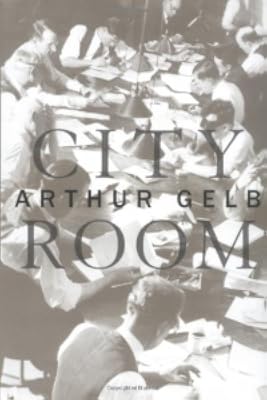
City Room
by Arthur Gelb
On This Page
Description
The veteran journalist discusses his life and career at the New York Times, sharing recollections of memorable events and personalities, and offering a behind-the-scenes look at the news industry.Tags
Recommendations
















Member Reviews
City Room takes place in a time in America's history when you could jot down your resume on the back of an index card while racing to an interview in a sputtering New York City taxi cab. There is an innocence to the era in which Gelb got his start. As the story of City Room goes on, Gelb reveals so many interesting behind-the-scenes details about life at the Times. For example, the strategic military censorship came back to haunt the paper when the American public belatedly learned of the true atrocities of World War II; especially the genocide in the German concentration camps of Buchenwald. Or how he scooped the Julius and Ethel Rosenberg executions. His front row seat to the Papp/Moses battle over the free Shakespeare theater in show more Central Park made for fascinating reading. His interest in the arts brought Gelb and John F. Kennedy together. And speaking of Kennedy, here is something I did not know. The New York Times was in the practice of writing obituaries for people before they died. Although The Times did not have an advance obituary for President Kennedy because he was so young when he was assassinated. Everyone collectively thought they had more time. Didn't we all? Other scoops of The Times: the Transit-Authority strike, the first Pope's visit to the United States, the largest power outage in history, the obtaining possession of Pentagon papers regarding the Vietnam War, and pervasive police and city hall corruption. When you put in forty-five years at one paper you can accumulate a lot of stories.
Gelb was grateful for early mentors. Enough so that he included a short biography of Mr. Fairbanks, a man who gave Gelb a chance at The Times. Gelb also reveals a wicked sense of humor. The story about sending the same pound cake back and forth between couples was hilarious. show less
Gelb was grateful for early mentors. Enough so that he included a short biography of Mr. Fairbanks, a man who gave Gelb a chance at The Times. Gelb also reveals a wicked sense of humor. The story about sending the same pound cake back and forth between couples was hilarious. show less
What a disappointment!
City Room, Arthur Gelb's autobiography, is like reading about the petty concerns of a shopkeeper ... who just happened to monger newspapers instead of groceries ... a mediocre man describing people in such a way as to make them (incredibly) seem almost as mediocre. The book's only probable use is that Gelb manages to give the reader a pretty good idea of what the practical careerist's mentality is like: devoid of vision, idealism or conceptual courage. Even relative highlights, like the Serpico affair, something that with a little intelligent analysis should have been fascinating, was almost made to be dull.
At first, I thought that Gelb was affecting ... for effect ... a kind of subtle detachment from the show more conceptual implications of the tremendous events covered by the Times ... but no ... by the end of the book one realises that he simply was a a somewhat stupid man (though probably an excellent businessman). Far from being "a man of letters", Gelb basically wrote a book about commerce. So only read it if it's the business aspect of "the newspaper business" that interests you. show less
City Room, Arthur Gelb's autobiography, is like reading about the petty concerns of a shopkeeper ... who just happened to monger newspapers instead of groceries ... a mediocre man describing people in such a way as to make them (incredibly) seem almost as mediocre. The book's only probable use is that Gelb manages to give the reader a pretty good idea of what the practical careerist's mentality is like: devoid of vision, idealism or conceptual courage. Even relative highlights, like the Serpico affair, something that with a little intelligent analysis should have been fascinating, was almost made to be dull.
At first, I thought that Gelb was affecting ... for effect ... a kind of subtle detachment from the show more conceptual implications of the tremendous events covered by the Times ... but no ... by the end of the book one realises that he simply was a a somewhat stupid man (though probably an excellent businessman). Far from being "a man of letters", Gelb basically wrote a book about commerce. So only read it if it's the business aspect of "the newspaper business" that interests you. show less
A thick slice of the American century as seen from a career in NYC journalism, particulary from the environs of the New York Times, this memoir is also a social history of sorts. Full of telling detail.
Written when the newspaper business was healthy, this NYTimesman's memoir reminds us of what we stand to lose by the daily papers' demise. No more carefully fact-checked investigative reporting. No more culutre commentary that drives the taste of a city, and even a nation. And, importantly, no more widely-shared source of news that promotes thoughtful discussion and political action.
A very interesting book on three levels – first about the New York Time and how it has worked and changed over the 20th century. Second about an interesting career in journalism over several decades. And most of all, as a window into the city itself over those decades, along with events in other parts of the world.
Autobiography of an old-time newspaper man. Interesting to see the inner workings of a paper, but a bit long-winded at times.
this book should be one of the world's best autobiography....this book was like good company sitting next to me and sharing insights that might seem at once unique and familiar..from this book i met another great writers and with each page, phase by phase, through the span of mr. gelb's years i felt that someone give me big history lesson .
Members
- Recently Added By
Author Information

14+ Works 582 Members
Arthur Neal Gelb was born in East Harlem, New York on February 3, 1924. He dropped out of City College to work as a copy boy for The New York Times in 1944. He graduated from New York University in 1946. He held many positions at The Times including critic, chief cultural correspondent, metropolitan editor, deputy managing editor, and managing show more editor. He retired at the end of 1989. He and his wife Barbara Gelb wrote several books together including Bellevue Is My Home, O'Neill, O'Neill: Life with Monte Cristo, and By Women Possessed: A Life of Eugene O'Neill. He died from complications of a stroke on May 20, 2014 at the age of 90. (Bowker Author Biography) show less
Common Knowledge
- People/Characters
- New York Times
Classifications
- Genres
- Nonfiction, Biography & Memoir, General Nonfiction, History
- DDC/MDS
- 070.92 — Computer science, information & general works News media, journalism & publishing Documentary media, educational media, news media; journalism; publishing Biography And History Biographies
- LCC
- PN4874 .G347 .A3 — Language and Literature Literature (General) Literature (General) Journalism. The periodical press, etc. By region or country
- BISAC
Statistics
- Members
- 197
- Popularity
- 166,922
- Reviews
- 7
- Rating
- (3.98)
- Languages
- English
- Media
- Paper, Ebook
- ISBNs
- 4
- UPCs
- 1
- ASINs
- 2