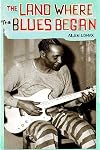
The Land Where the Blues Began
by Alan Lomax
On This Page
Description
The bluesmen were the bards of America's last frontier, the rowdy Mississippi Delta, in the days of the cotton boom, of levee and railroad building. Alan Lomax takes us on an adventure into the "bad old days" of the Delta. Weaving together the tales of muleskinners and roustabouts, church matrons and convicts, children and blind street singers, Lomax gives us the rich, sorrow-ridden background of the blues. We meet Muddy Waters (the father of modern blues), learn how Robert Johnson met his show more end, and are introduced to Fred McDowell and Son House, who taught Mick Jagger and Eric Clapton how to play the blues. In pre-integration days, when Lomax, a Southerner, first began his research, custom forbade a white man to socialize or even shake hands with a black. Despite threats of jail and violence, Lomax broke through the veil of silence that up till the 1940s had concealed the life of blacks in the Deep South. For the first time the people in these lower depths told the story of their humiliation and exploitation - of the brutal work camps that wasted lives and of the monstrous state penitentiaries that devoured the rebellious. No blacks before them had dared to expose the cruelties of the post-Reconstruction Deep South, the time of broken promises and illegal repression. In 1941, Blind Sid Hemphill, drum major of the Hills, introduced Lomax to the African roots of the Mississippi music, whose performance style (in song, speech, music, dance) has survived virtually intact in American black folk communities. This powerful, joy-filled, nonverbal and oral tradition gave rise to spirituals, jazz, dance steps, humor, and other folkways that kept the hearts of blacks alive all through their time of travail. It is this river of African-American culture - swept along in a tide of bawdy tales, murder ballads, work songs, hollers, game songs, church shouts - that produced the blues, which now enchant the world. show lessTags
Recommendations






















Member Reviews
A book about the history of the blues, it isn't a fun read, slavery and oppression are common. Alan Lomax is off course very knowledgeable about the subject which gives the book a certain authentic (and unique) feel. The only problem I had while reading is the use of accented language (for non-native English speakers it can get quite tricky to understand).
Absolutely fascinating!!! A look at the origins and development of the blues against a backdrop of the social hierarchy of Black America, particularly in the 40's and 50's. Frightening and fascinating.
“El evangelio según Alan Lomax”, El País 12.06.2021: https://elpais.com/babelia/2021-06-12/el-evangelio-segun-alan-lomax.html
Jun 12, 2021Spanish
Ratings
Members
- Recently Added By
Author Information

118+ Works 1,794 Members
Born in Austin, Texas, and educated at Harvard University, the University of Texas, and Columbia University, American folklorist Alan Lomax is one of the most dedicated and knowledgeable folk-music scholars of the twentieth century. Lomax became interested in collecting and recording folk songs through the work of his father, John Avery Lomax, a show more curator at the Library of Congress and a pioneer in the field of folk music. After college, he toured prisons in the South, recording folk song performances for the Archive of American Song of the Library of Congress. During his travels, he met the great blues singer Huddie Ledbetter ("Leadbelly"). Lomax later became responsible for introducing radio audiences to a number of folk and blues artists, including Woody Guthrie and Burl Ives. Between 1951 and 1958, he traveled throughout Europe, recording hundreds of folk songs in England, Scotland, Italy, and Spain. His most important work is, perhaps, "The Folk Songs of North America" (1959). He also published a number of works with his father, including "American Ballads and Folk Songs" (1934) and "Folk Song: USA" (1946). In addition to his work with folk songs, Lomax was very interested in the historical and social origins of jazz, and he wrote a notable biography of the early jazzman Ferdinand "Jelly Roll" Morton entitled "Mister Jelly Roll" (1950). (Bowker Author Biography) show less
Awards and Honors
Common Knowledge
- Original publication date
- 1993
- Important places*
- Mississippi, Verenigde Staten
*Some information comes from Common Knowledge in other languages. Click "Edit" for more information.
Classifications
- Genres
- Music, Nonfiction, General Nonfiction, History, Biography & Memoir
- DDC/MDS
- 781.643 — Arts & recreation Music General principles and musical forms Traditions of music Western popular music {equally instrumental and vocal} Blues
- LCC
- ML3521 .L64 — Music Literature on music Literature on music History and criticism Popular music
- BISAC
Statistics
- Members
- 464
- Popularity
- 66,069
- Reviews
- 3
- Rating
- (4.00)
- Languages
- 5 — Dutch, English, French, Italian, Spanish
- Media
- Paper
- ISBNs
- 14
- UPCs
- 3
- ASINs
- 5