Introduction to Topology and Modern Analysis
by George F. Simmons
On This Page
Description
This material is intended to contribute to a wider appreciation of the mathematical words "continuity and linearity". The book's purpose is to illuminate the meanings of these words and their relation to each other -- Product Description.Tags
Recommendations
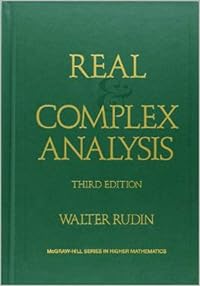
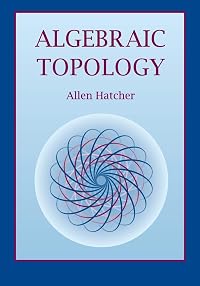
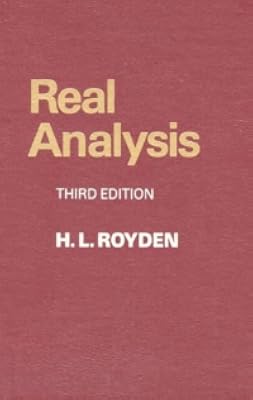
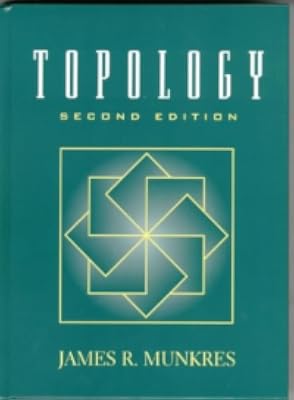













Member Reviews
Simply put, a great introduction! In my opinion, this is the first book every graduate student of analysis should read, preferably cover to cover, and try to do all the exercises. It consists of three parts, the first one ranging from sets, through metric spaces and topology to the Stone-Weierstrass theorems; the second from groups and rings, through Banach spaces to the spectral theorem in finite-dimensional Hilbert spaces. The third part unites the topological and algebraic developments in Banach algebras.
What makes this a great book is the way the author presents the subject matter in such a "beautiful", unified manner, and throughout the book there is a sense of direction, or even "plot". At the last page, the reader feels very show more enlightened and ready to proceed in his direction-of-choice. Simmons' writing is very motivating, and most of the proofs are easy to follow, because he uses well-placed, "streamlining" informal short-cuts. The difficulty level rises steadily through the book, the third part being a bit harder.
The problems at the end of each section are very interesting, well-made, just appropriately challenging, and they are an integral part of the development. There are hardly any boring, mechanical computations.
The lack of integration theory is definitely a minus, but perhaps it would have bloated the book too much. Now, at 350 pages, it's very accessible. Also, it doesn't serve that well as a reference, since there's so much informal text, and the definitions are not numbered. show less
What makes this a great book is the way the author presents the subject matter in such a "beautiful", unified manner, and throughout the book there is a sense of direction, or even "plot". At the last page, the reader feels very show more enlightened and ready to proceed in his direction-of-choice. Simmons' writing is very motivating, and most of the proofs are easy to follow, because he uses well-placed, "streamlining" informal short-cuts. The difficulty level rises steadily through the book, the third part being a bit harder.
The problems at the end of each section are very interesting, well-made, just appropriately challenging, and they are an integral part of the development. There are hardly any boring, mechanical computations.
The lack of integration theory is definitely a minus, but perhaps it would have bloated the book too much. Now, at 350 pages, it's very accessible. Also, it doesn't serve that well as a reference, since there's so much informal text, and the definitions are not numbered. show less
this is supposed to be fantastic. if you can find it.
Ratings
Members
- Recently Added By
Author Information

8 Works 768 Members
Classifications
Statistics
- Members
- 133
- Popularity
- 244,888
- Reviews
- 2
- Rating
- (4.00)
- Languages
- English
- Media
- Paper
- ISBNs
- 5
- ASINs
- 3