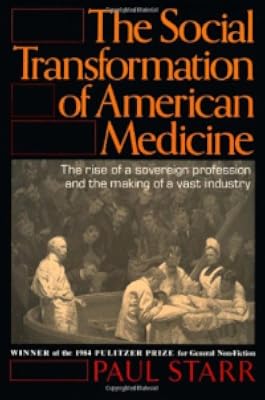
The Social Transformation of American Medicine: The Rise of a Sovereign Profession and the Making of a Vast Industry
by Paul Starr
On This Page
Description
Considered the definitive history of the American healthcare system, The Social Transformation of American Medicine examines how the roles of doctors, hospitals, health plans, and government programs have evolved over the last two and a half centuries. How did the financially insecure medical profession of the nineteenth century become a most prosperous one in the twentieth century? Why was national health insurance blocked? And why are corporate institutions taking over our medical care show more system today? Beginning in 1760 and coming up to the present day, renowned sociologist Paul Starr traces the decline of professional sovereignty in medicine, the political struggles over healthcare, and the rise of a corporate system. Updated with a new preface and an epilogue analyzing developments since the early 1980s, this new edition of The Social Transformation of American Medicine is a must-read for anyone concerned about the future of our fraught healthcare system. show lessTags
Recommendations








































Member Reviews
To the casual observer, a quick look at the American healthcare system brings out more questions than insights. Most of the developed world has some form of socialized medicine, whether nationalized health insurance or a national health system. By comparison, the American system appears disorderly and inefficient, yet resisting any changes, some swear by its effectiveness. Why? The answer lies not in a simple social, political, or economic force but in the scope of history. In this book, originally written in 1982, Paul Starr offers a seminal historical narrative that won the 1984 Pulitzer Prize. These dynamics remained relevant entering the Obamacare debates of the 21st century and continue to influence after that legislation modified show more the system.
I did not read the updated edition with a new epilogue published in 2017, but I am now curious what the epilogue says. This book clearly has the marks of a text that interested parties need to study for generations. It’s well-researched, eloquent, and with abundant endnotes. If anything, it’s too careful in its treatment and could become difficult and dense to read. Of course, readers who, like myself, appreciate scholarly erudition will appreciate the challenge.
America’s political landscape in the 1980s clearly influences Starr’s perspective. The 1960s offered ambitious scientific progress while the 1970s offered inflationary pressures. The election of 1980 transformed political dynamics by pushing cost controls to the fore. Starr’s final two chapters address these issues squarely to its original audience. However, the preceding nine chapters of history remain relevant and authoritative forty years later.
I slogged through years of medical school and presently work in medical research. Still, Starr taught me tones, and I wish I had read this book before I undertook these ventures. Understanding the social and economic dynamics can help explain human behavior around the biology and medicine. It simply isn’t better expressed than here. Other books offer more recent opinions about how to shape today’s future in 2024, but this history offers a clear explanation of how we got here. Again, reading forty years later, I found little that speaks of cobwebs in an ancient relic. It remains extremely relevant.
Anyone interested in a “big picture” look at the American medical system should start here. Political diatribes – and there are plenty of those – seem to paralyze rather than enhance constructive dialogue. This book, in contrast, informs and educates. Those working in the healthcare system and especially those leading the system can benefit. Those interested in government, politics, and health policy can also learn. I can see why it won a Pulitzer. Despite being rooted in discussions of the times, this book approaches being a timeless classic of a history about American healthcare. show less
I did not read the updated edition with a new epilogue published in 2017, but I am now curious what the epilogue says. This book clearly has the marks of a text that interested parties need to study for generations. It’s well-researched, eloquent, and with abundant endnotes. If anything, it’s too careful in its treatment and could become difficult and dense to read. Of course, readers who, like myself, appreciate scholarly erudition will appreciate the challenge.
America’s political landscape in the 1980s clearly influences Starr’s perspective. The 1960s offered ambitious scientific progress while the 1970s offered inflationary pressures. The election of 1980 transformed political dynamics by pushing cost controls to the fore. Starr’s final two chapters address these issues squarely to its original audience. However, the preceding nine chapters of history remain relevant and authoritative forty years later.
I slogged through years of medical school and presently work in medical research. Still, Starr taught me tones, and I wish I had read this book before I undertook these ventures. Understanding the social and economic dynamics can help explain human behavior around the biology and medicine. It simply isn’t better expressed than here. Other books offer more recent opinions about how to shape today’s future in 2024, but this history offers a clear explanation of how we got here. Again, reading forty years later, I found little that speaks of cobwebs in an ancient relic. It remains extremely relevant.
Anyone interested in a “big picture” look at the American medical system should start here. Political diatribes – and there are plenty of those – seem to paralyze rather than enhance constructive dialogue. This book, in contrast, informs and educates. Those working in the healthcare system and especially those leading the system can benefit. Those interested in government, politics, and health policy can also learn. I can see why it won a Pulitzer. Despite being rooted in discussions of the times, this book approaches being a timeless classic of a history about American healthcare. show less
Starr's book is one of the landmarks in the history of medicine. Using a framing theory of professional authority and a desire for independence, he examines medicine in America from the late Colonial period up through 1980. This book is sometimes overwhelming, but rarely obscure, and useful for both scholars and interested laymen. Starr explains the major periods of American medicine (disorder and disrepute to about 1870, standardization and professionalization from 1870 to WW2, and specialization and conglomeration after WW2) and their broader social and political contexts in education, public health, hospitals, and how doctors are paid.
Obviously, this book doesn't cover the past 30 years, and Starr is interested more in the character show more of a defined era than the actual moments of transformation, which to be fair, may be too elusive to really observe in a historic sense. But for anyone interested in why American healthcare is so expensive and why it is so resistant to reform, this is a definitive history. show less
Obviously, this book doesn't cover the past 30 years, and Starr is interested more in the character show more of a defined era than the actual moments of transformation, which to be fair, may be too elusive to really observe in a historic sense. But for anyone interested in why American healthcare is so expensive and why it is so resistant to reform, this is a definitive history. show less
I was at Drs. Glen and Ros Ramsey's house in 1982 or 1983 and Glen recommended that I read this book. Well, I thought it over and decided to go ahead and read it. Sadly, it is now a little dated, but I can't blame Glen for that, and it is a great socio-economic history of Medicine in the US–perhaps the greatest. The big villain is usually the AMA in most of the described conflicts over the years; this comes as no surprise if you realize what the AMA members' interests are. I am tempted to quote a great American, "Who knew that health care was so complicated?", but that's the one thing that (almost) everybody does know. The solution is easy, invite some Canadians down to set things up, but that would require either a benevolent show more dictatorship or a special freeze device that could be used to temporarily inactivate the AMA, big Pharma, the commercial insurance industry, the Blues, the hospitals, the medical schools, and all healthcare workers. They'd be pissed off when they thawed out, but, let's face it, they had their chance. show less
Wow...I've worked in healthcare for a really long time and 99% of this book were things that I had never known about. The part about women doctors in the 19th century and the victorian age switch was the wildest thing I've ever read.
I had to read this for my Health Law class. It was *excellent*. Anyone interested on how we got from there to here in the medical mess that we call health insurance, it's a must read. My only complaint is that it's dated since it was published in the '80s. I'd love to see a second edition. Don't call me crazy fellow Health Law students. :)
In The Social Transformation of American Medicine, Paul Starr argues, "The dominance of the medical profession...goes considerably beyond this rational foundation. Its authority spills over its clinical boundaries into arenas of moral and political action for which medical judgment is only partially relevant and often incompletely equipped. Moreover, the profession has been able to turn its authority into social privilege, economic power, and political influence" (pg. 5). He bases his analysis on three premises: "Social structure is the outcome of historical processes" (pg. 7); "the organization of medical care cannot be understood with reference solely to medicine, the relations between doctors and patients, or even all the various show more forces internal to the health care sector" (pg. 8); and "the problem of professional sovereignty calls for an approach that encompasses both culture and institutions" (pg. 8). With this focus and organizing premises, Starr traces medicine's social role from the colonial era through the Clinton administration. Anyone interested in medical history will find this an invaluable source while those studying medicine should read this to better contextualize their own place in American society so that they can work with greater self-awareness. show less
How medicine fell from being a humanitarian profession to an entreprenurial enterprise.
Members
- Recently Added By
Lists

Best Medical Nonfiction
79 works; 29 members

2024-2025 Ezra Klein Guest Recommendations
213 works; 6 members
Author Information
14 Works 1,190 Members
Paul Starr is professor of sociology and public affairs, Princeton University, and cofounder and coeditor of The American Prospect. His 1984 book The Social Transformation of American Medicine won the Pulitzer Prize for Nonfiction and the Bancroft Prize in American history. A senior advisor on health policy in the Clinton White House, he writes show more frequently on national politics. show less
Awards and Honors
Awards
Distinctions
Common Knowledge
- Canonical title
- The Social Transformation of American Medicine: The Rise of a Sovereign Profession and the Making of a Vast Industry
- Original title
- The Social Transformation of American Medicine
- Original publication date
- 1982
- Dedication
- To the memory of
My Father - First words
- I have divided this history into two books to emphasize two long movements in the development of American medicine; first the rise of professional sovereignty; and second the transformation of medicine into an industry and th... (show all)e growing, though still unsettled, role of corporations and the state. -Preface (1982)
The dream of reason did not take power into account. The dream was that reason, in the form of the arts and sciences, would liberate humanity from scarcity and the caprices of nature, ignorance and superstition, tyranny, and ... (show all)not least of all, the diseases of the body and spirit. But reason is no abstract force pushing inexorably toward greater freedom at the end of history. Its forms and used are determined by the narrower purposes of men and women; their interests and ideals shape even what counts as knowledge. -Introduction, The Social Origins of Professional Sovereignty
The social history of health care in the United States used to be a relatively esoteric subject. People who wanted to understand American society, the economy, or politics did not typically feel a need to learn much about the... (show all) organization of health care and its development. But the growth of the health care system and persistence of national discord over it have given the subject more prominence and urgency. -Preface to the Second Edition (2016)
Before the twentieth century, American physicians found the path to professional status blocked by popular resistance, internal division, and an inhospitable economic environment. -Chapter One: Medicine in a Democratic Cultur... (show all)e, 1760-1850 - Last words
- (Click to show. Warning: May contain spoilers.)Whether it does depends on choices that Americans have still to make.
- Blurbers
- Geiger MD, H Jack; Numbers, Ronald L.; Relman, Arnold; Bell, Daniel; Enthoven, Alain
- Canonical DDC/MDS
- 305.9610973
- Canonical LCC
- RA395.A3
Classifications
- Genres
- Sociology, History, Nonfiction, General Nonfiction, Science & Nature, Philosophy
- DDC/MDS
- 305.9610973 — Society, government, & culture Social sciences, sociology & anthropology Social group - Age, Gender, Ethnicity People by occupation and miscellaneous social statuses Persons occupied with applied sciences, technologists Occupied with medicine
- LCC
- RA395 .A3 — Medicine Public aspects of medicine Public aspects of medicine Medicine and the state
- BISAC
Statistics
- Members
- 644
- Popularity
- 44,833
- Reviews
- 8
- Rating
- (4.24)
- Languages
- English, Spanish
- Media
- Paper, Audiobook, Ebook
- ISBNs
- 9
- ASINs
- 10