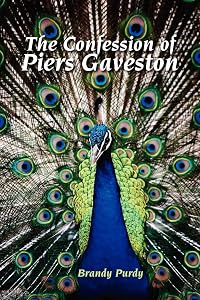
The Confession of Piers Gaveston
by Brandy Purdy
On This Page
Description
The history books tell us that Piers Gaveston was many things: arrogant, ambitious, avaricious, flamboyant, extravagant, reckless, brave, and daring, indiscreet, handsome, witty, vivacious, vain, and peacock-proud, a soldier and champion jouster, the son of a condemned witch, who used witchcraft, his own wicked wiles, and forbidden sex to entice and enslave King Edward II, alienate him from his nobles and advisors, and keep him from the bed of his beautiful bride Isabelle. Edward's show more infatuation with Gaveston, and the deluge of riches he showered on him, nearly plunged England into civil war. Now the object of that scandalous and legendary obsession tells his side of the story in The Confession of Piers Gaveston: "Mayhap even now, when I have only just begun, it is already too late to set the story straight. My infamy, I fear, is too well entrenched. Whenever they tell the story of Edward's reign I will always be the villain and Edward, the poor, weak-willed, pliant king who fell under my spell, the golden victim of a dark enchantment. There are two sides to every coin; but when the bards and chroniclers, the men who write the histories, tell this story, will anyone remember that?" show lessTags
Recommendations

















Member Reviews
Piers Gaveston was a soldier, a champion jouster, and a witty conversationalist. According to his own fictional account in this novel by Brandy Purdy, he was also a pagan and a male prostitute who viewed his long-standing affair with King Edward II as merely another means to make a living.
The Confession of Piers Gaveston is a skillfully written debut novel which reveals some very ugly aspects of the British monarchy in the fourteenth century. I am not speaking of King Edward’s gay love affair with the narrator, Piers Gaveston, but of Edward’s obsessive and histrionic personality. He was certainly not the first or the last ruler to allow his lusts to cloud his judgment, but he may have been one of the most disinterested and show more incompetent kings in England’s history. Some of the scenes in the novel seem almost unbelievably melodramatic – such as Edward abandoning his bride on their wedding day for his male lover’s company and actually giving him the jewelry that had been a wedding gift from the queen’s father – but these are all documented historical facts! Brandy Purdy’s depiction of them is probably accurate, outrageous though it may seem that a king would behave that way.
Piers Gaveston makes a lively and personable narrator for this tale, and Purdy has given him a lyrical, compelling, and sometimes playful voice. She has created in Piers a believable man of many talents who nonetheless is only credited with one – his ability to seduce almost anyone with his good looks and wit. During the novel, Piers bitterly reflects on how his prowess on the battlefield and intelligence in statecraft go unappreciated by his detractors and his friends alike, as he is considered merely a pretty bauble to be used to sate the king’s lust. Meanwhile, the man on the throne of England clearly is incapable of the job he has inherited. As Piers so aptly puts it: “Edward is the King of England and if he cannot find one misplaced shoe which he knows is somewhere in a single locked room then no wonder his subjects have no confidence in him!”
It is inevitable that this book will be compared to Susan Higginbotham’s novel, The Traitor’s Wife, which also depicts Edward’s reign. Brandy Purdy’s novel focuses on a narrower time period, includes a smaller cast, but still provides a chilling glimpse of the events which follow Piers Gaveston’s death. All in all, I wish I had read The Confessions of Piers Gaveston first, because this novel clearly introduces and explains the King’s three most serious adversaries: Pembroke, Lancaster, and Warwick, whom I confused in the other, longer novel. However, both books are very worth reading for anyone interested in this dark era of England’s history and a king who makes King Henry VIII seem temperate and reasonable by comparison! show less
The Confession of Piers Gaveston is a skillfully written debut novel which reveals some very ugly aspects of the British monarchy in the fourteenth century. I am not speaking of King Edward’s gay love affair with the narrator, Piers Gaveston, but of Edward’s obsessive and histrionic personality. He was certainly not the first or the last ruler to allow his lusts to cloud his judgment, but he may have been one of the most disinterested and show more incompetent kings in England’s history. Some of the scenes in the novel seem almost unbelievably melodramatic – such as Edward abandoning his bride on their wedding day for his male lover’s company and actually giving him the jewelry that had been a wedding gift from the queen’s father – but these are all documented historical facts! Brandy Purdy’s depiction of them is probably accurate, outrageous though it may seem that a king would behave that way.
Piers Gaveston makes a lively and personable narrator for this tale, and Purdy has given him a lyrical, compelling, and sometimes playful voice. She has created in Piers a believable man of many talents who nonetheless is only credited with one – his ability to seduce almost anyone with his good looks and wit. During the novel, Piers bitterly reflects on how his prowess on the battlefield and intelligence in statecraft go unappreciated by his detractors and his friends alike, as he is considered merely a pretty bauble to be used to sate the king’s lust. Meanwhile, the man on the throne of England clearly is incapable of the job he has inherited. As Piers so aptly puts it: “Edward is the King of England and if he cannot find one misplaced shoe which he knows is somewhere in a single locked room then no wonder his subjects have no confidence in him!”
It is inevitable that this book will be compared to Susan Higginbotham’s novel, The Traitor’s Wife, which also depicts Edward’s reign. Brandy Purdy’s novel focuses on a narrower time period, includes a smaller cast, but still provides a chilling glimpse of the events which follow Piers Gaveston’s death. All in all, I wish I had read The Confessions of Piers Gaveston first, because this novel clearly introduces and explains the King’s three most serious adversaries: Pembroke, Lancaster, and Warwick, whom I confused in the other, longer novel. However, both books are very worth reading for anyone interested in this dark era of England’s history and a king who makes King Henry VIII seem temperate and reasonable by comparison! show less
Ratings
Members
- Recently Added By
Author Information
12 Works 681 Members
Classifications
Statistics
- Members
- 28
- Popularity
- 980,481
- Reviews
- 1
- Rating
- (2.88)
- Languages
- English
- Media
- Paper, Ebook
- ISBNs
- 3
- ASINs
- 3