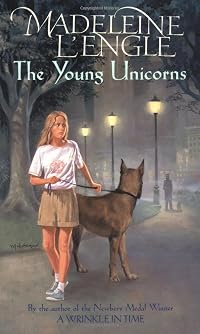
The Young Unicorns
by Madeleine L'Engle
Chronos/The Austins: Publication Order (3), Chronos/The Austins: Chronological Order (5)
On This Page
Description
The life of the Austin family is changed by the arrival of self-centered young Maggy Hamilton, orphaned by the sudden death of her pilot father.Tags
Recommendations



Member Reviews
This is third in the Austin family series, and quite a dark, thought-provoking book. It's a thriller with a bit of medical science fiction, and quite a bit of suspense. However it's intended for older children and younger teens, so I didn't find it too disturbing. Indeed, although thrillers are not a genre I would choose, I enjoyed this book very much.
There's a Christian element - much of the action takes place in or around a Cathedral, and some of the characters are clergymen - but it's quite low-key with no preaching. There are also some philosophical issues, such as the nature of freedom, and how far one can go in the quest for peace. The writing is excellent, creating just the right level of atmosphere without being frightening, and show more if some of the situations and people are a bit caricatured, it really doesn't matter. While reading the book, I was totally caught up in the storyline and could barely put it down.
Some of the concepts are quite advanced, and some of the situations could be worrying for a younger or sensitive child, so I wouldn't suggest this to anyone below the age of about ten or eleven. But I would definitely recommend it to older children and teens, as well as adults wanting a fairly quick read with a bit of depth, and some interesting issues to ponder. show less
There's a Christian element - much of the action takes place in or around a Cathedral, and some of the characters are clergymen - but it's quite low-key with no preaching. There are also some philosophical issues, such as the nature of freedom, and how far one can go in the quest for peace. The writing is excellent, creating just the right level of atmosphere without being frightening, and show more if some of the situations and people are a bit caricatured, it really doesn't matter. While reading the book, I was totally caught up in the storyline and could barely put it down.
Some of the concepts are quite advanced, and some of the situations could be worrying for a younger or sensitive child, so I wouldn't suggest this to anyone below the age of about ten or eleven. But I would definitely recommend it to older children and teens, as well as adults wanting a fairly quick read with a bit of depth, and some interesting issues to ponder. show less
The Young Unicorns differs completely from the previous two novels in Madeleine L’Engle’s Austin Family Chronicles. The first novel, Meet the Austins, introduces us both to the lovely Austin family but also to the theme of the importance of family — which is defined more by love than blood. The second, The Moon by Night, is one of the best, most realistic coming-of-age stories I’ve read, despite its original release being 1963; the novel holds up well nearly 60 years later.
However, The Young Unicorns most resembles The Arm of the Starfish, published just two years earlier; indeed, Canon John Calvin O’Keefe, a main character in The Arm of the Starfish, is mentioned. In both, science-fiction melds with a suspenseful thriller, show more where the forces of innocence and compassion combat egomania and a hunger for power, not always winning. Phrased bluntly like that, it makes it sound as if L’Engle had penned a shallow polemic, but it’s a testament to her writing that The Young Unicorns never becomes twee or predictable. The Moon by Night remains my favorite book in the series, but it only beats this one by a hair. show less
However, The Young Unicorns most resembles The Arm of the Starfish, published just two years earlier; indeed, Canon John Calvin O’Keefe, a main character in The Arm of the Starfish, is mentioned. In both, science-fiction melds with a suspenseful thriller, show more where the forces of innocence and compassion combat egomania and a hunger for power, not always winning. Phrased bluntly like that, it makes it sound as if L’Engle had penned a shallow polemic, but it’s a testament to her writing that The Young Unicorns never becomes twee or predictable. The Moon by Night remains my favorite book in the series, but it only beats this one by a hair. show less
Took off half a star because the book suffers from the absence of enough awareness of race (and Black people) and does get a little heavy-handed, even for L'Engle. But otherwise still charms me with its multitude of characters, precocious children, drama/danger, ties to other books, love of the cathedral, portrait of New York, exhalting of dogs, use of music, etc. Narration pretty good.
The third book in the Austin family series takes a turn that moves it firmly into the same universe as the Meg Murry series. Now living in New York, the Austins have made friends with Josiah "Dave" Davidson and Emily, a young girl who is a brilliant pianist but recently made blind when she walked in on someone stealing research from the very study where Dr. Austin now works. Something sinister is going on; who can be trusted in the big city?
With gang names like the Alphabats (and leaders called A, B, C, D....), a "genie" that apparently comes out of a lamp and other over-the-top scenarios, I didn't quite roll my eyes but I never truly believed anyone was in danger. Dave's name, Josiah Davidson, definitely references the Biblical king - show more and in case we missed it, one of the characters makes a statement to that effect and his father's name is also Amon. The narrative also changes from Vicky's first-person account to a third person narrator that mostly follows Suzy and Rob, Dave and Emily (with some of Vicky), and comes across as a bit more heavy-handed and old-fashioned without having her teenage voice in the mix. That being said, it's the kind of book I would've loved (and probably did) as a kid, and had I been the right age it would've been just the right amount of suspense. As it was, I needed something a little lighter alongside the heavy adult books I'd been reading, so I enjoyed it more than I didn't. show less
With gang names like the Alphabats (and leaders called A, B, C, D....), a "genie" that apparently comes out of a lamp and other over-the-top scenarios, I didn't quite roll my eyes but I never truly believed anyone was in danger. Dave's name, Josiah Davidson, definitely references the Biblical king - show more and in case we missed it, one of the characters makes a statement to that effect and his father's name is also Amon. The narrative also changes from Vicky's first-person account to a third person narrator that mostly follows Suzy and Rob, Dave and Emily (with some of Vicky), and comes across as a bit more heavy-handed and old-fashioned without having her teenage voice in the mix. That being said, it's the kind of book I would've loved (and probably did) as a kid, and had I been the right age it would've been just the right amount of suspense. As it was, I needed something a little lighter alongside the heavy adult books I'd been reading, so I enjoyed it more than I didn't. show less
My L'Engle reviews seem to have a theme: complaining noises followed by assertions why said complaints are meaningless in view of the whole, and a reference to love as the universal solvent. This book is no different.
I'm unable to keep from rolling my eyes when Rob, age 7, pipes up with a malapropism followed with an erudite comment on the second movement of some obscure 12th century piece of music which he knows by heart.
The plot here is so unrealistic it would be laughable in anyone else's hands. The scary laser? The tough, gun-toting 'hoods' with the third-grade name? The hysteria about what L'Engle insisted on calling "pot" and "acid" to further distance herself from them? The villains are one-dimensional. Wait for it...
Yeah, not show more a bit of this matters. Honest. Just doesn't matter. The preachifying, the transparent manipulation? Just doesn't matter. Somehow, L'Engle transcends all of that, sucks you in, makes you believe, and holds your hand throughout. Her unvarying theme- love, love, love- makes the Austins real, makes Canon Tallis true, makes the Rabbi lovable, makes your heart pound at all the right places. It's a wonderful book. Put that in the pocket of your scorflam jacket and take it to the bank. show less
I'm unable to keep from rolling my eyes when Rob, age 7, pipes up with a malapropism followed with an erudite comment on the second movement of some obscure 12th century piece of music which he knows by heart.
The plot here is so unrealistic it would be laughable in anyone else's hands. The scary laser? The tough, gun-toting 'hoods' with the third-grade name? The hysteria about what L'Engle insisted on calling "pot" and "acid" to further distance herself from them? The villains are one-dimensional. Wait for it...
Yeah, not show more a bit of this matters. Honest. Just doesn't matter. The preachifying, the transparent manipulation? Just doesn't matter. Somehow, L'Engle transcends all of that, sucks you in, makes you believe, and holds your hand throughout. Her unvarying theme- love, love, love- makes the Austins real, makes Canon Tallis true, makes the Rabbi lovable, makes your heart pound at all the right places. It's a wonderful book. Put that in the pocket of your scorflam jacket and take it to the bank. show less
I enjoy Madeleine L'Engle's books, in part because of their underlying philosophy. This book, while a bit of a thriller, explores freedom, trust, free will, beliefs, and choices. It also looks at the use and misuse of technology. While dated, it still resonated deeply with me. Today's young adults might need some reminding of a time without cell phones.
Much of the book can be summed up in this quotation, "Because to take away a man’s freedom of choice, even his freedom to make the wrong choice, is to manipulate him as though he were a puppet and not a person." To have the ability to choose, to be trusted to make the right choice, to have people believe in you and your choices speaks to having a good life.
This book is for anyone who show more enjoys a well-plotted novel and doesn't mind dated technology. show less
Much of the book can be summed up in this quotation, "Because to take away a man’s freedom of choice, even his freedom to make the wrong choice, is to manipulate him as though he were a puppet and not a person." To have the ability to choose, to be trusted to make the right choice, to have people believe in you and your choices speaks to having a good life.
This book is for anyone who show more enjoys a well-plotted novel and doesn't mind dated technology. show less
This is the last in The Austins series by L'Engle and the only one of this series that I have read. The writing is rich and dense, and the upper West Side Manhattan autumn setting was perfect when curling up as the daylight has waned. This is not a perfect book, however, but I would recommend it to a reader who enjoys some dense, delicious writing and is willing to navigate some of the dated elements of the story (a racial slur & a fearsome street gang named the "Alphabats") for the quirky characters and the '70s-era New York.
The science/technology in the plot is funny in an early Star Trek way (beware the "Micro-Ray"), but it does allow for discussion of the use and misuse of technology. Likewise the setting in the Cathedral of St. show more John the Divine, incorporating a vicar and a dean, & the friendship of precocious young Rob with the neighborhood rabbi creates the opportunity for examination of good and bad. In keeping with the moral tenor of the book, we also learn that power corrupts, and that "'One can tell a great deal around a dinner table....I think the closest we ever come in this naughty world to realizing unity in diversity is around a family table.'" (p. 205)
Having read this, I'd like to go back to New York and meet the Austins again.
show less
The science/technology in the plot is funny in an early Star Trek way (beware the "Micro-Ray"), but it does allow for discussion of the use and misuse of technology. Likewise the setting in the Cathedral of St. show more John the Divine, incorporating a vicar and a dean, & the friendship of precocious young Rob with the neighborhood rabbi creates the opportunity for examination of good and bad. In keeping with the moral tenor of the book, we also learn that power corrupts, and that "'One can tell a great deal around a dinner table....I think the closest we ever come in this naughty world to realizing unity in diversity is around a family table.'" (p. 205)
Having read this, I'd like to go back to New York and meet the Austins again.
show less
Members
- Recently Added By
Lists

Fantastical/Mythological Creatures in the Title
37 works; 2 members

Two faces on cover -- children's/young adult fiction
120 works; 2 members

Best Sellers / Popular 1968
237 works; 5 members
Author Information

122+ Works 128,919 Members
Author Madeleine L'Engle was born in New York City on November 29, 1918. She graduated from Smith College. She is best known for A Wrinkle in Time (1962), which won the 1963 Newbery Medal for best American children's book. While many of her novels blend science fiction and fantasy, she has also written a series of autobiographical books, including show more Two Part Invention: The Story of a Marriage, which deals with the illness and death of her husband, soap opera actor Hugh Franklin. In 2004, she received a National Humanities Medal from President George W. Bush. She died on September 6, 2007 of natural causes. Since 1976, Wheaton College in Illinois has maintained a special collection of L'Engle's papers, and a variety of other materials, dating back to 1919. (Bowker Author Biography) show less
Awards and Honors
Series


Work Relationships
Common Knowledge
- Canonical title
- The Young Unicorns
- Original title
- The Young Unicorns
- Original publication date
- 1968
- People/Characters
- Vicky Austin; Canon Tallis; Emmanuele Theotocopoulos (Mr. Theo); Rob Austin; Emily Gregory; Wallace Austin (show all 9); Victoria Eaton (Victoria Austin); Suzy Austin; John Austin
- Important places
- New York, New York, USA
- Dedication
- For all my friends at the Cathedral Church of St John the Divine who are as the stars of heaven for multitude and brightness….
- First words
- Winter came early to the city that year.
- Last words
- (Click to show. Warning: May contain spoilers.)His family.
Classifications
- Genres
- Fiction and Literature, Kids, Teen, Fantasy, Young Adult
- DDC/MDS
- 813.54 — Literature & rhetoric American literature in English American fiction in English 1900-1999 1945-1999
- LCC
- PZ7 .L5385 .Y — Language and Literature Fiction and juvenile belles lettres Fiction and juvenile belles lettres Juvenile belles lettres
- BISAC
Statistics
- Members
- 1,638
- Popularity
- 13,803
- Reviews
- 20
- Rating
- (3.73)
- Languages
- English
- Media
- Paper, Audiobook, Ebook
- ISBNs
- 23
- UPCs
- 1
- ASINs
- 9