
A Thousand Plateaus: Capitalism and Schizophrenia
by Gilles Deleuze (Author), Félix Guattari (Author)
Capitalism and Schizophrenia (book 2)
On This Page
Description
A companion volume to Anti-Oedipus: capitalism and schizophrenia. Described as "a positive exercise in the affirmative "nomad" thought called for in Anti-Oedipus.Tags
Recommendations
















































Member Reviews
How does one read this book, and why? Hopefully not from beginning to end, and hopefully not expecting to find many easily digestible passages, let alone meaty, neatly wrapped takeaways.
This book is very much post 1968 (for Deleuze, the great Paris student revolt). It's politics are anti-authoritarian, acting itself out with irony, irreverence, and a heightened continental-styled intellectual obfuscation. Straight language and discourse were to be tossed out with a corrupt old guard that deliciously, for Deleuze, included many of his own professors. The style combines the exuberance of revolt and the vindictiveness of rebellion, exuberance in the energy of the language and vindictiveness in its opacity. It's rare to find a sentence that show more makes immediate sense or a pair of sentences with easy logical continuity between them.
Guattari, the team's other half, was a psychoanalyst, and you see that vector in the quirky obscure images and symbols that appear to have popped out of dreams to ride the monotonous rhythm of these sentences, one after the other for what feels like forever, soothed in the cozy confidence that the analyst in the corner, one of the good guys, never censures or censors. There will be a solidarity and classless parity in the parading of these repeating words, images, and ideas, each little one a citoyen of a new in-world that has pushed the old one decisively out.
So why give five stars to something whose language I mostly couldn't understand? Probably to honor its uniqueness; there's nothing quite like it. But more likely, for its musicality. It offers music of a kind I'll come back to; in small doses, one little plateau at a time. It will be a kind of music I can get nowhere else. It will refresh me. My fellow-traveling psychiatrist in the corner will look on avuncularly as I declaim (or Deleuze does for me) anything that suddenly and urgently demands to break free. It will be spring. I will be young. Masses will cheer as budding trees fall to the buzz of buzz saws to become our barricades. I will let my world die, knowing that it has already been reborn.
Then I'll wake up, smile, and say what a good little nap that was -- and be so, so glad the trees weren't really sawn down. show less
This book is very much post 1968 (for Deleuze, the great Paris student revolt). It's politics are anti-authoritarian, acting itself out with irony, irreverence, and a heightened continental-styled intellectual obfuscation. Straight language and discourse were to be tossed out with a corrupt old guard that deliciously, for Deleuze, included many of his own professors. The style combines the exuberance of revolt and the vindictiveness of rebellion, exuberance in the energy of the language and vindictiveness in its opacity. It's rare to find a sentence that show more makes immediate sense or a pair of sentences with easy logical continuity between them.
Guattari, the team's other half, was a psychoanalyst, and you see that vector in the quirky obscure images and symbols that appear to have popped out of dreams to ride the monotonous rhythm of these sentences, one after the other for what feels like forever, soothed in the cozy confidence that the analyst in the corner, one of the good guys, never censures or censors. There will be a solidarity and classless parity in the parading of these repeating words, images, and ideas, each little one a citoyen of a new in-world that has pushed the old one decisively out.
So why give five stars to something whose language I mostly couldn't understand? Probably to honor its uniqueness; there's nothing quite like it. But more likely, for its musicality. It offers music of a kind I'll come back to; in small doses, one little plateau at a time. It will be a kind of music I can get nowhere else. It will refresh me. My fellow-traveling psychiatrist in the corner will look on avuncularly as I declaim (or Deleuze does for me) anything that suddenly and urgently demands to break free. It will be spring. I will be young. Masses will cheer as budding trees fall to the buzz of buzz saws to become our barricades. I will let my world die, knowing that it has already been reborn.
Then I'll wake up, smile, and say what a good little nap that was -- and be so, so glad the trees weren't really sawn down. show less
Only read a handful of essays so far, but they never fail to blow my mind. Which isn't to say they aren't problematic in many ways...
Reminds me Marshall McLuhan. Great and scintillating in short segments, but then you delve the corpus and go "Wha-aaa...?!?" Marvelous overextension, though.
I felt off balance with this one, especially in stark relief to Anti-Oedipus. I'm not suggesting I deftly maneuvered through that one, but the posture remained intact. I largely flailed and screeched during my readinging and kept it such until I read that Alec Empire loves this as well as some squatters in St. Petersburg: I read that second detail Wired magazine. Yeah, I bought a pair of copies of that back in the early months of Clinton's second term. It is strange, I recall so much of that article about digital anarchists in the "new" Russia but i don't recall that much from Thousand Plateaus.
Woe. A thousand plateaus by Deleuze and Guatteri. Mmmmm maybe several thousand scantily related sentences published as a whole. A rhizomatic layering where what comes first last or middle really doesnt matter.
Spinuzzi's blog makes some sense of it
Spinuzzi's blog makes some sense of it
o man. most people greet this with horror. but the two chapters worth hanging on to are: Introduction: The Rhizome; and 10,000 BC: The Geology of Morals.
Will probably come back to it some other time
Members
- Recently Added By
Lists


Author Information

Gilles Deleuze (1925-1995) was professor of philosophy at the University of Paris, Vincennes-St. Denis.
Some Editions
Series

Belongs to Publisher Series
Work Relationships
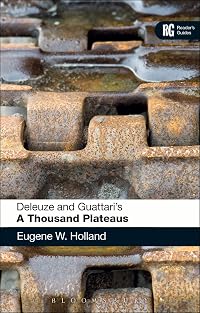
Has as a reference guide/companion
Common Knowledge
- Canonical title*
- Капитализм и шизофрения
- Original title
- Mille Plateaux
- Original publication date
- 1980 (original French) (original French); 1987 (English) (English)
*Some information comes from Common Knowledge in other languages. Click "Edit" for more information.
Classifications
Statistics
- Members
- 2,241
- Popularity
- 8,986
- Reviews
- 13
- Rating
- (4.31)
- Languages
- 11 — Czech, Danish, English, French, German, Japanese, Polish, Russian, Spanish, Swedish, Turkish
- Media
- Paper, Ebook
- ISBNs
- 21
- ASINs
- 9
