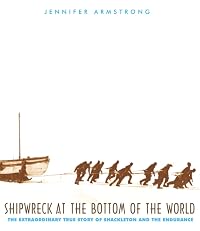
Shipwreck at the Bottom of the World: The Extraordinary True Story of Shackleton and the Endurance
by Jennifer Armstrong
On This Page
Description
Describes the events of the 1914 Shackleton Antarctic expedition when, after being trapped in a frozen sea for nine months, their ship, Endurance, was finally crushed, forcing Shackleton and his men to make a very long and perilous journey across ice and stormy seas to reach inhabited land.Tags
Recommendations




















Member Reviews
Just imagine yourself in the most hostile place on earth. It's not the Sahara or the Gobi Desert. It's not the Arctic. The most hostile place on earth is the Antarctic, the location of the South Pole--what's the difference? The Arctic is mostly water--with ice on top, of course--and that ice is never more than a few feet thick. But under the South Pole lies a continent that supports glaciers up to two miles in depth. Almost the entire southern continent is covered by ice. The mammoth icecap presses down so heavily that it actually distorts the shape of the earth. The ice never melts; it clings to the bottom of the world, spawning winds, storms, and weather that affect the whole planet.
I have read Jennifer Armstrong's Shipwreck at the show more Bottom of the World five or six times now. (Most recently in 2022). The narrative is so strong and compelling, and, yes, even inspiring. It is definitely one of my favorite nonfiction books. And nonfiction isn't something I usually take the time to reread. It is rare for me to keep coming back again and again to a nonfiction book.
Originally published in 1998, Shipwreck at the Bottom of the World won the Orbis Pictus Award in 1999. The book follows "the extraordinary true story of Shackleton and the Endurance." If you are unfamiliar with this story, then you really SHOULD read this one. It is a great introduction to the subject. Chapter by chapter, the book follows Shackleton and his men on their journey to Antarctica. Almost from the start, there are indicators that their goal, their quest, will not be an easy one to achieve. After a series of mishaps--thanks to nature--it becomes a long fight to survive.
The story is simple and yet dramatic. I think the story would be gripping no matter who told it. But I do think that Jennifer Armstrong did a wonderful job in painting a very human picture of Shackleton and his crew. I think the ending was beautiful--very moving! This one is a book I think everyone should read. show less
I have read Jennifer Armstrong's Shipwreck at the show more Bottom of the World five or six times now. (Most recently in 2022). The narrative is so strong and compelling, and, yes, even inspiring. It is definitely one of my favorite nonfiction books. And nonfiction isn't something I usually take the time to reread. It is rare for me to keep coming back again and again to a nonfiction book.
Originally published in 1998, Shipwreck at the Bottom of the World won the Orbis Pictus Award in 1999. The book follows "the extraordinary true story of Shackleton and the Endurance." If you are unfamiliar with this story, then you really SHOULD read this one. It is a great introduction to the subject. Chapter by chapter, the book follows Shackleton and his men on their journey to Antarctica. Almost from the start, there are indicators that their goal, their quest, will not be an easy one to achieve. After a series of mishaps--thanks to nature--it becomes a long fight to survive.
The story is simple and yet dramatic. I think the story would be gripping no matter who told it. But I do think that Jennifer Armstrong did a wonderful job in painting a very human picture of Shackleton and his crew. I think the ending was beautiful--very moving! This one is a book I think everyone should read. show less
I cannot say that I liked this book, but I also cannot say that it was through any fault of the author; in fact, Jennifer Armstrong's powers of description put me in a place, as a reader, that I didn't want to be. She stranded me in an Antarctic no man's land with 28 brave, capable, scared, and desolate men. Although the book's cover gives away the fact the the men all make it out alive, it is so hard to believe that one almost forgets that they make it. The journey starts out harrowing enough in their ship, but when the ship gets crunched up between ice floes and they have to camp out in the elements it is almost unimaginable what the men survived. I say almost because Armstrong allows the reader to imagine it quite well, in fact show more forces the reader to, with her detailed descriptions and agile storytelling. She fills in the blanks just right. For instance, in the chapter "Mutiny," Armstrong prefaces the story of how Shackleton dealt with some resistance to his leadership with the story of a famous mutiny of an expedition lead by Sir John Franklin, and the "insanity, desertion, [and] cannibalism" that took place (62). She mentions how there was a book pertaining to a rescue mission for those men, and that the men of the Endurance would have known the stories of the ill-fated crew. This sets up the suspense perfectly, because we realize what could be at stake if a mutiny did indeed take place, and we also get insight into what Shackleton may have been thinking when he tried to avert it.
With respect to the detail that Armstrong includes,she describes all aspects of the natural world around the men, many details of their actions and challenges, and even their thoughts and fears when possible. This book feels like a complete story. Armstrong clearly researched this book very thoroughly, and the photographs add so much as well. They fill in the rest of the blanks. I lay curled up in my comfortable chair reading this book, but feeling none of the comforts of my room temperature cozy home. My toes ached from frostbite. I was afraid and disgusted and hopeful and on edge. I waited for killer whales to find me and despaired at being away from civilization for so long. By the end of the book I was spent. It was almost too much. I wanted to stop reading about halfway through, as every harrowing detail of the journey is told here, and readers, it turns out, can get PTSD from a book. So Armstrong did a wonderful job; she took me there. I just didn't want to go. show less
With respect to the detail that Armstrong includes,she describes all aspects of the natural world around the men, many details of their actions and challenges, and even their thoughts and fears when possible. This book feels like a complete story. Armstrong clearly researched this book very thoroughly, and the photographs add so much as well. They fill in the rest of the blanks. I lay curled up in my comfortable chair reading this book, but feeling none of the comforts of my room temperature cozy home. My toes ached from frostbite. I was afraid and disgusted and hopeful and on edge. I waited for killer whales to find me and despaired at being away from civilization for so long. By the end of the book I was spent. It was almost too much. I wanted to stop reading about halfway through, as every harrowing detail of the journey is told here, and readers, it turns out, can get PTSD from a book. So Armstrong did a wonderful job; she took me there. I just didn't want to go. show less
I've always been intrigued and inspired by Shackleton - a man who was obsessed with Antarctica and failed to reach his goal repeatedly, but who was a true leader and the definition of perseverance.
Shipwreck at the Bottom of the World is a great retelling of Shackleton and the Endurance's story for all ages. Armstrong portrays the stark realities of what the men endured, pulling no punches but refraining from wallowing in the misery. The various journal excerpts really add to the variety of perspectives and authenticity of the events.
Armstrong clearly did a lot of research and is passionate about the subject; her writing is readable and interesting without ever dumbing anything down or using jargon. I'm left with even more admiration for show more Shackleton than I had before. show less
Shipwreck at the Bottom of the World is a great retelling of Shackleton and the Endurance's story for all ages. Armstrong portrays the stark realities of what the men endured, pulling no punches but refraining from wallowing in the misery. The various journal excerpts really add to the variety of perspectives and authenticity of the events.
Armstrong clearly did a lot of research and is passionate about the subject; her writing is readable and interesting without ever dumbing anything down or using jargon. I'm left with even more admiration for show more Shackleton than I had before. show less
Extraordinary indeed. This tale is so remarkable, it is too good for words. I thoroughly enjoyed every word, picture, and caption in this narrative and would recommend it to young readers and adult alike. The author truly captured the strength of humankind, portraying the vigor, fearlessness, and unquenchable thirst for knowledge of this time.
In reading this story, I felt relieved to know right off the bat that all of these men survived. Many might think that this ruined the plot or the ending for them, but in my experience, I found it quite a relief. Instead of focusing on whether or not they will survive, flipping through the pages to get to the end, I found myself instead wondering HOW they survived, which left me swimming in every show more word, page, description and picture given. Unlike most modern children's page-turning adventure novels like the Harry Potter series or the Hunger Games, it is not about the end, it is about the EXPERIENCE. Quite a lesson for life, if you ask me. Too bad we don't know how our own life story will end.
Read this! It is quick, easy, and will make you feel like you may need a physical challenge once in a while, which is not such a bad motivation. After hiking 75 miles on the PCT this summer, this story spoke to me.
In terms of using this in my curriculum, I could design a number of lessons surrounding this book. I have already designed a lesson involving the use of timelines. Student groups of three or four took one class period (45 minutes), and chose 10 major events to draw a timeline. The purpose of this assignment was to teach the order of events and the importance of having visual aids to support the text. One group thought of the idea to make a timeline for the last half of the book, when the group separates on two separate voyages. I thought this was an excellent way to interpret the assignment! Other activities I could do is to write a character analysis essay or pair this book with another text that discusses the same event, but in a different tone or perspective. This could be a great way to teach students about how historical events can be interpreted and reinterpreted by different authors or historians. I could also teach a valuable lesson on letter writing and journaling. The the options are endless! show less
In reading this story, I felt relieved to know right off the bat that all of these men survived. Many might think that this ruined the plot or the ending for them, but in my experience, I found it quite a relief. Instead of focusing on whether or not they will survive, flipping through the pages to get to the end, I found myself instead wondering HOW they survived, which left me swimming in every show more word, page, description and picture given. Unlike most modern children's page-turning adventure novels like the Harry Potter series or the Hunger Games, it is not about the end, it is about the EXPERIENCE. Quite a lesson for life, if you ask me. Too bad we don't know how our own life story will end.
Read this! It is quick, easy, and will make you feel like you may need a physical challenge once in a while, which is not such a bad motivation. After hiking 75 miles on the PCT this summer, this story spoke to me.
In terms of using this in my curriculum, I could design a number of lessons surrounding this book. I have already designed a lesson involving the use of timelines. Student groups of three or four took one class period (45 minutes), and chose 10 major events to draw a timeline. The purpose of this assignment was to teach the order of events and the importance of having visual aids to support the text. One group thought of the idea to make a timeline for the last half of the book, when the group separates on two separate voyages. I thought this was an excellent way to interpret the assignment! Other activities I could do is to write a character analysis essay or pair this book with another text that discusses the same event, but in a different tone or perspective. This could be a great way to teach students about how historical events can be interpreted and reinterpreted by different authors or historians. I could also teach a valuable lesson on letter writing and journaling. The the options are endless! show less
“Shipwreck at the Bottom of the World” is an informational and biographical account of Ernest Shackleton’s Antarctic expedition on the ship “Endurance.” After the ship becomes trapped in ice and eventually destroyed, Shackleton and his crew spend nearly eighteen months surviving the impossible Antarctic climate, and manage to navigate themselves back north, through one harrowing event after another, in order to be rescued.
Simply put, this is one of the most amazing stories ever told. Time and time again, when the conditions look absolutely dire, Shackleton and his crew would find a way to endure -- only to be met with another unbelievable trial on the other side. This cycle continues throughout the entire book, yet somehow show more every man who was aboard the “Endurance” manages to survive.
From an ELA perspective, there are many themes at play in “Shipwreck at the Bottom of the World” that are worth examining -- courage, the human spirit, leadership, hope, desperation, and resiliency, to name a few. I envisioned teaching a lesson/unit on the book where students searched for explicit and implicit text examples of different crewmembers exemplifying these themes.
For example, I was in absolute awe of the fact that the photographer continued to document the journey the entire eighteen months, even in the most perilous of conditions. What an amazing example of the driving force of hope. I have to believe that he would not have continued to take photos if he thought they would never be rescued. I had the same feeling with the journal entries. Even when conditions were at their bleakest, the men continued to write. Now, here I am, 100 years later, examining these documents from the comfort of my warm apartment. There is something to be said about the journey of not only the men, but also their story. The crew's collective will to survive was unbelievable and worth having students examine from a literary perspective -- making inner-textual, cross-textual, and personal connections.
“Shipwreck at the Bottom of the World” also presents many opportunities for interdisciplinary connections. The author does a fantastic job describing the history, geography, and meteorology that was involved in the expedition. It would be interesting to have students engage with the book across multiple subjects. A history course could examine the significance of the timing of the expedition, leading into WWI; a geography course could map out the expedition, and study the Antarctic circle; and a science class could really immerse themselves into the meteorology and methods of navigation that the crew relied on while searching for rescue. It would be incredible to access a sextant and have the students chart their own path around the school.
I loved this book; it completely captured my imagination. I’ve already begun searching for other Shackleton biographies to add to my summer reading list. show less
Simply put, this is one of the most amazing stories ever told. Time and time again, when the conditions look absolutely dire, Shackleton and his crew would find a way to endure -- only to be met with another unbelievable trial on the other side. This cycle continues throughout the entire book, yet somehow show more every man who was aboard the “Endurance” manages to survive.
From an ELA perspective, there are many themes at play in “Shipwreck at the Bottom of the World” that are worth examining -- courage, the human spirit, leadership, hope, desperation, and resiliency, to name a few. I envisioned teaching a lesson/unit on the book where students searched for explicit and implicit text examples of different crewmembers exemplifying these themes.
For example, I was in absolute awe of the fact that the photographer continued to document the journey the entire eighteen months, even in the most perilous of conditions. What an amazing example of the driving force of hope. I have to believe that he would not have continued to take photos if he thought they would never be rescued. I had the same feeling with the journal entries. Even when conditions were at their bleakest, the men continued to write. Now, here I am, 100 years later, examining these documents from the comfort of my warm apartment. There is something to be said about the journey of not only the men, but also their story. The crew's collective will to survive was unbelievable and worth having students examine from a literary perspective -- making inner-textual, cross-textual, and personal connections.
“Shipwreck at the Bottom of the World” also presents many opportunities for interdisciplinary connections. The author does a fantastic job describing the history, geography, and meteorology that was involved in the expedition. It would be interesting to have students engage with the book across multiple subjects. A history course could examine the significance of the timing of the expedition, leading into WWI; a geography course could map out the expedition, and study the Antarctic circle; and a science class could really immerse themselves into the meteorology and methods of navigation that the crew relied on while searching for rescue. It would be incredible to access a sextant and have the students chart their own path around the school.
I loved this book; it completely captured my imagination. I’ve already begun searching for other Shackleton biographies to add to my summer reading list. show less
Shipwreck at the Bottom of the World, by Jennifer Armstrong, is a fantastic triumph. I can’t remember the last time I enjoyed a book this much. It was short, concise and engaging; her choices for what information to use and what to omit proves her tremendous ability as a writer. Sir Ernest Shackleton was a man’s man; men from his age like him and Teddy Roosevelt just don’t exist anymore. I found myself constantly engaged and I finished the text in one sitting.
This story has testosterone dripping from every pore, and Armstrong’s ability to keep her narrative consistently nonjudgmental while describing the efforts of these crazy, brave men is a testament to her great skill. After hearing classmates review the book early last week, show more I expected a more reproachful tone; that is not the case at all. I would guess that she was a trained journalist who, realizing the dwindling morality and objectivity of that field, focused on writing books of value instead. Her keen portrayal stays useful and relevant throughout the whole book.
I found myself getting chilly and piling on blankets while reading this book; as someone who retreated South after college from the inclement Virginian climate, I simply cannot imagine being freezing and wet for as long as the crew of the Endurance was. The experience is portrayed as pure misery. However, the adventurous nature of these men is inspiring, and I applaud with and relate to their aim.
The book’s referencing section is less exact that I am 100% comfortable with. While the bibliography seems complete, I would prefer for the source to be more precisely attributed to their inclusion in the text, in the same manner as was implemented in Deborah Heiligman’s Charles and Emma. I feel you could never cite too much in nonfiction, and I would have liked more. However, the sources appear veritable and her telling of the story, which hinges greatly on Captain Frank Worsley’s logbook, feels genuine and accurate.
The author goes to great lengths to construct Shackleton as a great, omnipotent leader. His passion for exploration and relentless commitment to his men serves as a lesson of what real leadership is all about. Shackleton said, “The thought of those fellows on Elephant Island kept us going all the time. It might have been different if we’d had ourselves to think about” (116). As the book progresses, the reader develops a trust of the man; it’s a feeling that his strives to project humane leadership to his men to the same degree that he chases glory. I’m giving this book to my Dad now that I’ve read it; I know he’ll love it. I read that Armstrong wrote a book on Audubon, which I plan on borrowing or purchasing when I have time. show less
This story has testosterone dripping from every pore, and Armstrong’s ability to keep her narrative consistently nonjudgmental while describing the efforts of these crazy, brave men is a testament to her great skill. After hearing classmates review the book early last week, show more I expected a more reproachful tone; that is not the case at all. I would guess that she was a trained journalist who, realizing the dwindling morality and objectivity of that field, focused on writing books of value instead. Her keen portrayal stays useful and relevant throughout the whole book.
I found myself getting chilly and piling on blankets while reading this book; as someone who retreated South after college from the inclement Virginian climate, I simply cannot imagine being freezing and wet for as long as the crew of the Endurance was. The experience is portrayed as pure misery. However, the adventurous nature of these men is inspiring, and I applaud with and relate to their aim.
The book’s referencing section is less exact that I am 100% comfortable with. While the bibliography seems complete, I would prefer for the source to be more precisely attributed to their inclusion in the text, in the same manner as was implemented in Deborah Heiligman’s Charles and Emma. I feel you could never cite too much in nonfiction, and I would have liked more. However, the sources appear veritable and her telling of the story, which hinges greatly on Captain Frank Worsley’s logbook, feels genuine and accurate.
The author goes to great lengths to construct Shackleton as a great, omnipotent leader. His passion for exploration and relentless commitment to his men serves as a lesson of what real leadership is all about. Shackleton said, “The thought of those fellows on Elephant Island kept us going all the time. It might have been different if we’d had ourselves to think about” (116). As the book progresses, the reader develops a trust of the man; it’s a feeling that his strives to project humane leadership to his men to the same degree that he chases glory. I’m giving this book to my Dad now that I’ve read it; I know he’ll love it. I read that Armstrong wrote a book on Audubon, which I plan on borrowing or purchasing when I have time. show less
I did not expect this story to be nearly half as compelling as it was. This is a masterpiece for Armstrong: an excellent blend of informative, yet riveting prose and thought-provoking photographs, all chronologically organized in a coherent, student-friendly fashion. The text is written as if it is taking place in the present and yet we know this scenario could not happen today: Armstrong doesn't make any excuses for the lack of women aboard the Endurance, or the occasional racist act or sentiment-- this is simply how it was in the early twentieth century. The amazing tenacity of the crew, their creative forms of entertainment and culinary innovations amazed me. This is a book that proves the power and utter necessity of teamwork and show more why hope is something we can never lose track of. This text should appear in every middle, high, and public library. show less
Members
- Recently Added By
Lists

Polar exploration
54 works; 4 members

Books Read in 2016
4,666 works; 197 members

Wilderness Survival (Hatchet readers)
19 works; 1 member

Books I Read in Middle School
18 works; 1 member

Beautiful Feet Books
304 works; 7 members
Author Information

44+ Works 5,134 Members
Jennifer Armstrong, a noted author of historical fiction, including "Black-Eyed Susan" & "The Dreams of Mairhe Mehan", lives in Saratoga Springs, New York. (Publisher Provided) Jennifer Armstrong was born in 1961 in Waltham, Massachusettes. When she was two, her family moved to New York State. They also lived in Switzerland for a year. Armstrong show more attended Smith College where she majored in English and American Literature. She graduated in 1983. After college, Armstrong worked for a publishing company in New York City. She quit to write full time. Armstrong has written over 50 books for kids and teens. She is the winner of the Orbis Pictus Award for Outstanding Nonfiction for Shipwreck at the Bottom of the World. Many of her books have been designated as Notable Books by the American Library Association and the International Reading Association. Armstrong also won the Knickernocker Award from the school librarians of New York. (Bowker Author Biography) show less
Awards and Honors
Awards
Distinctions
Common Knowledge
- Original publication date
- 1998
- People/Characters
- Ernest Shackleton; Frank Worsley; Frank Wild; Tom Crean; Frank Hurley; Harry McNeish (show all 7); Alexander Macklin
- Important places
- Antarctica; Atlantic Ocean; Elephant Island; South Atlantic Ocean; South Georgia Island
- Important events
- Endurance Expedition (1914 | 1917)
- Epigraph
- "For scientific discovery, give me Scott; for speed and efficiency of travel, give me Amundsen; but when disaster strikes and all hope is gone, get on your knees and pray for Shackleton."
Apsl... (show all)ey Cherry-Garrard, polar explorer, 1922 - Dedication
- For Jim: I'd go to the ends of the earth for you.
- First words
- Just imagine yourself in the most hostile place on earth.
Classifications
- Genres
- Nonfiction, Tween, Kids
- DDC/MDS
- 919.8 — History & geography Geography & travel Geography of and travel in Australasia, Pacific Ocean islands, Atlantic Ocean islands, Arctic islands, Antarctica and on extraterrestrial worlds Polar regions
- LCC
- G850 — Geography, Anthropology and Recreation Geography (General) Arctic and Antarctic regions
- BISAC
Statistics
- Members
- 1,109
- Popularity
- 22,875
- Reviews
- 129
- Rating
- (4.16)
- Languages
- English
- Media
- Paper, Audiobook
- ISBNs
- 20
- ASINs
- 11