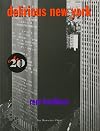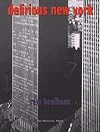
Delirious New York: A Retroactive Manifesto for Manhattan
by Rem Koolhaas
On This Page
Description
"Since its original publication in 1978, Delirious New York has attained mythic status. Back in print in a newly designed edition, this influential cultural, architectural, and social history of New York is even more popular, selling out its first printing on publication. Rem Koolhaas's celebration and analysis of New York depicts the city as a metaphor for the incredible variety of human behavior. At the end of the nineteenth century, population, information, and technology explosions made show more Manhattan a laboratory for the invention and testing of a metropolitan lifestyle -- "the culture of congestion"--And its architecture. "Manhattan," he writes, "is the 20th century's Rosetta Stone ... occupied by architectural mutations (Central Park, the Skyscraper), utopian fragments (Rockefeller Center, the U.N. Building), and irrational phenomena (Radio City Music Hall)." Koolhaas interprets and reinterprets the dynamic relationship between architecture and culture in a number of telling episodes of New York's history, including the imposition of the Manhattan grid, the creation of Coney Island, and the development of the skyscraper. Delirious New York is also packed with intriguing and fun facts and illustrated with witty watercolors and quirky archival drawings, photographs, postcards, and maps. The spirit of this visionary investigation of Manhattan equals the energy of the city itself." http://catdir.loc.gov/catdir/enhancements/fy0835/94076577-d.html. show lessTags
Recommendations



















Member Reviews
I remember reading 'The Generic City' by Rem Koolhaas (pdf) when I was a masters student and greatly enjoying it. His analysis is entertainingly idiosyncratic and yet curiously illuminating. His selective account of New York’s architectural history is likewise fragmentary yet instructive. It contains a wealth of strange anecdotes, a forest of illustrations, and several underlying theses about the nature of New York City. Inevitably, the most memorable elements are weird details, such as Gaudi’s never-built skyscraper (pictured here), everything about Dreamland on Coney Island (which deserves the many pages Koolhaas devotes to it), the 1931 costume ball at which architects dressed as the skyscrapers they designed, and Dali’s show more arrival in NYC:
Theoretical points are raised in a similar, vaguely impressionistic fashion. The concept of ‘reality shortage’ was particularly intriguing, as were the culture of congestion and the analogy between hotels and movies. Much like Lefebvre in [b:Writings on Cities|1010140|Writings on Cities|Henri Lefebvre|https://images.gr-assets.com/books/1347635147s/1010140.jpg|996264], Koolhaas is no great fan of Le Corbusier, although he discusses his views on New York in some detail. This description is both acute and comical:
The most alarming unrealised proposal in the whole book, though, is Harvey Wiley Corbett’s vision of traffic planning. He thought not only that pedestrians should be relegated to first floor walkways to leave the entire street for cars, but that the front of buildings should be cut into for additional parking and traffic lanes, culminating in twenty lane streets. Can you imagine if this dystopian scheme had materialised.
'delirious new york' is by no means a systematic or full history of its architecture and planning, nor is it meant to be. Koolhaas provides detailed insight into the antecedents of iconic buildings such as the Rockefeller Centre and a real sense of the spirit of the city in the first three decades of the twentieth century, in his inimitable style. show less
For shock effect on arrival, Dali decides to realise - retroactively - a Surrealist project originally intended to upset Paris, the baking of ‘a fifteen metre loaf of bread’.
The baker on board ship offers to bake a version 2.5 metres long (the maximum capacity of the ship’s oven) with ‘a wood armature inside it so that it would not break into two the moment it began to dry…’ But when Dali disembarks an ‘utterly disconcerting thing’ happens: “Not one of the reporters [of a waiting group] asked me a single question about the loaf of bread which I held conspicuously during the whole interview either in my arm or resting on the ground as if it was a large cane…”
The disconcerter disconcerted: Dali’s first discovery is that in Manhattan Surrealism is invisible. His Reinforced Dough is just another false act among the multitudes.
Theoretical points are raised in a similar, vaguely impressionistic fashion. The concept of ‘reality shortage’ was particularly intriguing, as were the culture of congestion and the analogy between hotels and movies. Much like Lefebvre in [b:Writings on Cities|1010140|Writings on Cities|Henri Lefebvre|https://images.gr-assets.com/books/1347635147s/1010140.jpg|996264], Koolhaas is no great fan of Le Corbusier, although he discusses his views on New York in some detail. This description is both acute and comical:
The Parisian authorities do not take the Radiant proposal seriously. Their rejection forces Le Corbusier to become a Cartesian carpetbagger, peddling his horizontal glass Skyscraper like a furious prince dragging a colossal glass slipper on an Odyssey from Metropolis to Metropolis.
The most alarming unrealised proposal in the whole book, though, is Harvey Wiley Corbett’s vision of traffic planning. He thought not only that pedestrians should be relegated to first floor walkways to leave the entire street for cars, but that the front of buildings should be cut into for additional parking and traffic lanes, culminating in twenty lane streets. Can you imagine if this dystopian scheme had materialised.
'delirious new york' is by no means a systematic or full history of its architecture and planning, nor is it meant to be. Koolhaas provides detailed insight into the antecedents of iconic buildings such as the Rockefeller Centre and a real sense of the spirit of the city in the first three decades of the twentieth century, in his inimitable style. show less
This is a non-fiction book focusing on the history of New York's architecture, explaining how this city architectually exploded into what it is now. It's from the 70's so it's not exactly up to date, and the writing style lives up to it's "delirious" title sometimes.
Not every chapter is captivating, but altogether it's a very interesting history lesson on New York. I was especially surprised by the rich history of Coney Island, considering the sad (but somehow beautiful) little beach it is nowadays.
Not every chapter is captivating, but altogether it's a very interesting history lesson on New York. I was especially surprised by the rich history of Coney Island, considering the sad (but somehow beautiful) little beach it is nowadays.
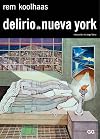
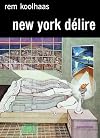
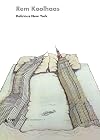
Koolhaas's immensely influential "Retroactive Manifesto" for Manhattan architecture. The dust jacket image derives from a painting by Madelon Vriesendorp, Koolhaas's wife. In it the Chrysler Building and the Empire State Building, their forms softened like a pair of Dalí watches, lie together in bed in apparent post-coital exhaustion while Rockerfeller Center, playing the jealous husband in this surreal architectural drama, emerges from a doorway at stage left and shines his spotlight onto the guilty pair.
A fun and thoughtful love letter to the greatest city in the world, Rem Koolhaus not only takes us through an architectural history of nyc (the extensive coverage of coney island is delightful) -- he also proposes some fanciful projects to the city. That Rem is one kool nutjob.
Ratings
Members
- Recently Added By
Lists

Best Architecture Books
87 works; 14 members
Author Information

100+ Works 3,148 Members
Rem Koolhaas is principal of the Office for Metropolitan Architecture, Rotterdam, and the author of Delirious New York and S,M,L,XL. He is the recipient of the 2000 Pritzker Prize. (Bowker Author Biography)
Awards and Honors
Series
Belongs to Publisher Series
Common Knowledge
- Original publication date
- 1978
- Important places
- Manhattan, New York, New York, USA
Classifications
Statistics
- Members
- 884
- Popularity
- 30,665
- Reviews
- 4
- Rating
- (4.23)
- Languages
- 8 — English, French, German, Italian, Japanese, Polish, Portuguese, Spanish
- Media
- Paper, Ebook
- ISBNs
- 18
- ASINs
- 7