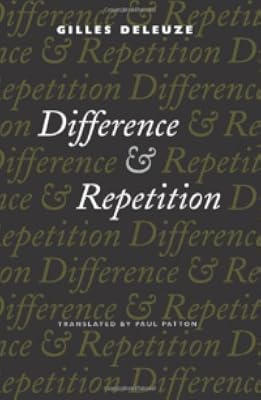
Difference and Repetition
by Gilles Deleuze
On This Page
Description
Since its publication in 1968, "Difference and Repetition", an exposition of the critique of identity, has come to be considered a contemporary classic in philosophy and one of Deleuze's most important works. The text follows the development of two central concepts, those of pure difference and complex repetition. It shows how the two concepts are related, difference implying divergence and decentring, repetition being associated with displacement and disguising. The work moves deftly show more between Hegel, Kierkegaard, Freud, Althusser and Nietzsche to establish a fundamental critique of Western metaphysics, and has been a central text in initiating the shift in French thought - away from Hegel and Marx, towards Nietzsche and Freud. show lessTags
Recommendations




















Member Reviews
la répétition forme une synthèse des temps succéssifs indépendants cette synthèse contracte les temps les uns dans les autres
Members
- Recently Added By
Lists

Best Sellers / Popular 1968
237 works; 5 members
Author Information

169+ Works 17,568 Members
Gilles Deleuze (1925-1995) was professor of philosophy at the University of Paris, Vincennes-St. Denis.
Some Editions
Awards and Honors
Notable Lists
Series
Belongs to Publisher Series
Work Relationships
Has as a reference guide/companion
Common Knowledge
- Canonical title
- Difference and Repetition
- Original title
- Différence et Repetition
- Original publication date
- 1968 (original French) (original French); 1994 (English) (English)
- Quotations
- "It is these three syntheses which must be understood as constitutive of the unconscious. They correspond to the figures of repetition which appear in the work of a great novelist: the binding, the ever renewed fine cord; the... (show all) ever displaced stain on the wall; the ever erased eraser. The repetition-binding, the repetition-stain, the repetition-eraser: the three beyonds of the pleasure principle. The first synthesis expresses the foundation of time upon the basis of a living present, a foundation which endows pleasure with its value as a general empirical principle to which is subject the content of the psychic life in the Id. The second synthesis expresses the manner in which time is grounded in a pure past, a ground which conditions the application of the pleasure principle to the contents of the Ego. The third synthesis, however, refers to the absence of ground into which we are precipitated by the ground itself: Thanatos appears in third place as this groundlessness, beyond the ground of Eros and the foundation of Habitus. He therefore has a disturbing kind of relation with the pleasure principle which is often expressed in the unfathomable paradoxes of a pleasure linked to pain (when in fact it is a question of something else altogether: the desexualisation which operates in this third synthesis, in so far as it inhibits the application of the pleasure principle as the prior directive idea in order then to proceed to a resexualisation in which pleasure is invested only in a pure, cold, apathetic and frozen thought, as we see in the cases of sadism and masochism). In one sense the third synthesis unites all the dimensions of time, past, present and future, and causes them to be played out in the pure form. In another sense it involves their reorganisation, since the past is treated in function of a totality of time as the condition by default which characterises the Id, while the present is defined by the metamorphosis of the agent in the ego ideal. In a third sense, finally, the ultimate synthesis concerns only the future, since it announces in the superego the destruction of the Id and the ego, of the past as well as the present, of the condition and the agent. At this extreme point the straight line of time forms a circle again, a singularly tortuous one; or alternatively, the death instinct reveals an unconditional truth hidden in its „other” face – namely, the eternal return in so far as this world which has rid itself of the default of the condition and the equality of the agent in order to affirm only the excessive and the unequal, the extreme formality. This is how the story of time ends: by undoing its too well centred natural or physical circle and forming a straight line which then, led by its own length, reconstitutes an eternally decentred circle." (140-1)
Classifications
Statistics
- Members
- 1,091
- Popularity
- 23,511
- Reviews
- 1
- Rating
- (4.27)
- Languages
- 15 — Chinese, Dutch, English, Estonian, French, German, Italian, Japanese, Polish, Portuguese, Romanian, Russian, Serbian, Spanish, Turkish
- Media
- Paper, Ebook
- ISBNs
- 34
- ASINs
- 5