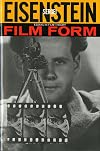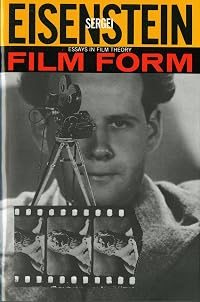
Film Form: Essays in Film Theory
by Sergei Eisenstein
On This Page
Description
A classic on the aesthetics of filmmaking from the pioneering Soviet director who made Battleship Potemkin. Though he completed only a half-dozen films, Sergei Eisenstein remains one of the great names in filmmaking, and is also renowned for his theory and analysis of the medium. Film Form collects twelve essays, written between 1928 and 1945, that demonstrate key points in the development of Eisenstein's film theory and in particular his analysis of the sound-film medium. Edited, show more translated, and with an introduction by Jay Leyda, this volume allows modern-day film students and fans to gain insights from the man who produced classics such as Alexander Nevsky and Ivan the Terrible and created the renowned "Odessa Steps" sequence. show lessTags
Recommendations









Member Reviews
Sergei Eisenstein is a brilliant film theorist many consider to be the father of modern film theory. His work has inspired thinking from the early days of cinema and is still one of the most respected and drawn upon arguments about film today. His essays, more than any other theorist, attempts to create a set of tools that film viewers can use to read films as texts. Eisenstein was a forward thinker about film as a textual medium with meaning beyond the literal level. He draws on many literary elements to explain how we should read film, but his work with the Haiku is the metaphor that resonates most with me. Haiku is juxtapositional poetry, as is film in the brilliant mind of Eisenstein. I think film belongs in an english classroom, show more and I think that Eisenstein is the ticket to take film from a movie day break in the schedule where kids come to class and zone out from the work they have been doing recently, to something rigorous, challenging, and inspiring. show less
Ratings
Members
- Recently Added By
Lists

Film
114 works; 1 member

In Our Time books
4,934 works; 2 members
Author Information

128+ Works 2,070 Members
Potemkin, a silent film that appeared in 1925, was the great Russian film director's first brilliant "mass epic," originally commissioned just after the 1917 Russian Revolution to commemorate the 1905 anti-Czarist uprising. In it Eisenstein broke new ground in the cinema with his anti-narrative technique of "shock-attraction," or dialectical, show more montage---a series of shots in which each pair being spliced gives rise to a collision of images, thereby creating a sharp impression, or synthesis, in the viewer's mind. Eisenstein (who had been an engineer before he became a film director) compared this technique to the series of explosions made by an internal combustion engine driving a vehicle forward---just so, the famous sequence of slaughter on the Odessa steps and the slow descent of a baby in its carriage through the carnage drives Potemkin forward. Dynamic cutting is again evident in Ten Days That Shook the World (1928), in which he uses slowly mounting sequences and fast cuts to depict the gathering storm of the Russian Revolution and its ultimate triumph. Despite his glorification of the Russian Revolution and the new Soviet state, Eisenstein often found himself at odds with the Soviet government. For a while he even attempted to work in Hollywood, but he returned to Russia to make Alexander Nevsky (1938), his most popular film, and Ivan the Terrible, which he envisioned as a three-part epic. Part I (1944) was completed and released, Part II was withheld at first by the Soviet Film Trust and then later released, and Eisenstein died of a heart attack while working on Part III. (Bowker Author Biography) show less
Awards and Honors
Notable Lists
Series
Belongs to Publisher Series
Work Relationships
Is contained in
Common Knowledge
- Original title
- Film Form
Classifications
Statistics
- Members
- 470
- Popularity
- 64,654
- Reviews
- 1
- Rating
- (4.16)
- Languages
- 7 — English, Finnish, Italian, Portuguese, Russian, Spanish, Turkish
- Media
- Paper, Ebook
- ISBNs
- 10
- ASINs
- 4