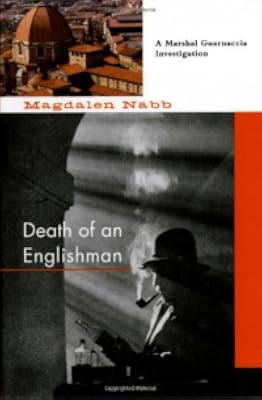
On This Page
Description
It is just before Christmas and the marshal wants to go South to spend the holiday with his wife and family, but first he must recover from the flu (which has left the Florentine caribinieri short-handed) and also solve a murder. A seemingly respectable retired Englishman, living in a flat on the Via Maggio near the Santa Trinita bridge, was shot in the back during the night. He was well-connected and Scotland Yard has despatched two officers to "assist" the Italians in solving the crime. show more But it is the marshal, a quiet observer, not an intellectual, who manages to figure out what happened, and why. show lessTags
Recommendations












Member Reviews
It’s a few days before Christmas and all Marshal Salvatore Guarnaccia, a Sicilian based in Florence, wants to do is travel south to spend the holiday with his family. But he is in bed sick with the flu. The city's police stations are understaffed due to the impending holidays and anyway Pitti station usually only has minor crimes to deal with, so when a call comes through about a murder Carabinieri Bacci, a young cadet still at police school, is unsure whether to wake the Marshal or begin investigating himself. Bacci is always impeccably dressed, well intentioned and knows all the textbook procedures has absolutely no practical experience.
When Bacci arrives alone at a small apartment complex he discovers the body of Mr. show more Langley-Smythe, a seemingly respectable English bachelor who had previously worked for the British embassy in Rome before retiring to Florence. More puzzling however, is an ancient Roman majolica bust found nearby and a safe filled with various foreign banknotes. Langley-Smythe was an apparent reclusive miser with no known friends or enemies, so who shot him in the back and where did all the money come from?
Being a British citizen with some influential family members two detectives from New Scotland Yard are sent to assist in the investigation. The British detectives have very limited Italian language skills whilst Bacci's Captain speaks no English at all so Bacci is kept on the investigation to act as an interpreter.
Initially it seemed somewhat disconcerting that Guarnaccia is pretty well permanently laid up in bed and has very little involvement in the actual investigation given that he is supposedly the central figure of these books. Initially we only see him through Bacci's eyes, who regards him as an obese old man with possible Mafia links. But as the book reaches its climax we see Guarnaccia in a very different light, as a sensitive man and a good detective.
It's always interesting to see how different cultures react to one another when thrown together in a situation, throw in the added complication of a language barrier and you have the ingredients of an interesting tale, and Nabb seems to have been a keen observer.
There is a real motley crew of neighbours living in the victim's apartment block who add both colour and humour. We are shown the role of Italian night guards, given a glimpse into the relations between the North and the South of the country, the shady world of illegal antique exports and Nabb takes a sly poke at British ex-pats who live in the country without bothering to try to learn the language or the food. But the most important element is the city itself. You can almost visualise its narrow streets with its once grand buildings now struggling under the ravages of modern traffic.
In truth I'm not a real fan of detective novels but it felt like a homage to the Sherlock Holmes' novels, where others do all the grunt work and then Holmes or in this case Guarniccia with a piece of insight solves the crime. This also had the distinction that come the end of the book I felt that the murderer was the real victim here.
I found this a quick, entertaining read with some interesting characters. I'm curious to learn more about the Marshal and I cannot help but feel that Nabb was only testing the water with this book so surely those that follow must be even better so consequently I will be keeping my eyes peeled for the next book in the series. show less
When Bacci arrives alone at a small apartment complex he discovers the body of Mr. show more Langley-Smythe, a seemingly respectable English bachelor who had previously worked for the British embassy in Rome before retiring to Florence. More puzzling however, is an ancient Roman majolica bust found nearby and a safe filled with various foreign banknotes. Langley-Smythe was an apparent reclusive miser with no known friends or enemies, so who shot him in the back and where did all the money come from?
Being a British citizen with some influential family members two detectives from New Scotland Yard are sent to assist in the investigation. The British detectives have very limited Italian language skills whilst Bacci's Captain speaks no English at all so Bacci is kept on the investigation to act as an interpreter.
Initially it seemed somewhat disconcerting that Guarnaccia is pretty well permanently laid up in bed and has very little involvement in the actual investigation given that he is supposedly the central figure of these books. Initially we only see him through Bacci's eyes, who regards him as an obese old man with possible Mafia links. But as the book reaches its climax we see Guarnaccia in a very different light, as a sensitive man and a good detective.
It's always interesting to see how different cultures react to one another when thrown together in a situation, throw in the added complication of a language barrier and you have the ingredients of an interesting tale, and Nabb seems to have been a keen observer.
There is a real motley crew of neighbours living in the victim's apartment block who add both colour and humour. We are shown the role of Italian night guards, given a glimpse into the relations between the North and the South of the country, the shady world of illegal antique exports and Nabb takes a sly poke at British ex-pats who live in the country without bothering to try to learn the language or the food. But the most important element is the city itself. You can almost visualise its narrow streets with its once grand buildings now struggling under the ravages of modern traffic.
In truth I'm not a real fan of detective novels but it felt like a homage to the Sherlock Holmes' novels, where others do all the grunt work and then Holmes or in this case Guarniccia with a piece of insight solves the crime. This also had the distinction that come the end of the book I felt that the murderer was the real victim here.
I found this a quick, entertaining read with some interesting characters. I'm curious to learn more about the Marshal and I cannot help but feel that Nabb was only testing the water with this book so surely those that follow must be even better so consequently I will be keeping my eyes peeled for the next book in the series. show less
At first, I was somewhat stunned when I realized that most of the action in this book would take place while the marshal-- the main character-- is flat on his back in bed. But then I fell under the spell of Magdalen Nabb's Florence. This slim volume contains an entire feast of the streets and neighborhoods of the city, of the Italian way of life, of the keen observation of people's behavior and habits, that I willingly let Guaraccia recuperate while I did my own observing and putting clues together.
Part of the magic of this book is having two Scotland Yard detectives working with the Italian caribinieri. There is the difficulty of not speaking each other's language as well as the differences in investigative procedures. While I watched show more this group of policemen slowly piece together facts that show the deceased Englishman wasn't as respectable as they first thought, I put together what I'd observed. Nabb is masterful at using Conan Doyle's Holmes and Watson Method: the Italian and British police being Watson, the marshal being Holmes, and the reader somewhere between the two.
First published in 1981, Death of an Englishman, isn't a foray into the dazzling science of forensics. This is a mystery for those who like to observe, ponder and arrive at their own conclusions. How close your deductions are to the author's solution depends on how well you've observed and pondered a disparate group of people all living in the same old apartment building. A batty old Englishwoman operating her own museum, a husband who always seems to be coming home during the wee hours of the morning, a high-spirited little girl (who reminded me more than a little of "The Ransom of Red Chief"), and several more should provide readers with everything they need to know... but it's not until Marshal Salvatore Guaraccia has recuperated sufficiently that everything falls into place. He proves that there's scarcely a thing that can escape his eagle eye.
The setting, the characters, the intricately constructed plot with its touches of humor and compassion... Death of an Englishman is a leisurely-paced book that I enjoyed even more than I'd anticipated. I look forward to returning to Florence and observing the marshal in the future. show less
Part of the magic of this book is having two Scotland Yard detectives working with the Italian caribinieri. There is the difficulty of not speaking each other's language as well as the differences in investigative procedures. While I watched show more this group of policemen slowly piece together facts that show the deceased Englishman wasn't as respectable as they first thought, I put together what I'd observed. Nabb is masterful at using Conan Doyle's Holmes and Watson Method: the Italian and British police being Watson, the marshal being Holmes, and the reader somewhere between the two.
First published in 1981, Death of an Englishman, isn't a foray into the dazzling science of forensics. This is a mystery for those who like to observe, ponder and arrive at their own conclusions. How close your deductions are to the author's solution depends on how well you've observed and pondered a disparate group of people all living in the same old apartment building. A batty old Englishwoman operating her own museum, a husband who always seems to be coming home during the wee hours of the morning, a high-spirited little girl (who reminded me more than a little of "The Ransom of Red Chief"), and several more should provide readers with everything they need to know... but it's not until Marshal Salvatore Guaraccia has recuperated sufficiently that everything falls into place. He proves that there's scarcely a thing that can escape his eagle eye.
The setting, the characters, the intricately constructed plot with its touches of humor and compassion... Death of an Englishman is a leisurely-paced book that I enjoyed even more than I'd anticipated. I look forward to returning to Florence and observing the marshal in the future. show less
In this first novel in the series Marshall Guarnaccia hardly appears at all. He spends most of the novel confined to bed in a fever. In the end he solves the murder from within his fever dreams, while everyone else is solving another crime that they believe will lead them to the solution of the murder. The points most interesting about this novel is not the murder mystery but the way it shows the regional and class tensions between Florentines and Southern Italians; the feel it has for the combination of worldliness and claustrophobia of the Florentine streets and apartments; and the comical British who seem to arrive from the Island of the clueless to settle into the city of Machiavellian alleys and Renaissance beauty.
This mystery is set in Florence where the author lived for a long time. Marshall Guarnaccia has 'flu and the murder of an Englishman must be investigated by his superior assisted by two Scotland Yard detectives who speak little Italian and Carabineire Bacci who is able to translate. A very enjoyable mystery set at Christmas without being sugary, and featuring well developed characters and an engaging story.
1st in the Marshal Guarnaccia series.
Magdalen Nabb’s superb Italian police procedural series, set in Florence, has only relatively recently been reissued by SoHo Crime press. For a long time, the books were out of print. Upon re-issue, the series began to be advertised as the Marshal Guarnaccia series, based on the emergence of Guarnaccia, in later books, as a most engaging protagonist.
In truth, the first books did not especially feature Guarnaccia. In this, the first, Guarnaccia, the Marshal of the carabinieri station at the Pitti Palace in Florence, is down with a severe case of ‘flu and does not make a real appearance in the book until nearly two-thirds of the way into the story; occasional cameo appearances of him trying to show more cope with his illness while struggling to understand what is happening on the murder of an Englishman are limited to a few lines.
Instead, the major players are his immediate superior, “the Captain”, whom we will meet in later books as Captain Maestrangelo, and two inspectors from Scotland Yard who are in Florence to represent the interests of the dead Englishman’s well-connected family. Some other important characters: Carabineire Bacci, first on the murder scene and whose English language abilities earn him an important translator’s role, and a brash little girl, fond of pistols, who turns out to be an important witness.
Although late on the scene, it is Guarnaccia the Sicilian, ponderous, slow, but who understands and empathizes with the “ordinary people “ of his Quarter and their “little problems”, who solves the case.
Though not especially her best book, even this first installment contains what will become the hallmarks of the series: understated writing, excellent characterizations, realistic dialogue, an unusually empathetic protagonist, and Florence itself, alive and well, as an integral part of the story. The denouement is a surprise, and the ending, as Guarnaccia is on his way home by train to visit his family over the Christmas holidays, is quietly satisfying.
An excellent start to the series. Highly recommended. show less
Magdalen Nabb’s superb Italian police procedural series, set in Florence, has only relatively recently been reissued by SoHo Crime press. For a long time, the books were out of print. Upon re-issue, the series began to be advertised as the Marshal Guarnaccia series, based on the emergence of Guarnaccia, in later books, as a most engaging protagonist.
In truth, the first books did not especially feature Guarnaccia. In this, the first, Guarnaccia, the Marshal of the carabinieri station at the Pitti Palace in Florence, is down with a severe case of ‘flu and does not make a real appearance in the book until nearly two-thirds of the way into the story; occasional cameo appearances of him trying to show more cope with his illness while struggling to understand what is happening on the murder of an Englishman are limited to a few lines.
Instead, the major players are his immediate superior, “the Captain”, whom we will meet in later books as Captain Maestrangelo, and two inspectors from Scotland Yard who are in Florence to represent the interests of the dead Englishman’s well-connected family. Some other important characters: Carabineire Bacci, first on the murder scene and whose English language abilities earn him an important translator’s role, and a brash little girl, fond of pistols, who turns out to be an important witness.
Although late on the scene, it is Guarnaccia the Sicilian, ponderous, slow, but who understands and empathizes with the “ordinary people “ of his Quarter and their “little problems”, who solves the case.
Though not especially her best book, even this first installment contains what will become the hallmarks of the series: understated writing, excellent characterizations, realistic dialogue, an unusually empathetic protagonist, and Florence itself, alive and well, as an integral part of the story. The denouement is a surprise, and the ending, as Guarnaccia is on his way home by train to visit his family over the Christmas holidays, is quietly satisfying.
An excellent start to the series. Highly recommended. show less
Rarely do I give a series opener higher than 3.5 points, but this one is well worth the extra ratings point. This first entry was very well written, so much so that I bought a copy of the 2nd installment in the series, which is out of print and so cost some $. It was worth it...generally I've found that series mysteries only get better after the first one.
On to this one:
It's Christmas, and everyone in Florence is rushing off to go somewhere for the holidays, including Marshal Salvatore Guarnaccia, who is planning a trip to Sicily to see his family. He is quite ill, however, with a flu or something, and as such, has to be in Florence longer than he'd planned. One night while sleeping through a raging fever, the telephone rings in his show more office, to be answered by a member of the carbiniere who was answering phones for Guarnaccia while he is ill. There is a voice on the other end saying that an Englishman had been killed. The carbinieri does not want to wake the Marshal, so he goes himself to the crime scene where he finds an Englishman who is dead from a gunshot to the back. The question is who shot the Englishman and why? Why was this so important that Scotland Yard send out two of its own to investigate?
A very good mystery story that I highly recommend. show less
On to this one:
It's Christmas, and everyone in Florence is rushing off to go somewhere for the holidays, including Marshal Salvatore Guarnaccia, who is planning a trip to Sicily to see his family. He is quite ill, however, with a flu or something, and as such, has to be in Florence longer than he'd planned. One night while sleeping through a raging fever, the telephone rings in his show more office, to be answered by a member of the carbiniere who was answering phones for Guarnaccia while he is ill. There is a voice on the other end saying that an Englishman had been killed. The carbinieri does not want to wake the Marshal, so he goes himself to the crime scene where he finds an Englishman who is dead from a gunshot to the back. The question is who shot the Englishman and why? Why was this so important that Scotland Yard send out two of its own to investigate?
A very good mystery story that I highly recommend. show less
The first in the Marshal Guarnaccia series makes a promising start. Set in Florence, the marshal wants nothing more than to head home to Sicily for the Christmas holidays but is laid low with the flu. Desperately trying to recover in order that he may return to his family for the holidays, he is called out to a murder site... an Englishman had been shot in the back, the murder weapon is missing and there are no apparent clues.
It turns out the man is from a well-connected family in England, and Scotland Yard dispatches 2 of its own to Florence to work with the local police in solving this mystery.
With an interesting cast of characters and possible suspects, we are led a merry chase, but it's the marshal's quiet observations that solve show more the case. show less
It turns out the man is from a well-connected family in England, and Scotland Yard dispatches 2 of its own to Florence to work with the local police in solving this mystery.
With an interesting cast of characters and possible suspects, we are led a merry chase, but it's the marshal's quiet observations that solve show more the case. show less
Members
- Recently Added By
Author Information

30+ Works 3,187 Members
Magdalen Nabb 1947 - 2007 Children's author and crime writer Magdalen Nabb was born in Lancashire, England on January 16, 1947. She is the author of the Salvatore Guarnaccia series and the Josie Smith books. Her book Josie Smith was runner-up for the Guardian Children's Fiction Award in 1989 and Josie Smith and Eileen won the Smarties Book Prize show more in l99l. Occasionally she writes journalistic pieces for English, German, and Italian newspapers. Her final novel, Vita Nuova, was posthumously published in 2008. She died because of a stroke while in Florence, Italy, on August 18, 2007. She was 60 years old. (Bowker Author Biography) show less
Awards and Honors
Series

Belongs to Publisher Series
Work Relationships
Common Knowledge
- Canonical title
- Death of an Englishman
- Original title
- Death of an Englishman
- Original publication date
- 1982
- People/Characters
- Marshal Guarnaccia
- Important places
- Florence, Tuscany, Italy
- First words
- The small office was in darkness, except where the red night lamp stood by the telephone on the desk, and the white kid gloves lying on top of a sheaf of papers within the patch of light were flushed pink.
- Last words
- (Click to show. Warning: May contain spoilers.)And he bent over the photograph without noticing the other's amazed expression as he gaped from the Marshal's face to the window where the floodlit domes and towers of Florence were receding into the night.
Classifications
Statistics
- Members
- 496
- Popularity
- 60,888
- Reviews
- 22
- Rating
- (3.29)
- Languages
- 10 — Dutch, English, French, German, Hebrew, Italian, Japanese, Polish, Portuguese (Brazil), Portuguese (Portugal)
- Media
- Paper, Audiobook, Ebook
- ISBNs
- 19
- ASINs
- 6