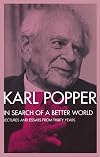
In Search of a Better World: Lectures and Essays from Thirty Years
by Karl Popper
206 Members (3.97)
On This Page
Description
'I want to begin by declaring that I regard scientific knowledge as the most important kind of knowledge we have', writes Sir Karl Popper in the opening essay of this book, which collects his meditations on the real improvements science has wrought in society, in politics and in the arts in the course of the twentieth century. His subjects range from the beginnings of scientific speculation in classical Greece to the destructive effects of twentieth century totalitarianism, from major show more figures of the Enlightenment such as Kant and Voltaire to the role of science and self-criticism in the arts. The essays offer striking new insights into the mind of one of the greatest twentieth century philosophers. show lessTags
Recommendations





















Member Reviews
Members
- Recently Added By
Author Information

122+ Works 11,112 Members
Although he writes widely in philosophy, Sir Karl Raimund Popper is best known for his thesis that an empirical statement is meaningless unless conditions can be specified that could show it to be false. He was born and educated in Vienna, where he was associated with, although not actually a member of, the Vienna Circle. Two years after the show more German publication of his Logic of Scientific Discovery (1935), he left Austria for New Zealand, where he was senior lecturer at the University of Canterbury. In 1945 he moved to England and began a distinguished career at the London School of Economics and Political Science. According to Popper, there is no "method of discovery" in science. His view holds that science advances by brilliant but unpredictable conjectures that then stand up well against attempts to refute them. This view was roundly criticized by more dogmatic positivists, on the one hand, and by Feyerabend and Kuhn, on the other. In 1945 he published The Open Society and Its Enemies, which condemns Plato, Georg Hegel, and Karl Marx as progenitors of totalitarianism and opponents of freedom. The scholarship that underpins this book remains controversial. Popper's later works continue his interest in philosophy of science and also develop themes in epistemology and philosophy of mind. He is particularly critical of historicism, which he regards as an attitude that fosters a deplorable tendency toward deterministic thinking in the social sciences. (Bowker Author Biography) show less
Series
Belongs to Publisher Series
Classifications
Statistics
- Members
- 206
- Popularity
- 159,349
- Rating
- (3.97)
- Languages
- 8 — English, French, German, Italian, Japanese, Portuguese, Slovak, Spanish
- Media
- Paper, Ebook
- ISBNs
- 18
- ASINs
- 2