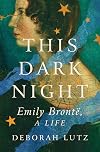
This Dark Night: Emily Bronte, a Life
by Deborah Lutz
On This Page
Recommendations










Member Reviews
Coarse, strange, disagreeable went the general consensus–too gloomy, savage, and eccentric. from This Dark Night
“It’s as if her readers hadn’t caught up with her yet,” Deborah Lutz writes, “It would take close to a hundred years for that to happen.”
Emily Bronte’s novel Wuthering Heights grew out of the Bronte siblings’ years of story spinning. The isolated children were each other’s best friends and playmates and spent years creating a make believe world. Even into adulthood, Emily lived in two worlds–the everyday filled with household chores, and the imagined world of Gondor. She wrote poems inspired by the characters and incidents in that make believe place.
Emily may have had only one year of formal schooling, show more but she was brilliant, and she was brave and fearless. She was drawn to nature and animals, inspired by both beauty and the power of destruction.
All of those years of world-building had finally come to fruition. from This Dark Night
Her novel of passion, obsession, and violence can still shock today.
The child Heathcliff, “dark almost as if it came from the devil”, clearly foreign, referred to as an ‘it’. His adopted father’s favorite, upon the father’s death he is relegated to low servanthood by the heir. Heathcliff and Cathy share a wildness, but Cathy is seduced into polite society and marriage to another. Heathcliff’s spurned love and rejection fuels his vengeance and retribution.
After Emily’s death, the sole surviving sibling Charlotte edited and revised Wuthering Heights, twisting it into conformity. She also changed Emily’s poems, undercutting “their doubting nature.”
Emily’s life was short, and the bulk of her work was related to the Gondor world. All of the Bronte sisters died too young, and we regret the books they may have written. Charlotte was the most popular selling of them all, but after reading this biography, it is Emily who I regret the most.
Thanks to the publisher for a free book through NetGalley. show less
“It’s as if her readers hadn’t caught up with her yet,” Deborah Lutz writes, “It would take close to a hundred years for that to happen.”
Emily Bronte’s novel Wuthering Heights grew out of the Bronte siblings’ years of story spinning. The isolated children were each other’s best friends and playmates and spent years creating a make believe world. Even into adulthood, Emily lived in two worlds–the everyday filled with household chores, and the imagined world of Gondor. She wrote poems inspired by the characters and incidents in that make believe place.
Emily may have had only one year of formal schooling, show more but she was brilliant, and she was brave and fearless. She was drawn to nature and animals, inspired by both beauty and the power of destruction.
All of those years of world-building had finally come to fruition. from This Dark Night
Her novel of passion, obsession, and violence can still shock today.
The child Heathcliff, “dark almost as if it came from the devil”, clearly foreign, referred to as an ‘it’. His adopted father’s favorite, upon the father’s death he is relegated to low servanthood by the heir. Heathcliff and Cathy share a wildness, but Cathy is seduced into polite society and marriage to another. Heathcliff’s spurned love and rejection fuels his vengeance and retribution.
After Emily’s death, the sole surviving sibling Charlotte edited and revised Wuthering Heights, twisting it into conformity. She also changed Emily’s poems, undercutting “their doubting nature.”
Emily’s life was short, and the bulk of her work was related to the Gondor world. All of the Bronte sisters died too young, and we regret the books they may have written. Charlotte was the most popular selling of them all, but after reading this biography, it is Emily who I regret the most.
Thanks to the publisher for a free book through NetGalley. show less
As I might have mentioned in previous reviews, Emily Bronte is my girl. I am 100% Team Emily, and I even have a badge from the Parsonage to prove it. Not only do we share a birthday - along with Kate Bush - but a birthplace (well, close enough) and an approach to life. I have read other biographies of Emily, most notably Edward Chatham's brief and factual epitome, and was of course drawn to this new title. I had the hardback on pre-order, before reading very mixed reviews, and then I decided to err on the side of caution and listen for 'free' on Audible, my cheat for new titles I don't want to pay for. (The voice artist was fair, apart from her West Country 'Yorkshire' accent and struggle with local place names.)
Were the less glowing show more reviews that put me off accurate? As the author acknowledges, little is known of Emily as almost none of her papers, personal or fictional survive, and so any biography of her inevitably falls into two traps: guesswork and supposition, mostly based on her writing, and including the whole family to pad out Emily's story. Deborah Lutz does both, and includes yet more filler in the form of long, drawn out passages about 'Bronte's time and her place in it' and 'the texture of her days'. So we get descriptions of Emily washing herself in the morning and lists of sites the family 'might have' viewed while passing through London. 'Probably', 'may have' and 'why not both?' do a lot of heavy lifting throughout, as do modern interpretations of Victorian women's lives, as is noted in the foreword - forewarned is forearmed, I suppose.
One review mentioned that this is a biography for Bronte enthusiasts rather than the general reader, which I would most wholeheartedly refute. The author feels the need to explain not only that Charlotte wrote Jane Eyre but also that the plot of Wuthering Heights needs recounting. And as the whole family are packed in, plus many familiar 'anecdotes' like the collapse of the peat bog, Patrick firing his gun every morning and Emily being bitten by a dog, no background expertise is required. Fans of the 2026 adaptation of "Wuthering Heights", for example, who eagerly sought out the novel after watching the movie, expecting a romance but finding a complex gothic generational horror story written in 'old English', are probably the target demographic.
The rest is supposition and wild speculation - in that, a little background knowledge would probably help in sorting the wheat from the chaff. To borrow Virginia Woolf's words from the author, Lutz is very keen to 'free life from its dependence on facts'. For a start, apparently everything the Brontës said or did is tied to the deaths of their mother and two elder sisters, 'despite the fact that [Emily] may not consciously have remembered it'. Lutz has a morbid fascination with the family crypt in St Michael's, Haworth, despite that being Patrick's church; she talks about Emily witnessing the crypt being reopened and burials in the churchyard like she was surrounded by corpses and coffins didn't exist (and this is obviously what inspired Heathcliff digging up Catherine's perfectly preserved body).
Other leaps in logic are made and then questioned - Emily's drawing of a window in which 'some claim to see a hand emerging, especially when the drawing is inverted'; a juvenilia poem of Charlotte's suggesting that 'Emily overindulged [in her aunt's store of alcohol] when the adults weren't looking'; Emily 'may have' been introduced to Anne Lister while working at Law Hill, while her claims of being treated like a slave there were obviously exaggerated (yet Cowan Bridge must have been reported accurately); and every word written by Emily of course need have some psychological significance, at the same time as 'these poems might have nothing to do with Emily's emotional make-up'. The author's constant dance of two leaps forward and one step back made me wonder if she wasn't channelling Elizabeth 'National Enquirer' Gaskell, who did the very same thing to Charlotte.
The attention-grabbing theories that really annoyed me, and which could belong to Bronte 'scholars' or the author herself, include Emily being 'banished' to Roe Head - where Charlotte was already teaching - because 'she may have become romantically entangled with a young man - or a young woman'! There is absolutely no evidence that Emily ever had a romance with either sex, but Lutz claims that Patrick asking Elizabeth Firth to look out for his daughters and Emily making herself ill, which even Charlotte knew was homesickness, proves that she was 'in exile' there. Or to employ Lutz's favourite phrase, 'But it could also be both.'
Lutz then doubles down and throws in a possible 'romantic attachment with a fellow teacher' at Law Hill because of a poem - written as part of Emily's Gondal fantasy, not reality - and also that 'it's tempting to imagine that Emily and Anne Lister met', while acknowledging that they were in no way part of the same social scene.
Branwell also gets a target slapped on his back from a letter to sexton John Brown - yes, the same one who sold out the family after Charlotte's death to cash in on Gaskell's book - where he teases his friend about his 'manhood'. But then, Branwell was also 'having sex and getting female servants pregnant'.
Every statement and event in this book has the potential to be a scandal or a gothic trope. Stories are always been told about Emily, and the family become part of local legend, as with the quite plainly false accusation that Emily beat her dog about the head to teach him a lesson (Gaskell, again), when she loved animals more than people. Ponden Kirk means 'the devil's church', while Halifax is not 'an area of coarse grass in a nook of land' but a fanciful tale about a young virgin being beheaded and her hair turning into trees. Or something. Emily was obsessed with Satan! She had a 'weird, witchy and violent' sense of humour!
The bones of Emily Bronte, apologies for the gothic imagery, are there, but buried under fanciful claims, oft repeated lore, and modern interpretations. To use another quote from the introduction, this biography is 'a collection of holes tied together with string'. We also get entire chapters dedicated to Charlotte in Roe Head/Brussels, and lengthy and unnecessary synopses of Wuthering Heights. I loved reading about Emily's forthright nature and 'not suffering fools gladly', her 'regularity papers' and fair copy notebooks, the way she would slip into a room with company, grab her book and walk out without speaking, her love of animals, and details of some of the papers recovered from the Honresfield Library - that's my Emily. Not autistic, not disabled, just not willing to play the game, like Charlotte. She died young and yet still suffers, from her own sister's bowdlerisation of her writing, and now shallow adaptations of her novel, misogynistic biopics and glory seeking biographies. Leave her alone! show less
Were the less glowing show more reviews that put me off accurate? As the author acknowledges, little is known of Emily as almost none of her papers, personal or fictional survive, and so any biography of her inevitably falls into two traps: guesswork and supposition, mostly based on her writing, and including the whole family to pad out Emily's story. Deborah Lutz does both, and includes yet more filler in the form of long, drawn out passages about 'Bronte's time and her place in it' and 'the texture of her days'. So we get descriptions of Emily washing herself in the morning and lists of sites the family 'might have' viewed while passing through London. 'Probably', 'may have' and 'why not both?' do a lot of heavy lifting throughout, as do modern interpretations of Victorian women's lives, as is noted in the foreword - forewarned is forearmed, I suppose.
One review mentioned that this is a biography for Bronte enthusiasts rather than the general reader, which I would most wholeheartedly refute. The author feels the need to explain not only that Charlotte wrote Jane Eyre but also that the plot of Wuthering Heights needs recounting. And as the whole family are packed in, plus many familiar 'anecdotes' like the collapse of the peat bog, Patrick firing his gun every morning and Emily being bitten by a dog, no background expertise is required. Fans of the 2026 adaptation of "Wuthering Heights", for example, who eagerly sought out the novel after watching the movie, expecting a romance but finding a complex gothic generational horror story written in 'old English', are probably the target demographic.
The rest is supposition and wild speculation - in that, a little background knowledge would probably help in sorting the wheat from the chaff. To borrow Virginia Woolf's words from the author, Lutz is very keen to 'free life from its dependence on facts'. For a start, apparently everything the Brontës said or did is tied to the deaths of their mother and two elder sisters, 'despite the fact that [Emily] may not consciously have remembered it'. Lutz has a morbid fascination with the family crypt in St Michael's, Haworth, despite that being Patrick's church; she talks about Emily witnessing the crypt being reopened and burials in the churchyard like she was surrounded by corpses and coffins didn't exist (and this is obviously what inspired Heathcliff digging up Catherine's perfectly preserved body).
Other leaps in logic are made and then questioned - Emily's drawing of a window in which 'some claim to see a hand emerging, especially when the drawing is inverted'; a juvenilia poem of Charlotte's suggesting that 'Emily overindulged [in her aunt's store of alcohol] when the adults weren't looking'; Emily 'may have' been introduced to Anne Lister while working at Law Hill, while her claims of being treated like a slave there were obviously exaggerated (yet Cowan Bridge must have been reported accurately); and every word written by Emily of course need have some psychological significance, at the same time as 'these poems might have nothing to do with Emily's emotional make-up'. The author's constant dance of two leaps forward and one step back made me wonder if she wasn't channelling Elizabeth 'National Enquirer' Gaskell, who did the very same thing to Charlotte.
The attention-grabbing theories that really annoyed me, and which could belong to Bronte 'scholars' or the author herself, include Emily being 'banished' to Roe Head - where Charlotte was already teaching - because 'she may have become romantically entangled with a young man - or a young woman'! There is absolutely no evidence that Emily ever had a romance with either sex, but Lutz claims that Patrick asking Elizabeth Firth to look out for his daughters and Emily making herself ill, which even Charlotte knew was homesickness, proves that she was 'in exile' there. Or to employ Lutz's favourite phrase, 'But it could also be both.'
Lutz then doubles down and throws in a possible 'romantic attachment with a fellow teacher' at Law Hill because of a poem - written as part of Emily's Gondal fantasy, not reality - and also that 'it's tempting to imagine that Emily and Anne Lister met', while acknowledging that they were in no way part of the same social scene.
Branwell also gets a target slapped on his back from a letter to sexton John Brown - yes, the same one who sold out the family after Charlotte's death to cash in on Gaskell's book - where he teases his friend about his 'manhood'. But then, Branwell was also 'having sex and getting female servants pregnant'.
Every statement and event in this book has the potential to be a scandal or a gothic trope. Stories are always been told about Emily, and the family become part of local legend, as with the quite plainly false accusation that Emily beat her dog about the head to teach him a lesson (Gaskell, again), when she loved animals more than people. Ponden Kirk means 'the devil's church', while Halifax is not 'an area of coarse grass in a nook of land' but a fanciful tale about a young virgin being beheaded and her hair turning into trees. Or something. Emily was obsessed with Satan! She had a 'weird, witchy and violent' sense of humour!
The bones of Emily Bronte, apologies for the gothic imagery, are there, but buried under fanciful claims, oft repeated lore, and modern interpretations. To use another quote from the introduction, this biography is 'a collection of holes tied together with string'. We also get entire chapters dedicated to Charlotte in Roe Head/Brussels, and lengthy and unnecessary synopses of Wuthering Heights. I loved reading about Emily's forthright nature and 'not suffering fools gladly', her 'regularity papers' and fair copy notebooks, the way she would slip into a room with company, grab her book and walk out without speaking, her love of animals, and details of some of the papers recovered from the Honresfield Library - that's my Emily. Not autistic, not disabled, just not willing to play the game, like Charlotte. She died young and yet still suffers, from her own sister's bowdlerisation of her writing, and now shallow adaptations of her novel, misogynistic biopics and glory seeking biographies. Leave her alone! show less
Ratings
Members
- Recently Added By
Author Information
6+ Works 362 Members
Deborah Lutz's books include Pleasure Bound: Victorian Sex Rebels and the New Eroticism and Relics of Death in Victorian Literature and Culture. She is the Thruston B. Morton Professor of English at the University of Louisville.
Awards and Honors
Distinctions
The Guardian Book of the Day (2026-04-28)
Notable Lists
Classifications
Statistics
- Members
- 41
- Popularity
- 714,318
- Reviews
- 2
- Rating
- (4.25)
- Languages
- English
- Media
- Paper
- ISBNs
- 1