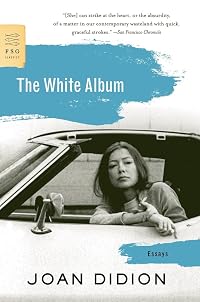
The White Album
by Joan Didion
On This Page
Description
First published in 1979, Joan Didion's "The White Album" records indelibly the upheavals and aftermaths of the 1960s. Examining key events, figures, and trends of the era-including Charles Manson, the Black Panthers, and the shopping mall-through the lens of her own spiritual confusion, Joan Didion helped to define mass culture as we now understand it. Written with a commanding sureness of tone and linguistic precision, The White Album is a central text of American reportage and a classic of show more American autobiography. show lessTags
Recommendations












Member Reviews
I adored this book. Didion writes beautifully, with a quickness and wit that is the equal of anything I've read. An essay can be heading on one direction, instantly turn on its head for a sentence or paragraph and then resume its original course, or change direction yet again. Everything is full of meaning, but as she explains in one of the later essays, it's not some meaning about the world, but only ever a personal one. Orchids, the Hoover Dam and serial killers are worth writing about because they're interesting, not because they're significant. It's a follow your nose attitude to intellectual life that makes Didion very fun company.
So is there anything deeper here, or is it just an exercise in aesthetics? Well first of all, what show more does "just aesthetics" mean? But second, yes I think there is. These essays are a celebration of curiosity and a warning against seriousness. Didion is modelling a spirit of enquiry and lightness which would make the world a much better place. She's not apolitical, in fact the timelessness of her political commentary is testament to the power of her approach. By looking at personality, style and rhetoric, she more accurately characterises the political temper of the time than the serious pundits and experts whose commentary long ago grew stale.
And that style! Everything is so clearly described and laden with meaning. It's a pleasure to read and wonderfully entertaining, which is exactly what a book should be. show less
So is there anything deeper here, or is it just an exercise in aesthetics? Well first of all, what show more does "just aesthetics" mean? But second, yes I think there is. These essays are a celebration of curiosity and a warning against seriousness. Didion is modelling a spirit of enquiry and lightness which would make the world a much better place. She's not apolitical, in fact the timelessness of her political commentary is testament to the power of her approach. By looking at personality, style and rhetoric, she more accurately characterises the political temper of the time than the serious pundits and experts whose commentary long ago grew stale.
And that style! Everything is so clearly described and laden with meaning. It's a pleasure to read and wonderfully entertaining, which is exactly what a book should be. show less
Blending journalism and memoir into snapshots of a narrative landscape during American 1960-70s, Didion expresses themes of separation, confusion and the search for meaning in a stylized format that is a signature of her writing. The titular essay “The White Album” is the strongest, followed by “Many Mansions,” “The Getty”, “In the Islands” and “On the Morning After the Sixties” — the writing feels most secure when she is in California. First published in 1979, many of the brief, more memoir essays may no longer have the impact they did upon publication, but her style left an indelible mark on the format.
A significant problem with Joan Didion’s writing is that it is often of such high standard, achieves such show more excellence in clarity through omission, that the bar is raised incredibly high for anything she writes, resulting in many of her works being subsequently considered to be not as good as expected. Opening with “We tell ourselves stories to live,” which became one of the most quoted sentences by Didion, the reader is set up immediately for expecting the very best. show less
A significant problem with Joan Didion’s writing is that it is often of such high standard, achieves such show more excellence in clarity through omission, that the bar is raised incredibly high for anything she writes, resulting in many of her works being subsequently considered to be not as good as expected. Opening with “We tell ourselves stories to live,” which became one of the most quoted sentences by Didion, the reader is set up immediately for expecting the very best. show less
Of course I recognize that this is a classic and a masterclass in nonfiction writing. I went thru a period about ten years ago where I read 3 or 4 Didion books in about as many months. I guess since then both the world and I have changed together, cuz I just don’t feel the same about this kind of book as I did back then. The section in “The Morning after the Sixties” where she talks about being at Berkeley in the fifties is a good example of what I mean. It’s just another work of post 60s malaise that settles comfortably into sedated fatalism, a phenomenon we’ll depicted in Adam Curtis’ film Hypernormalization. It’s sort of shocking to read the kind of opulence Didion and her family were living in back then. She makes a show more point in the beginning of the book about how living in California, contrary to popular belief, isn’t all milk and honey, and actually requires a rugged individual. It seems more likely to me that dealing with and recovering natural disasters is less about mindset and more about what’s in your bank account. Apparently these people could just up and move whenever they wanted. Of course that’s part of being a successful writer and intellectual, sure, but this book might as well be scripture to what was probably the most privileged group of people in the most privileged generation in American history.
Hard to not feel a little resentful. show less
Hard to not feel a little resentful. show less
"The beaches at Malibu are neither white nor as wide as the beach at Carmel. The hills are scrubby and barren, infested with bikers and rattlesnakes, scarred with cuts and old burns and new R.V. parks. For these and other reasons Malibu tends to astonish and disappoint those who have never seen it, and yet its very name remains, in the imagination of people all over the world, a kind of shorthand for the easy life. I had not before 1971 and will probably not again live in a place with a Chevrolet named after it."
I think that paragraph sums up, this collection of essays. A mosaic of snaphots, from the 60s and 70s, captured in Didion's deft, slightly aloof style, with razor-sharp insight and vivid imagery. Not every essay here sings, but show more there are plenty that do and she covers a lot of territory too, although the bulk, are centered around California. The collection opens with the title essay and it is a stunner. If you only want to read one, make it that one. show less
I think that paragraph sums up, this collection of essays. A mosaic of snaphots, from the 60s and 70s, captured in Didion's deft, slightly aloof style, with razor-sharp insight and vivid imagery. Not every essay here sings, but show more there are plenty that do and she covers a lot of territory too, although the bulk, are centered around California. The collection opens with the title essay and it is a stunner. If you only want to read one, make it that one. show less
Joan escreve maravilhosamente bem tornando interessante qualquer assunto por mais insólito. Sua prosa gostosa de ler é fluída e segura, que nos convida a olhar para seus temas de interesse com cumplicidade, sensibilidade e surpresa. Uma mistura de Camus com Rubem Braga. Seus ensaios são sobre temas surpreendentemente diversos. Sobre estufas de orquídeas, sistemas de distribuição de águas, salva-vidas de Malibu, a casa vazia do governador, o funcionamento de uma represa hidroelétrica ou acompanhar no estúdio uma gravação do The Doors. Nesse livro está o polêmico artigo sobre o feminismo, e em todos eles Joan é a personagem principal com sua visão do mundo da vida, valores, e comentários. Sua ironia fina é melancólica e show more conformada com um mundo sem sentido. Por vezes transparece um certo elitismo não esnobe porém incorporado como um fato da vida. Por ter lido o "Ano do Pensamento Mágico" antes desse me criou um sentimento estranho de conhecer o futuro da autora. De saber os desdobramentos de algumas histórias, e de futuras tragédias que não estavam nem no horizonte desses anos 60 e 70 cobertos nesse livro. Recomendo. show less
I think what Joan Didion is very good at is setting the stage and making you feel present in the moment, even when that moment happened decades ago. She is cagey. She is writing for herself first, capturing those images and those facts in prose that will reflect the minutia back to you like a mirror. She is in every word, you can feel her presence, her careful crafting of each sentence, but she is elusive. So what is she saying? How did that make her feel? What is she getting at? Some of her essays beg to be read more than once, to be delved into time and time again. And this is what makes her brilliant - what she has to say isn't the point - it is how she says it. She has preserved the moment, the day, the decade in all of its glory or show more shame. She has laid the trivial beside the momentous and in doing so has made it timeless. It is not flat - it has dimension.
This collection, like most collections of anything has an unevenness. The brilliant shares space with the adequate and the puzzling. I wonder at why some of the entries were included. BUT the title essay is a gorgeous example of how to present a decade for consumption - she delivers to us the 60s by giving us a glimpse of her own life in that decade. Small vignettes that form a collage representing the whole. And the opening dialogue has become iconic:
“We tell ourselves stories in order to live...We look for the sermon in the suicide, for the social or moral lesson in the murder of five. We interpret what we see, select the most workable of the multiple choices. We live entirely, especially if we are writers, by the imposition of a narrative line upon disparate images, by the "ideas" with which we have learned to freeze the shifting phantasmagoria which is our actual experience.”
Divided into five sections, each with a theme, the collection contains a total of twenty essays. I liked most of them, and I loved several - the collection is worth having just for the title essay, in my opinion. Highly recommended if you like essays with the caveat that the title essay is by far the best of the bunch. show less
This collection, like most collections of anything has an unevenness. The brilliant shares space with the adequate and the puzzling. I wonder at why some of the entries were included. BUT the title essay is a gorgeous example of how to present a decade for consumption - she delivers to us the 60s by giving us a glimpse of her own life in that decade. Small vignettes that form a collage representing the whole. And the opening dialogue has become iconic:
“We tell ourselves stories in order to live...We look for the sermon in the suicide, for the social or moral lesson in the murder of five. We interpret what we see, select the most workable of the multiple choices. We live entirely, especially if we are writers, by the imposition of a narrative line upon disparate images, by the "ideas" with which we have learned to freeze the shifting phantasmagoria which is our actual experience.”
Divided into five sections, each with a theme, the collection contains a total of twenty essays. I liked most of them, and I loved several - the collection is worth having just for the title essay, in my opinion. Highly recommended if you like essays with the caveat that the title essay is by far the best of the bunch. show less
I’ve read two Didion books now, the other being “The Year of Magical Thinking,” her 2005 memoir of the year following the unexpected death of her husband. That book won, among other awards, the Pulitzer Prize. Sad as it was, I liked it more than “The While Album.” This book is about all things California. Well, all things related to the Beautiful People in California in the 1960s and 1970s. Didion knew many of these people and spoke of them as you and I would speak of the names of the streets we’ve lived on in our lifetimes. That part of this memoir was mildly irritating to me, but the payoff with anything Didion has written is the writing itself. It may be second to none. When I think of the Writers’ Club Joan Didion is show more in, I think of the likes of Tom Wolfe, George Will, people like that. It’s very special writing indeed, and it’s worth the price of admission. show less
Members
- Recently Added By
Lists

Favourite Books
1,819 works; 316 members

Books Read in 2017
4,249 works; 129 members

Recommend the 20 best books you've read in the last five years
2,168 works; 601 members

Books I Wrote Essays on
34 works; 1 member

sad girl books
41 works; 2 members

Phoebe Bridgers
29 works; 1 member

Julie Parson’s Old Books
52 works; 4 members

sad girl books
51 works; 3 members
books featured on the book struggles twt
97 works; 2 members
Author Information

56+ Works 36,425 Members
Born in Sacramento, California, on December 5, 1934, Joan Didion received a B.A. from the University of California, Berkeley in 1956. She wrote for Vogue from 1956 to 1963, and was visiting regent's lecturer in English at the University of California, Berkeley in 1976. Didion also published novels, short stories, social commentary, and essays. Her show more work often comments on social disorder. Didion wrote for years on her native California; from there her perspective broadened and turned to the countries of Central America and Southeast Asia. Her novels include Democracy (1984) and The Last Thing He Wanted (1996). Well known nonfiction titles include Slouching Towards Bethlehem (1968), The White Album (1979), The Year of Magical Thinking (2005) and Blue Nights (2011). In 1971 Joan Didion was nominated for the National Book Award in fiction for Play It As It Lays. In 1981 she received the American Book Award in nonfiction, and was nominated for a National Book Critics Circle Prize in nonfiction for The White Album. Didion has received a great deal of recognition for The Year of Magical Thinking, which was awarded the National Book Award for Nonfiction in 2005. In 2007, Didion received the National Book Foundation's annual Medal for Distinguished Contribution to American Letters. In 2009, Didion was awarded an honorary Doctor of Letters degree by Harvard University. On July 3, 2013 the White House announced Didion was one of the recipients of the National Medals of Arts and Humanities presented by President Barack Obama. (Bowker Author Biography) show less
Some Editions
Awards and Honors
Awards
Distinctions
Work Relationships
Is contained in
Common Knowledge
- Original publication date
- 1979
- Dedication
- For Earl McGrath, and for Lois Wallace
- First words
- We tell ourselves stories in order to live. The princess is caged in the consulate. The man with candy will lead the children into the sea. The naked woman on the ledge outside the window on the sixteenth floor is a victim of... (show all) accidie, or the naked woman is an exhibitionist, and it would be "interesting" to know which. We tell ourselves that it makes some difference whether the naked woman is about to commit a mortal sit or is about to register a political protest or is about the be, the Aristophanic view, snatched back to the human condition by the fireman in priest's clothing just visible in the window behind her, the one smiling at the telephoto lens. We look for the sermon in the suicide, for the social or moral lesson in the murder of five. We interpret what we see, select the most workable of the multiple choices. We live entirely, especially if we are writers, by the imposition of a narrative line upon disparate images, by the "ideas" with which we have learned to freeze the shifting phantasmagoria which is our actual experience. -The White Album
- Last words
- (Click to show. Warning: May contain spoilers.)In any case, it was no longer our house.
- Canonical DDC/MDS
- 814.54
- Canonical LCC
- PS3554.I33
Classifications
Statistics
- Members
- 3,030
- Popularity
- 5,855
- Reviews
- 52
- Rating
- (4.07)
- Languages
- 6 — Dutch, English, German, Italian, Polish, Portuguese (Portugal)
- Media
- Paper, Audiobook, Ebook
- ISBNs
- 24
- ASINs
- 18