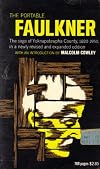
The Portable Faulkner
by William Faulkner
On This Page
Description
Covers a 130-year period in the history of Yoknapatawpha County and its citizens as revealed by the author who was one of them.Tags
Recommendations



























Member Reviews
Comment re 1961 printing of the 1946 publication. Very helpful overview of Faulkner prior to the publication of The Mansion, The Town, and The Reivers. The mid-section of The Bear is in the style of Absalom, Absalom, but otherwise the selections are not too difficult. The major selections are 2 chapters from The Unvanquished, The Bear, Spotted Horses (eventually incorporated into The Hamlet) and the Old Man parts from The Wild Palms (aka O Jerusalem). The arrangement is in chronological order of the fictional history of Yoknapatawpha County, not the order of publication or -- I assume -- creation. One can't help but notice how Faulkner likes to mess around with names -- the dialog between Ike McCaslin and McCaslin Edmonds in The Bear's show more middle section, naming the bear Old Ben, possibly in homage to Ben/Benjy in the Dilsey selection from The Sound and the Fury, or that those excluded from privileged Southern society don't have names-- the convict in Old Man, the slaves and former slaves lacking surnames. Troubling that the unquestioned assumption is that resistance to Reconstruction is heroic, or that Ike McCaslin's vision of the corruption of the primeval wilderness is expressed via the mixing of ethnic groups in Delta Autumn. Old Man (i.e. the Mississippi River) has been compared to Huckleberry Finn; the dizzying loss of direction in the flood reminded me of Edgar Allan Poe stories like the Narrative of A. Gordon Pym and Descent into the Maelstrom. Faulkner does seem closer to Poe's gothic darkness than he does to Twain. At the end, the collection made me eager to go on to books like The Unvanquished, Flags in the Dust, and Go Down Moses, and to re-read The Sound and the Fury, Light in August, and Absalom Absalom. show less
Includes selections of Faulkner's novels and short stories, ordered in such a manner so as to best coherently and linearly portray Faulkner's Yoknapatawpha County. Thus far it has proven to be a wonderful collection; it appears to be quite comprehensive and very well planned out.
Faulkner is one of my favorite nonfiction authors. His notoriously difficult reading opens doors to extreme and fantastic worlds. This collection is shorts and excerpts
“I’d no idea Faulkner was in that bad shape and very happy you are putting together the Portable of him. He has the most talent of anybody and he just needs a sort of conscience that isn’t there. Certainly if no nation can exist half free and half slave no man can write half whore and half straight. But he will write absolutely perfectly straight and then go on and on and not be able to end it. I wish the christ I owned him like you’d own a horse and train him like a horse and race him like a horse—only in writing. How beautifully he can write and as simple and as complicated as autumn or as spring.”
Letter to Malcolm Cowley, 1945
Selected Letters, pg. 603-604
Letter to Malcolm Cowley, 1945
Selected Letters, pg. 603-604
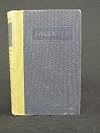
Good. No dust jacket. Includes: illustrations, maps. Book Description: The Viking Press, April 1946. Hardcover. Book Condition: Good. No Jacket. 16mo, mustard w/cloth binding, black titles, author name in mustard on black square on spine, stain spot on front cover, top of spine lightly worn, map by Faulkner himself on endpapers, previous owners name on fly (very small handwriting), an anthology of Faulkner's writings, 756 pages. INCLUDES the appendix "1699-1945 The Compsons".
Ratings
Members
- Recently Added By
Lists

New York Public Library's Books of the Century - All
170 works; 14 members

Five star books
1,755 works; 107 members
Author Information

464+ Works 99,209 Members
Born in an old Mississippi family, William Faulkner made his home in Oxford, seat of the University of Mississippi. After the fifth grade he went to school only off and on-lived, read, and wrote much as he pleased. In 1918, refusing to enlist with the "Yankees," he joined the Canadian Air Force, and was transferred to the British Royal Air Force. show more After the war he studied a little at the University, did house painting, worked as a night superintendent at a power plant, went to New Orleans and became a friend of Sherwood Anderson, then to Europe and back home to Oxford. By this time he had written two novels. The Sound and the Fury followed in 1929. Financial success came with Sanctuary in 1931, which he assisted in filming. Faulkner 's novels are intense in their character portrayals of disintegrating Southern aristocrats, poor whites, and African Americans. A complex stream-of-consciousness rhetoric often involves Faulkner in lengthy sentences of anguished power. Most of his tales are set in the mythical Yoknapatawpha County, Mississippi, and are characterized by the use of many recurring characters from families of different social levels spanning more than a century. His best subjects are the old, dying South and the newer materialistic South. As I Lay Dying (1930), is a grotesquely tragicomic story about a family of poor southern whites. With Absalom, Absalom! (1936); the difficult parts of his famous short novel "The Bear" (published in Go Down, Moses, 1942); and the allegorical A Fable (1954), a non-Yoknapatawpha novel set in France during World War I; Faulkner returned to an innovative and difficult style that most readers have trouble with. Yet, interspersed among such works are collections of easily read stories originally published in popular magazines. There seems to be a growing sentiment among critics that the Snopes trilogy-The Hamlet (1940), The Town (1957), and The Mansion (1959)-for the most part an example of Faulkner's "moderate" style, could well be among his most important works. Faulkner was awarded the 1949 Nobel Prize for literature "for his powerful and artistically independent contribution to the new American novel," but it would appear now that he also deserved to win that honor for his contribution to world literature. When reporting his death, the Boston Globe quoted Faulkner's having once told an interviewer: "Since man is mortal, the only immortality for him is to leave something behind him that is immortal since it will always move. That is the artist's way of scribbling "Kilroy was here" on the wall of the final and irrevocable oblivion through which he must some day pass." In addition to the Nobel Prize, Faulkner received the Howells Medal of the American Academy of Arts and Letters in 1950, and in 1951 he was given the National Book Award for his Collected Stories Collected Stories. For his novel A Fable he received the National Book Award for the second time, as well as the Pulitzer Prize in 1955. The Reivers (1962) was awarded the Pulitzer Prize in 1963. In 1957 and 1958, he was the University of Virginia's first writer-in-residence, and in January 1959 he accepted an appointment as consultant on contemporary literature to the Alderman Library of that university. Although Faulkner was not without honors in his lifetime and has received world recognition since then, it is surprising to learn that, when Malcolm Cowley edited The Portable Faulkner in 1946, he found that almost all of Faulkner's books were out of print. By arranging selections from the works to form a continuous chronicle, Cowley deserves much of the credit for making readers aware of the way in which Faulkner was creating a fictive world on a scale grander than that of any novelist since Balzac. William Faulkner died in Oxford, Mississippi, in 1962. (Bowker Author Biography) show less
All Editions
Awards and Honors
Series
Belongs to Publisher Series
Common Knowledge
- Canonical title
- The Portable Faulkner
- Original title
- The Portable Faulkner
- Original publication date
- 1946
- Important places
- USA; Yoknapatawpha County, Mississippi, USA
- Important events
- American Civil War (1861 | 1865); Reconstruction (1863 | 1877)
- Blurbers
- Wilson, Edmund
- Original language
- English US
- Disambiguation notice
- Please distinguish between this 1946 edition of The Portable Faulkner and the Revised & Expanded Edition (1976), which adds material not included in the original anthology. Thank you.
Classifications
Statistics
- Members
- 304
- Popularity
- 104,556
- Reviews
- 5
- Rating
- (4.21)
- Languages
- English
- Media
- Paper
- ISBNs
- 1
- ASINs
- 19