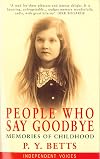
People Who Say Goodbye
by P. Y. Betts
On This Page
Description
Before World War I, when Wandsworth Common was still a countrified suburb, Phyllis Betts was growing up there, observing the behaviour and conversation of the unconventional parents and other adults around her. Here, in a kaleidoscope of places and events, she recreates that vanished world.Tags
Recommendations
























Member Reviews
Phyllis Y. Betts wrote for Graham Greene's magazine, "Night and Day", as well as producing a novel in the 30s,"French Polish" (no touchstone). Then she disappeared for 50 years until she was refound by Christopher Hawtree, living alone on a small-holding in Wales. The circuitous result was that she wrote again, her memories of her childhood: [People Who Say Goodbye].
An extraordinarily precocious and opinionated child, she was the product of very unusual parents. Her mother had what Phyllis termed a "learn as you burn" policy of keeping her kitchen knives wickedly sharp and allowing her children to use them as needed. A succession of maids went through the house, leaving to "better themselves", some becoming extended family, some show more returning after being bettered. Her mother believed in the efficacy of lots of fresh greens and the consumption of animal fats. She also did not believe in education for her daughter until she was about ten or eleven. Consequently, Phyllis had to play a bit of catch-up with private tutors to be accepted into a decent school. She was also a direct woman who didn't beat around the bush when questioned:
Phyllis: "What happens to all those dead people who are put into graves?"
Mother: "They rot," she replied, spreading dripping on toast.
Her mother came from a wealthy family, her father not so. But he had a keen intellect and an inability to suffer fools gladly, as well as a peppery temper. Phyllis was convinced that he loved her best; her mother loved her brother best. P.Y. hated visiting her mother's family as they were stuffy, snobbish and odd. Her grandfather had made his wealth by his wits and ability to seize an opportunity. He had blue eyes of the kind which impaled you with their look. She hated him but was told by her mother that she was just like him. There were two sisters of her mother's, the aunts, and an assortment of odd sub-characters.
Her father's family were not wealthy but her grandfather had been a famous chef, even cooking for the King, and the chef for the Duke of Westminster. However, he loved to play the horses so in his old age had little to show for his days of glory and success. He had taught his wife all his cooking secrets, and still adored her, so it was to a happy home with glorious food that the young Phyllis was taken when diptheria was suspected in the family (her older brother came down with it and probably lived because of his mother's nursing of him). Phyllis was sent away for safety - the wealthy family would have nothing to do with her for fear of infection but the poor one took her in gladly. It was one of the happiest times of her life, sleeping up in the loft in a feather bed and eating the food of kings.
It isn't the details per se which enchant as much as Phyllis's incredible power of observation about them for one so young, as well as her ability to remember and describe events covering the end of the war, the post-war streets with more than their fair share of the maimed and wounded, schoolteachers, the quasi quack doctor who looked after their family. all manner of relationships, animals, insane asylums, religion, and the mysteries of life as they appeared to a child. Best of all were the things she thought about.
At times I wondered if the adult writer was putting an adult overlay over the memories of the child but mostly it didn't matter as the life being described, the events and emotions taking place, were so very interesting. Acerbic, at times cocky, very funny, boundlessly curious, she was an altogether fascinating child who wrote an equally fascinating book of her childhood memories. I am so glad that Slightly Foxed Editions saw fit to reprint this. Recommended. show less
An extraordinarily precocious and opinionated child, she was the product of very unusual parents. Her mother had what Phyllis termed a "learn as you burn" policy of keeping her kitchen knives wickedly sharp and allowing her children to use them as needed. A succession of maids went through the house, leaving to "better themselves", some becoming extended family, some show more returning after being bettered. Her mother believed in the efficacy of lots of fresh greens and the consumption of animal fats. She also did not believe in education for her daughter until she was about ten or eleven. Consequently, Phyllis had to play a bit of catch-up with private tutors to be accepted into a decent school. She was also a direct woman who didn't beat around the bush when questioned:
Phyllis: "What happens to all those dead people who are put into graves?"
Mother: "They rot," she replied, spreading dripping on toast.
Her mother came from a wealthy family, her father not so. But he had a keen intellect and an inability to suffer fools gladly, as well as a peppery temper. Phyllis was convinced that he loved her best; her mother loved her brother best. P.Y. hated visiting her mother's family as they were stuffy, snobbish and odd. Her grandfather had made his wealth by his wits and ability to seize an opportunity. He had blue eyes of the kind which impaled you with their look. She hated him but was told by her mother that she was just like him. There were two sisters of her mother's, the aunts, and an assortment of odd sub-characters.
Her father's family were not wealthy but her grandfather had been a famous chef, even cooking for the King, and the chef for the Duke of Westminster. However, he loved to play the horses so in his old age had little to show for his days of glory and success. He had taught his wife all his cooking secrets, and still adored her, so it was to a happy home with glorious food that the young Phyllis was taken when diptheria was suspected in the family (her older brother came down with it and probably lived because of his mother's nursing of him). Phyllis was sent away for safety - the wealthy family would have nothing to do with her for fear of infection but the poor one took her in gladly. It was one of the happiest times of her life, sleeping up in the loft in a feather bed and eating the food of kings.
It isn't the details per se which enchant as much as Phyllis's incredible power of observation about them for one so young, as well as her ability to remember and describe events covering the end of the war, the post-war streets with more than their fair share of the maimed and wounded, schoolteachers, the quasi quack doctor who looked after their family. all manner of relationships, animals, insane asylums, religion, and the mysteries of life as they appeared to a child. Best of all were the things she thought about.
At times I wondered if the adult writer was putting an adult overlay over the memories of the child but mostly it didn't matter as the life being described, the events and emotions taking place, were so very interesting. Acerbic, at times cocky, very funny, boundlessly curious, she was an altogether fascinating child who wrote an equally fascinating book of her childhood memories. I am so glad that Slightly Foxed Editions saw fit to reprint this. Recommended. show less
Ratings
Members
- Recently Added By
Author Information
2 Works 72 Members
Series
Belongs to Publisher Series
Common Knowledge
- Canonical title
- People Who Say Goodbye
- Original publication date
- 1989
- First words
- There were sudden voices, and a scurry of people across the hall from right to left and through a door which was slammed.
- Last words
- (Click to show. Warning: May contain spoilers.)'Specially of you,' replied my brutal parent, flashing at me her radiant smile as she rattled away the cups and saucers, plates, sppons and forks and the little killer knives she kept so sharp.
Classifications
- Genres
- Biography & Memoir, Nonfiction, History
- DDC/MDS
- 942.1083092 — History & geography History of Europe England and Wales London Historical periods; Modified standard subdvisions of London 1837- 1910–1936, George V
- LCC
- DA688 — History of Europe, Asia, Africa and Oceania Great Britain History of Great Britain England Local history and description London
- BISAC
Statistics
- Members
- 71
- Popularity
- 443,867
- Reviews
- 1
- Rating
- (4.28)
- Languages
- English
- Media
- Paper, Ebook
- ISBNs
- 8
- ASINs
- 1