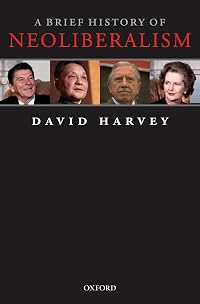
A Brief History of Neoliberalism
by David Harvey
On This Page
Description
Neoliberalism-the doctrine that market exchange is an ethic in itself, capable of acting as a guide for all human action-has become dominant in both thought and practice throughout much of the world since 1970 or so. Writing for a wide audience, David Harvey, author of The New Imperialism and The Condition of Postmodernity, here tells the political-economic story of where neoliberalization came from and how it proliferated on the world stage. Through critical engagement with this history, he show more constructs a framework, not only for analyzing the political and economic dangers that now surround us, but also for assessing the prospects for the more socially just alternatives being advocated by many oppositional movements. show lessTags
Recommendations

























Member Reviews
Excerpted from Inside Higher Ed with permission.
If you’re wondering how government got so caught up in the well-being of Wall Street, I have a book for you: A Brief History of Neoliberalism by David Harvey. I had a basic understanding of what neoliberalism is, and have sometimes winced at how liberally it’s sprinkled about as the root of most evil. But it’s a fundamentally powerful influence on our economic and political life as well as our everyday experience, and I’m grateful to the author for helping me understand how we got here – and how market behavior isn’t a fundamental law of the universe but an influential part of our recent intellectual history.
In the 1970s, businesses and financial institutions began to show more organize themselves to fight for their interests. They did so through making existing organizations like the US Chamber of Commerce more powerfully political in furthering their mission. Even the Nobel Committee got into the act, recognizing American economists who have put their stamp our world through their talismanic belief in the wisdom of markets. (Though we tend to see Sweden as a socialist worker’s paradise, Sweden has a traditionally powerful wealthy class that wields influence in high places and wanted to dethrone post-Keynesianism.) They built entire financial industries and financialized existing industries that capitalized on distrust of government and America’s traditional reverence toward individual rights. They were able to refashion the state’s purpose: rather than provide social welfare programs, it should create healthy conditions for businesses to thrive, which should in turn would trickle down to benefit society, though that’s proven less reliable than the trickles of springs that people in Puerto Rico rely on for drinking water right now. So many of our current debates – health care, infrastructure, environmental protection, creating jobs that pay enough to live on – were illuminated for me by this accessible and informative book. show less
If you’re wondering how government got so caught up in the well-being of Wall Street, I have a book for you: A Brief History of Neoliberalism by David Harvey. I had a basic understanding of what neoliberalism is, and have sometimes winced at how liberally it’s sprinkled about as the root of most evil. But it’s a fundamentally powerful influence on our economic and political life as well as our everyday experience, and I’m grateful to the author for helping me understand how we got here – and how market behavior isn’t a fundamental law of the universe but an influential part of our recent intellectual history.
In the 1970s, businesses and financial institutions began to show more organize themselves to fight for their interests. They did so through making existing organizations like the US Chamber of Commerce more powerfully political in furthering their mission. Even the Nobel Committee got into the act, recognizing American economists who have put their stamp our world through their talismanic belief in the wisdom of markets. (Though we tend to see Sweden as a socialist worker’s paradise, Sweden has a traditionally powerful wealthy class that wields influence in high places and wanted to dethrone post-Keynesianism.) They built entire financial industries and financialized existing industries that capitalized on distrust of government and America’s traditional reverence toward individual rights. They were able to refashion the state’s purpose: rather than provide social welfare programs, it should create healthy conditions for businesses to thrive, which should in turn would trickle down to benefit society, though that’s proven less reliable than the trickles of springs that people in Puerto Rico rely on for drinking water right now. So many of our current debates – health care, infrastructure, environmental protection, creating jobs that pay enough to live on – were illuminated for me by this accessible and informative book. show less
Everyone can accept that class struggle on behalf of the unwashed masses manifests as strikes and revolutions. But what about the other way? That's the void that Harvey's consistently addresses: the elites fight a class struggle too and their tool is neoliberalism. From Reagan and Thatcher to current globalization tactics, Harvey's point is that the rich fight the poor all the time. However, instead of doing it in the streets, they do it via public policy that regardless of political bent will ultimately favour continued advantage for the ruling class.
Wow, what a helpful introduction to the history of neoliberalism. This book introduces the concept, traces a theory of its origin, and then details its emergence and eventual hegemony from the Seventies to Nineties.
I never knew the extent to which capitalists banded together as a unified class in the Seventies to secure their economic and political power in response to anti-establishment struggles. Harvey demonstrates how think tanks, business associations, and propaganda efforts went hard during that period, successfully exploiting the stagflation crisis and malaise of the Seventies to take the reins back from Keynesianism. Harvey is known for foregrounding economics in the birth of neoliberalism, in contrast to Foucault and his show more followers, who argue its an evolution of liberal governmentality.
That said, I have a problem with his theory about neoliberalism’s birth from the Sixties. Like a Marxist would, he sets up a dichotomy between two allegedly contradictory threads running through the period: social justice and individual freedom. Social justice requires working towards the interests of the group and other people, which allegedly requires submerging individual desires. Because the Sixties hosted both threads, and they emerged from dissatisfaction with the bureaucratic society built by the New Deal, the capitalists were able to use the desire for individual freedom to build consensus for neoliberalism. By framing it that the individual as consumer and producer should be free to pursue their own interests without permission from the group, they were able to make neoliberal ideas alluring.
Here’s what I think of that. There’s no way we’re going to build a better world without people being free to pursue their own desires and interests. Short of converting us all to zealots as SJWs try to do, most of us are not going to fight hard and take risks for the sake of other people, especially for a group we don’t belong to. Some of us will, sure, but most won’t. And I’d argue that those who did fight hard for others also had personal investment in whatever social change they were fighting for. The key here is to find ways of combining social and personal liberation, not heralding the former at the expense of the latter.
Additionally, it’s just not true that neoliberalism used individual desire and not social justice. Individual desire is not a cohesive enough glue to keep society together. That’s why Reagan rode in on the back of nationalism and religious conservatism and Thatcher benefited from it as well. Neoliberalism needs its own brand of “social justice”, however much we may disagree with its definition of the concept.
Now that I’ve vented my anarchist ire, I’ll say that this book is an important history for understanding the time we’re living in. I recommend it to everyone. show less
I never knew the extent to which capitalists banded together as a unified class in the Seventies to secure their economic and political power in response to anti-establishment struggles. Harvey demonstrates how think tanks, business associations, and propaganda efforts went hard during that period, successfully exploiting the stagflation crisis and malaise of the Seventies to take the reins back from Keynesianism. Harvey is known for foregrounding economics in the birth of neoliberalism, in contrast to Foucault and his show more followers, who argue its an evolution of liberal governmentality.
That said, I have a problem with his theory about neoliberalism’s birth from the Sixties. Like a Marxist would, he sets up a dichotomy between two allegedly contradictory threads running through the period: social justice and individual freedom. Social justice requires working towards the interests of the group and other people, which allegedly requires submerging individual desires. Because the Sixties hosted both threads, and they emerged from dissatisfaction with the bureaucratic society built by the New Deal, the capitalists were able to use the desire for individual freedom to build consensus for neoliberalism. By framing it that the individual as consumer and producer should be free to pursue their own interests without permission from the group, they were able to make neoliberal ideas alluring.
Here’s what I think of that. There’s no way we’re going to build a better world without people being free to pursue their own desires and interests. Short of converting us all to zealots as SJWs try to do, most of us are not going to fight hard and take risks for the sake of other people, especially for a group we don’t belong to. Some of us will, sure, but most won’t. And I’d argue that those who did fight hard for others also had personal investment in whatever social change they were fighting for. The key here is to find ways of combining social and personal liberation, not heralding the former at the expense of the latter.
Additionally, it’s just not true that neoliberalism used individual desire and not social justice. Individual desire is not a cohesive enough glue to keep society together. That’s why Reagan rode in on the back of nationalism and religious conservatism and Thatcher benefited from it as well. Neoliberalism needs its own brand of “social justice”, however much we may disagree with its definition of the concept.
Now that I’ve vented my anarchist ire, I’ll say that this book is an important history for understanding the time we’re living in. I recommend it to everyone. show less
"US leaders have, with considerable domestic public support, projected upon the world the idea that American neoliberal values of freedom are universal and supreme, and that such values are to die for. The world is in a position to reject that imperialist gesture and refract back into the heartland of neoliberal and neoconservative capitalism a completely different set of values: those of an open democracy dedicated to the achievement of social equality coupled with economic, political, and cultural justice. Roosevelt's arguments are one place to start. Within the US an alliance has to be built to regain popular control of the state apparatus and to thereby advance the deepening rather than the evisceration of democratic practices and show more values under the juggernaut of market power."
This is as clear and concise an account of how neoliberalism has developed and taken hold of our political and economic landscape from the 1970s to the present as any could ask for. David Harvey is such a clear and compelling writer that the ideas in this book come across effortlessly without becoming overly simplistic.
This book actually prefigures our economic collapse (it was written in 2005) and yet it describes our current state with pinpoint accuracy:
"On the one hand [US nationalism] presumes that it is the God-given (and the religious invocation is deliberate) manifest destiny of the US to be the greatest power on earth (if not number one in everything from baseball to the Olympics) and that, as a beacon of freedom, liberty, and progress, it has been and continues to be universally admired and considered worthy of emulation. Everyone, it is said, wants to either live in or be like the US. The US therefore benevolently and generously gives freely of its resources and its values and culture to the rest of the world, in the cause of conferring the privilege of Americanization and American values on all and sundry. But US nationalism also has a darker side in which paranoia about fearful threats from enemies and evil forces from outside take over. The fear is of foreigners and of immigrants, of outside agitators, and now, of course, of 'terrorists'. This leads to the internal circling of wagons and the closing down of civil liberties and freedoms in episodes like the persecution of anarchists in the 1920s, the McCarthyism of the 1950s directed against communists and their sympathizers, the paranoid style of Richard Nixon towards opponents of the Vietnam War and, since 9/11, the tendency to characterize all critics of administration policies as aiding and abetting the enemy. This kind of nationalism easily fuses with racism (most particularly now towards Arabs), the restriction of civil liberties (the Patriot Act), the curbing of press freedoms (the gaoling of journalists for not revealing their sources), and the embrace of incarceration and the death penalty to deal with malfeasance."
Sorry for the long quotes. Needless to say I find this book to be quotable and, quite honestly, important for everyone to read.
Everyone should read this book and engage with Harvey's ideas. The fate of our society depends on it. show less
This is as clear and concise an account of how neoliberalism has developed and taken hold of our political and economic landscape from the 1970s to the present as any could ask for. David Harvey is such a clear and compelling writer that the ideas in this book come across effortlessly without becoming overly simplistic.
This book actually prefigures our economic collapse (it was written in 2005) and yet it describes our current state with pinpoint accuracy:
"On the one hand [US nationalism] presumes that it is the God-given (and the religious invocation is deliberate) manifest destiny of the US to be the greatest power on earth (if not number one in everything from baseball to the Olympics) and that, as a beacon of freedom, liberty, and progress, it has been and continues to be universally admired and considered worthy of emulation. Everyone, it is said, wants to either live in or be like the US. The US therefore benevolently and generously gives freely of its resources and its values and culture to the rest of the world, in the cause of conferring the privilege of Americanization and American values on all and sundry. But US nationalism also has a darker side in which paranoia about fearful threats from enemies and evil forces from outside take over. The fear is of foreigners and of immigrants, of outside agitators, and now, of course, of 'terrorists'. This leads to the internal circling of wagons and the closing down of civil liberties and freedoms in episodes like the persecution of anarchists in the 1920s, the McCarthyism of the 1950s directed against communists and their sympathizers, the paranoid style of Richard Nixon towards opponents of the Vietnam War and, since 9/11, the tendency to characterize all critics of administration policies as aiding and abetting the enemy. This kind of nationalism easily fuses with racism (most particularly now towards Arabs), the restriction of civil liberties (the Patriot Act), the curbing of press freedoms (the gaoling of journalists for not revealing their sources), and the embrace of incarceration and the death penalty to deal with malfeasance."
Sorry for the long quotes. Needless to say I find this book to be quotable and, quite honestly, important for everyone to read.
Everyone should read this book and engage with Harvey's ideas. The fate of our society depends on it. show less
"US leaders have, with considerable domestic public support, projected upon the world the idea that American neoliberal values of freedom are universal and supreme, and that such values are to die for. The world is in a position to reject that imperialist gesture and refract back into the heartland of neoliberal and neoconservative capitalism a completely different set of values: those of an open democracy dedicated to the achievement of social equality coupled with economic, political, and cultural justice. Roosevelt's arguments are one place to start. Within the US an alliance has to be built to regain popular control of the state apparatus and to thereby advance the deepening rather than the evisceration of democratic practices and show more values under the juggernaut of market power."
This is as clear and concise an account of how neoliberalism has developed and taken hold of our political and economic landscape from the 1970s to the present as any could ask for. David Harvey is such a clear and compelling writer that the ideas in this book come across effortlessly without becoming overly simplistic.
This book actually prefigures our economic collapse (it was written in 2005) and yet it describes our current state with pinpoint accuracy:
"On the one hand [US nationalism] presumes that it is the God-given (and the religious invocation is deliberate) manifest destiny of the US to be the greatest power on earth (if not number one in everything from baseball to the Olympics) and that, as a beacon of freedom, liberty, and progress, it has been and continues to be universally admired and considered worthy of emulation. Everyone, it is said, wants to either live in or be like the US. The US therefore benevolently and generously gives freely of its resources and its values and culture to the rest of the world, in the cause of conferring the privilege of Americanization and American values on all and sundry. But US nationalism also has a darker side in which paranoia about fearful threats from enemies and evil forces from outside take over. The fear is of foreigners and of immigrants, of outside agitators, and now, of course, of 'terrorists'. This leads to the internal circling of wagons and the closing down of civil liberties and freedoms in episodes like the persecution of anarchists in the 1920s, the McCarthyism of the 1950s directed against communists and their sympathizers, the paranoid style of Richard Nixon towards opponents of the Vietnam War and, since 9/11, the tendency to characterize all critics of administration policies as aiding and abetting the enemy. This kind of nationalism easily fuses with racism (most particularly now towards Arabs), the restriction of civil liberties (the Patriot Act), the curbing of press freedoms (the gaoling of journalists for not revealing their sources), and the embrace of incarceration and the death penalty to deal with malfeasance."
Sorry for the long quotes. Needless to say I find this book to be quotable and, quite honestly, important for everyone to read.
Everyone should read this book and engage with Harvey's ideas. The fate of our society depends on it. show less
This is as clear and concise an account of how neoliberalism has developed and taken hold of our political and economic landscape from the 1970s to the present as any could ask for. David Harvey is such a clear and compelling writer that the ideas in this book come across effortlessly without becoming overly simplistic.
This book actually prefigures our economic collapse (it was written in 2005) and yet it describes our current state with pinpoint accuracy:
"On the one hand [US nationalism] presumes that it is the God-given (and the religious invocation is deliberate) manifest destiny of the US to be the greatest power on earth (if not number one in everything from baseball to the Olympics) and that, as a beacon of freedom, liberty, and progress, it has been and continues to be universally admired and considered worthy of emulation. Everyone, it is said, wants to either live in or be like the US. The US therefore benevolently and generously gives freely of its resources and its values and culture to the rest of the world, in the cause of conferring the privilege of Americanization and American values on all and sundry. But US nationalism also has a darker side in which paranoia about fearful threats from enemies and evil forces from outside take over. The fear is of foreigners and of immigrants, of outside agitators, and now, of course, of 'terrorists'. This leads to the internal circling of wagons and the closing down of civil liberties and freedoms in episodes like the persecution of anarchists in the 1920s, the McCarthyism of the 1950s directed against communists and their sympathizers, the paranoid style of Richard Nixon towards opponents of the Vietnam War and, since 9/11, the tendency to characterize all critics of administration policies as aiding and abetting the enemy. This kind of nationalism easily fuses with racism (most particularly now towards Arabs), the restriction of civil liberties (the Patriot Act), the curbing of press freedoms (the gaoling of journalists for not revealing their sources), and the embrace of incarceration and the death penalty to deal with malfeasance."
Sorry for the long quotes. Needless to say I find this book to be quotable and, quite honestly, important for everyone to read.
Everyone should read this book and engage with Harvey's ideas. The fate of our society depends on it. show less
I had been teaching about neo-liberal economic theory in my class and thought I should probably read this book to understand it better. I'm glad I did. In addition to explaining the nuts and bolts of neo-liberalism, Harvey also argues that neo-liberal rhetoric is, at heart, a disguise for its underlying project: the restoration [or creation] of class power. Harvey convincingly argues that neo-liberalism, despite its claims of the pursuit of freedom, is actually profoundly undemocratic. Harvey, a Marxist cultural geographer, makes no bones about his beliefs about the dangers and failures of neo-liberalism and argues for a return to the "embedded" liberalism of the post-1945 era.
I was a little bit afraid that this book would be filled show more with economic jargon, but I found it quite readable. I got a little bit lost in his discussions about China, as I'm just not familiar enough with macro-economic theories to understand exactly how neo-liberalism would play out there. I was also hoping for an epilogue or an updated prologue with information about the 2008 economic crisis in the US, which seemed to conform to Harvey's predictions. Harvey shines in his analysis of the UK and US situations and I was glad to see that he included a fair amount of information on Latin America as well, as it often seems to be a laboratory for economic theories.
This book asks some profoundly troubling but very necessary questions about our conceptions of freedom and democracy. show less
I was a little bit afraid that this book would be filled show more with economic jargon, but I found it quite readable. I got a little bit lost in his discussions about China, as I'm just not familiar enough with macro-economic theories to understand exactly how neo-liberalism would play out there. I was also hoping for an epilogue or an updated prologue with information about the 2008 economic crisis in the US, which seemed to conform to Harvey's predictions. Harvey shines in his analysis of the UK and US situations and I was glad to see that he included a fair amount of information on Latin America as well, as it often seems to be a laboratory for economic theories.
This book asks some profoundly troubling but very necessary questions about our conceptions of freedom and democracy. show less
A really thorough investigation and description of neoliberalism that helped me understand it as a body, rather than a cloak with a name. More later, probably. But still worth reading.
I’m not referring to my notes, so these are impressions. The book traces the history and impact of neoliberal policies from its theoretical beginnings in the 50s and 60s and the first inklings of its ideals in the fallout of the great depression in the 30s. It sets up the theoretical position of neoliberalism historically, which I liked. It’s very easy to read, the explanations are succinct and most of the required concepts are introduced pretty well (thought I had read *Debt* a few months ago so I may be more economically primed than I usually am). show more Then it starts discussing the impact of that theoretical position and how the people who implemented it sought and got their power, and what they did with it. You already know a lot of neoliberalism’s impact in the US and the UK if you’ve watched “Hypernormalisation” and all the other Adam Curtis films (which you should!), but probably not in this detail. What you probably don’t know about are the details of other countries’ histories with it, and the impact the end of the Bretton Woods policy had, though you’ve probably heard of some of the social consequences through authoritarianism and village slaughter.
The book is decidedly against neoliberalism both for its consequences and its theoretical faults. It feels like it’s written by that strain of liberal who champions FDR as the greatest president, who seeks a reconciliation between democratic socialism and liberal humanism. (I have no idea; I know the author publishes a lot but this is the only thing of his I’ve read.)
Anyway, it’s a really good book and if you’ve ever wondered what someone meant when they said the word “neoliberal,” my prescription is to watch some Adam Curtis films, then if you’re still interested, read this book. Or maybe the other way around if you can’t stand his tone. Either way, both make a meal. show less
I’m not referring to my notes, so these are impressions. The book traces the history and impact of neoliberal policies from its theoretical beginnings in the 50s and 60s and the first inklings of its ideals in the fallout of the great depression in the 30s. It sets up the theoretical position of neoliberalism historically, which I liked. It’s very easy to read, the explanations are succinct and most of the required concepts are introduced pretty well (thought I had read *Debt* a few months ago so I may be more economically primed than I usually am). show more Then it starts discussing the impact of that theoretical position and how the people who implemented it sought and got their power, and what they did with it. You already know a lot of neoliberalism’s impact in the US and the UK if you’ve watched “Hypernormalisation” and all the other Adam Curtis films (which you should!), but probably not in this detail. What you probably don’t know about are the details of other countries’ histories with it, and the impact the end of the Bretton Woods policy had, though you’ve probably heard of some of the social consequences through authoritarianism and village slaughter.
The book is decidedly against neoliberalism both for its consequences and its theoretical faults. It feels like it’s written by that strain of liberal who champions FDR as the greatest president, who seeks a reconciliation between democratic socialism and liberal humanism. (I have no idea; I know the author publishes a lot but this is the only thing of his I’ve read.)
Anyway, it’s a really good book and if you’ve ever wondered what someone meant when they said the word “neoliberal,” my prescription is to watch some Adam Curtis films, then if you’re still interested, read this book. Or maybe the other way around if you can’t stand his tone. Either way, both make a meal. show less
Members
- Recently Added By
Lists

LT picks: Blue Books
197 works; 44 members

History is a Weapon Recommended Reading List
43 works; 3 members

Books cited in Progress by Samuel McDonald
160 works; 1 member

Maybe This Year? Books to Look Forward To
413 works; 9 members
Author Information

41+ Works 7,204 Members
David Harvey received a Bachelor's degree and Ph.D. in geography from Cambridge University. After graduating in 1961, he joined the geography department at Bristol University as a lecturer. In the following years, he held teaching positions at Johns Hopkins and Oxford universities. He has written numerous books including Justice Nature and the show more Geography of Differences, The Urban Experience, The Condition of Postmodernity, and An Enquiry into the Origins of Cultural Change. He has received many honors, among them the Outstanding Contributor Award of the Association of American Geographers, the Anders Retzuis Gold Medal of the Swedish Society of Anthropology and Geography, and the Vautrin Lud International Geography Prize. (Bowker Author Biography) show less
Awards and Honors
Common Knowledge
- Canonical title*
- Breve storia del neoliberismo; La guerra perpetua: analisi del nuovo imperialismo
- Original title
- A brief history of neoliberalism
- Original publication date
- 2005
- First words*
- Es könnte durchaus sein, dass künftige Historiker die Jahre 1978 bis 1980 als einen revolutionären Wendepunkt in der globalen Wirtschafts- und Sozialgeschichte interpretieren.
- Quotations*
- Neoliberalismus bedeutet kurz und knapp: Finanzmärkte über alles. (S. 45)
...die liberale Utopie [ist] einzig und allein durch Macht, Gewalt und ein autoritäres System aufrechtzuerhalten. Nach Polanyi ist der libera... (show all)le oder neoliberale Utopismus also dazu verdammt, in einem autoritären System oder gar im offenen Faschismus zu enden. (S. 50) - Last words*
- (Click to show. Warning: May contain spoilers.)Die Neoliberalen werden uns weiterhin ihre Freiheiten predigen, aber wir können für eine weitaus noblere Perspektive der Freiheit kämpfen. Und wir können ein unendlich viel besseres Regierungssystem aufbauen als jenes, das uns die Neokonservativen zugedacht haben.
*Some information comes from Common Knowledge in other languages. Click "Edit" for more information.
Classifications
Statistics
- Members
- 1,241
- Popularity
- 19,955
- Reviews
- 14
- Rating
- (4.01)
- Languages
- 12 — English, Finnish, French, German, Italian, Japanese, Norwegian (Bokmål), Polish, Portuguese, Russian, Slovenian, Spanish
- Media
- Paper, Audiobook, Ebook
- ISBNs
- 25
- ASINs
- 5