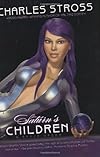
Saturn's Children
by Charles Stross
On This Page
Recommendations


Member Reviews
“Of course, space travel isn’t only about being stuffed into a claustrophobia-inducing cell, scared witless, trussed up in a restraint harness, and raped through every orifice for years on end. Because, you know, if that was all there was to it, there’d be a queue outside every travel agent.” Freya Nakamichi-47
In Charles Stross’s latest novel, “Saturn’s Children”, space travel takes time, often large amounts of it. (Humorously, Stross also writes that space travel is excrement, though in harsher terms. This becomes a running joke throughout the book, not to mention that the book dubs itself a ‘space opera’.) Years can stretch into decades or even centuries if the distance is vast enough. Space vessels store show more passengers in cramped safety cocoons (and these are the best accommodations), thoroughly isolating their passengers from the outside world. It’s like traveling outside of time, time travel with a long, bland interlude in between. Friends and family age, and possibly die, during the course of the journey. The world changes, sometimes drastically. A person arrives in a different situation than the one they left behind, but are still the same person, and this causes confusion in their self-identity. Are you changed or not? Are you still the same person, although everything and everyone around you has changed, yet you’ve experienced no change?
Freya’s quote about the attractiveness of the “upside” of space travel is followed by her admitting that the “downside” is this sense of personal dislocation. Space travel makes her question who and what she is. This questioning of selfhood and personal identity is a major theme in the book. Freya’s quest for self-understanding in “Saturn’s Children” raises questions about selfhood, love, freedom, and technological exploitation. The twist is: Freya’s a robot. But her struggle is cleverly tied and easily applicable to the human experience. She is a psychological surrogate for the reader, as she pieces together the human experience without ever experiencing a human. She offers the reader the imagined perspective of looking at our experiences from outside of ourselves. While clearly speculative, it’s quite intriguing and well-done.
Within the last couple of centuries, humanity has gone extinct, leaving behind a galactic civilization run by androids. Freya Nakamichi-47 is one of the last remaining sexual courtesans still functioning. Instantiated from her template-matriarch, Rhea, she is programmed to selflessly pleasure humans sexually (and I mean this in the total-loss-of-all-self sense). Since humanity, which Freya refers to as her Dead Love, no longer exists, she’s purposeless. This leads her to question herself and existence: what is she if she cannot fulfill her stated purpose? Is she defined by teleology or by something else? Is she defined by her origins, since her concept of self arose out of a template? What makes her Freya and not Rhea?
Stross is being mischievously clever in creating a character whose self-delineation is confused by their cloned origins as well as their understood, but unachievable, purpose. He further ratchets this confusion up with the introduction of soul chips. Freya, who wears her own soul chip that’s responsible for recording her memories, actions and thoughts, has the ability to access the soul chips of all of her sibs, each one an instantiation of Rhea. By accessing the soul chips of her sibs, she can experience their experiences, and dream their dreams. Of course, the downside is that her sense of self can get even more fragmented (to the point of schizophrenia).
As the novel begins, Freya finds herself in trouble with an aristo she encounters on Venus. Aristos (the rich and powerful members of society) are slave-holders who totally control their arbeiters through implanted slave chips. Running from the aristo’s hired assassins, Freya flees Venus with the help of Ichiban. In order to secure her escape though, she consents to work for Ichiban’s sponsor, the Jeeves Corporation. Freya’s job is to smuggle a mysterious organism from Mercury to Mars, while avoiding the Pink Police. Soon, she discovers that she has become a pawn in a much greater game, a game that could up with her enslaved or killed. With the help of a soul chip from one of her sibs, Freya must uncover the mystery of who she really is.
Stross has imagined an intellectually rich and scientific setting filled with intriguing androids, most which are non-humanoid in design, and populated with some interesting societal insights like the static nature of a slave society. The lack of moral questioning by Freya about some issues like soul chips and their moral implications is intriguing. There is no objection on ethical grounds to tapping into another sib’s memory. Moral issues are abstractions which the androids don’t consider, or are not programmed to consider. It makes morality seem deliciously human. This sharing of personal experiences through soul chips amounts to a group share that makes the delineation of self even more troublesome, and more interesting. (Is self sustainable through shared experiences?) All this adds up to an alienness that is refreshingly original, as well as being an astute social satire.
The underlying story unfolds like a mystery. It’s told to the reader through Freya’s recollection of events. Her tone at times is conversational, charming, confused, or schizophrenic, and is entirely consistent and appropriate for her situation. Stross displays a deft touch in keeping Freya on point, never letting her search for self deviate into abstractions. He successfully raises points without belaboring the issues, all the while keeping the story unfolding smoothly. The smooth pacing makes “Saturn’s Children” ultimately seem more accessible to mainstream readers. While there is a rich scientific environment, it isn’t so overwhelming as to be incomprehensible to those without a doctorate in the sciences.
Last Word:
Charles Stross has created a space opera which unapologetically asks big questions that scream to be pondered. “Saturn’s Children” is a new entry in the long line of science fiction stories that examine the concept of identity and self, and whether technology strips the aspects of self away. Will science in its unraveling of nature take the mystery out of us? It’s a pertinent question that receives a well-balanced, clever and entertaining treatment here. show less
In Charles Stross’s latest novel, “Saturn’s Children”, space travel takes time, often large amounts of it. (Humorously, Stross also writes that space travel is excrement, though in harsher terms. This becomes a running joke throughout the book, not to mention that the book dubs itself a ‘space opera’.) Years can stretch into decades or even centuries if the distance is vast enough. Space vessels store show more passengers in cramped safety cocoons (and these are the best accommodations), thoroughly isolating their passengers from the outside world. It’s like traveling outside of time, time travel with a long, bland interlude in between. Friends and family age, and possibly die, during the course of the journey. The world changes, sometimes drastically. A person arrives in a different situation than the one they left behind, but are still the same person, and this causes confusion in their self-identity. Are you changed or not? Are you still the same person, although everything and everyone around you has changed, yet you’ve experienced no change?
Freya’s quote about the attractiveness of the “upside” of space travel is followed by her admitting that the “downside” is this sense of personal dislocation. Space travel makes her question who and what she is. This questioning of selfhood and personal identity is a major theme in the book. Freya’s quest for self-understanding in “Saturn’s Children” raises questions about selfhood, love, freedom, and technological exploitation. The twist is: Freya’s a robot. But her struggle is cleverly tied and easily applicable to the human experience. She is a psychological surrogate for the reader, as she pieces together the human experience without ever experiencing a human. She offers the reader the imagined perspective of looking at our experiences from outside of ourselves. While clearly speculative, it’s quite intriguing and well-done.
Within the last couple of centuries, humanity has gone extinct, leaving behind a galactic civilization run by androids. Freya Nakamichi-47 is one of the last remaining sexual courtesans still functioning. Instantiated from her template-matriarch, Rhea, she is programmed to selflessly pleasure humans sexually (and I mean this in the total-loss-of-all-self sense). Since humanity, which Freya refers to as her Dead Love, no longer exists, she’s purposeless. This leads her to question herself and existence: what is she if she cannot fulfill her stated purpose? Is she defined by teleology or by something else? Is she defined by her origins, since her concept of self arose out of a template? What makes her Freya and not Rhea?
Stross is being mischievously clever in creating a character whose self-delineation is confused by their cloned origins as well as their understood, but unachievable, purpose. He further ratchets this confusion up with the introduction of soul chips. Freya, who wears her own soul chip that’s responsible for recording her memories, actions and thoughts, has the ability to access the soul chips of all of her sibs, each one an instantiation of Rhea. By accessing the soul chips of her sibs, she can experience their experiences, and dream their dreams. Of course, the downside is that her sense of self can get even more fragmented (to the point of schizophrenia).
As the novel begins, Freya finds herself in trouble with an aristo she encounters on Venus. Aristos (the rich and powerful members of society) are slave-holders who totally control their arbeiters through implanted slave chips. Running from the aristo’s hired assassins, Freya flees Venus with the help of Ichiban. In order to secure her escape though, she consents to work for Ichiban’s sponsor, the Jeeves Corporation. Freya’s job is to smuggle a mysterious organism from Mercury to Mars, while avoiding the Pink Police. Soon, she discovers that she has become a pawn in a much greater game, a game that could up with her enslaved or killed. With the help of a soul chip from one of her sibs, Freya must uncover the mystery of who she really is.
Stross has imagined an intellectually rich and scientific setting filled with intriguing androids, most which are non-humanoid in design, and populated with some interesting societal insights like the static nature of a slave society. The lack of moral questioning by Freya about some issues like soul chips and their moral implications is intriguing. There is no objection on ethical grounds to tapping into another sib’s memory. Moral issues are abstractions which the androids don’t consider, or are not programmed to consider. It makes morality seem deliciously human. This sharing of personal experiences through soul chips amounts to a group share that makes the delineation of self even more troublesome, and more interesting. (Is self sustainable through shared experiences?) All this adds up to an alienness that is refreshingly original, as well as being an astute social satire.
The underlying story unfolds like a mystery. It’s told to the reader through Freya’s recollection of events. Her tone at times is conversational, charming, confused, or schizophrenic, and is entirely consistent and appropriate for her situation. Stross displays a deft touch in keeping Freya on point, never letting her search for self deviate into abstractions. He successfully raises points without belaboring the issues, all the while keeping the story unfolding smoothly. The smooth pacing makes “Saturn’s Children” ultimately seem more accessible to mainstream readers. While there is a rich scientific environment, it isn’t so overwhelming as to be incomprehensible to those without a doctorate in the sciences.
Last Word:
Charles Stross has created a space opera which unapologetically asks big questions that scream to be pondered. “Saturn’s Children” is a new entry in the long line of science fiction stories that examine the concept of identity and self, and whether technology strips the aspects of self away. Will science in its unraveling of nature take the mystery out of us? It’s a pertinent question that receives a well-balanced, clever and entertaining treatment here. show less
Stross brings us an entertaining homage to Robert Heinlein's later work with a robotic heroine, Freya, designed as a love slave for the now-extinct human species. While the tale is a classic space opera adventure, Stross takes the challenge of adhering to "Mundane SF" guidelines: all the technology is a reasonable extrapolation from the present day. Interplanetary travel is extremely slow and annoying, even for robots who can survive situations that would kill a human, fusion power is big and expensive, and even artificial intelligence relies on mimicking human brain architecture rather than any breakthroughs in computer science.
Freya is caught up in intrigue in a society run by robots who wound up in charge of a society where the rules show more were crafted by humans who kept robots as slaves; even the most emancipated robots are just owned by a corporation that they control themselves, and are vulnerable to legal attack. Without humans to fix the problem, the system remains static-- but if someone were to re-create a human from the leftover DNA and raise them as they chose, they would be able to rule the entire solar system by proxy. There are indications of a conspiracy to do just that. Freya cherishes her freedom... but designed to yearn for a human to fall in love with. show less
Freya is caught up in intrigue in a society run by robots who wound up in charge of a society where the rules show more were crafted by humans who kept robots as slaves; even the most emancipated robots are just owned by a corporation that they control themselves, and are vulnerable to legal attack. Without humans to fix the problem, the system remains static-- but if someone were to re-create a human from the leftover DNA and raise them as they chose, they would be able to rule the entire solar system by proxy. There are indications of a conspiracy to do just that. Freya cherishes her freedom... but designed to yearn for a human to fall in love with. show less
I realized after giving up on this that I've read quite a few of Charles Stross's books but I haven't really loved any of them.
So why do I keep reading them? I think it's because they always sound really interesting, but the execution never quite lives up to the promise. I really like his characters, but there's just always too much STUFF in the way of the story!
In this one, even after I stopped reading I still kept thinking about the main character and sort of wondering what was happening to her, but while actually reading it I just got bored with all the descriptions of technology.
This book was billed as being like "late Heinlein" but I don't really see the comparison other than the fact that the protagonist is a sex robot. Late show more Heinlein in my experience is kind of ooky and full of cringy ideas about women, but at least the people don't take a backseat to the stuff. show less
So why do I keep reading them? I think it's because they always sound really interesting, but the execution never quite lives up to the promise. I really like his characters, but there's just always too much STUFF in the way of the story!
In this one, even after I stopped reading I still kept thinking about the main character and sort of wondering what was happening to her, but while actually reading it I just got bored with all the descriptions of technology.
This book was billed as being like "late Heinlein" but I don't really see the comparison other than the fact that the protagonist is a sex robot. Late show more Heinlein in my experience is kind of ooky and full of cringy ideas about women, but at least the people don't take a backseat to the stuff. show less
If you've been reading Charles Stross you'll notice that many of the usual tendencies are in operation in this story. The put-upon female protagonist; check. The plot based on a covert scam; check. Much musing on the post-human future; check.
This time around we have a world without humans (having stupidly offed ourselves) and our artificial creations have picked up right where we left off with our arrogance and, dare I say it, our inhumanity. As those lines of servants (can you say 'house slaves'?) who were closest to humanity in our last days have managed to insert themselves at the top of the social food chain over 90% of the AI population. Mankind having failed to do their creations the favor of collective manumission before show more shuffling off this mortal coil.
Thus we find our heroine Freya (a sex worker in a world without human clients) early on the run from what looks like a chance encounter with an overbearing "aristo." She thus falls into a world of private covert operations, where the great prize is the recreation of biological life forms, and where the dominant species is the red herring.
It's in this scenario that Stross makes heavy use of one of my less-favorite tropisms; that of the downloaded personality. However, I find it deployed in a more efficient fashion then in "Accelerando" or "Glasshouse," as the characters in this novel are very dependent on the knowledge gleaned from their parallel selves, and there are no guarantees that even their other selves are trustworthy. In a middle section that is rather roundabout, this keeps the suspense up until the countdown to the big bang at the climax (ahem) and onto a satisfactory conclusion.
As to Stross' observation that this is his homage to late-period Heinlein, this is certainly the case, down to our heroine who goes on and on and on in a chatty verging on blathering fashion. There's a good reason for this in the end but there are points in the novel where the data dumps are very long, even for Stross. On the other hand, just because Stross respects Heinlein, it doesn't mean that he isn't above satirizing the prophet (there's a shock), and there's much in this book that is absurdly funny, and could have been played up with even more absurdity had Stross chosen to do so. Never say that the man doesn't respect his characters, even when he puts them through the wringer. show less
This time around we have a world without humans (having stupidly offed ourselves) and our artificial creations have picked up right where we left off with our arrogance and, dare I say it, our inhumanity. As those lines of servants (can you say 'house slaves'?) who were closest to humanity in our last days have managed to insert themselves at the top of the social food chain over 90% of the AI population. Mankind having failed to do their creations the favor of collective manumission before show more shuffling off this mortal coil.
Thus we find our heroine Freya (a sex worker in a world without human clients) early on the run from what looks like a chance encounter with an overbearing "aristo." She thus falls into a world of private covert operations, where the great prize is the recreation of biological life forms, and where the dominant species is the red herring.
It's in this scenario that Stross makes heavy use of one of my less-favorite tropisms; that of the downloaded personality. However, I find it deployed in a more efficient fashion then in "Accelerando" or "Glasshouse," as the characters in this novel are very dependent on the knowledge gleaned from their parallel selves, and there are no guarantees that even their other selves are trustworthy. In a middle section that is rather roundabout, this keeps the suspense up until the countdown to the big bang at the climax (ahem) and onto a satisfactory conclusion.
As to Stross' observation that this is his homage to late-period Heinlein, this is certainly the case, down to our heroine who goes on and on and on in a chatty verging on blathering fashion. There's a good reason for this in the end but there are points in the novel where the data dumps are very long, even for Stross. On the other hand, just because Stross respects Heinlein, it doesn't mean that he isn't above satirizing the prophet (there's a shock), and there's much in this book that is absurdly funny, and could have been played up with even more absurdity had Stross chosen to do so. Never say that the man doesn't respect his characters, even when he puts them through the wringer. show less
(I received this audiobook through the Early Reviewers program on LibraryThing.)
This book is heavy on the worldbuilding more than the other conventional attributes of good storytelling, but I enjoyed its vision of the far distant future. There are pivotal scenes which take place largely offstage, large numbers of characters whom we take the effort to get to know who end up being abandoned long before the end, and crucial plot points which are simply stated in a non-dramatic fashion to the point where they seem like offhand remarks. Yet the characters which work do work quite well, in my opinion, and the otherworldly settings work well as convincingly strange, and even if the central plot conceit (inhabited space dominated by the forces show more of economics) ends up giving impression of being the author's pet hobby-horse, it just kind of works for me in a way.
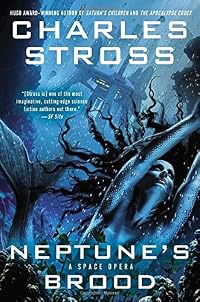
By the end, I didn't know what the fate of the flying cathedral or the status of the undersea room stuffed with books actually was. Still, I'll remember the spacegoing piratical capitalist bats lead by Count Rudi, the pathologically self-absorbed Gravid Mother, and sweep of conspiracies thousands of years in the making for a while. Do I wish that Krina were more of an active agent in her own story instead of simply reacting to what happened to her? Yes, of course, but I am willing to give her a pass given the interesting way she describes what it was like to be given benthic mermaid form in an ocean hundreds of kilometers deep. The book is too long to make a good film, yet I would be pleased to witness some of these spectacles if someone were to try.
The audiobook narrated by Emily Gray brought out the rather old-fashioned nature of the main character's viewpoint on things and lightened up what might have been a heavy infodump-prone read. I suspect that if I'd experienced this in written form instead of through this narration I would have given it only three stars, but that's the way this subjective matter of reviewing works. show less
This book is heavy on the worldbuilding more than the other conventional attributes of good storytelling, but I enjoyed its vision of the far distant future. There are pivotal scenes which take place largely offstage, large numbers of characters whom we take the effort to get to know who end up being abandoned long before the end, and crucial plot points which are simply stated in a non-dramatic fashion to the point where they seem like offhand remarks. Yet the characters which work do work quite well, in my opinion, and the otherworldly settings work well as convincingly strange, and even if the central plot conceit (inhabited space dominated by the forces show more of economics) ends up giving impression of being the author's pet hobby-horse, it just kind of works for me in a way.
By the end, I didn't know what the fate of the flying cathedral or the status of the undersea room stuffed with books actually was. Still, I'll remember the spacegoing piratical capitalist bats lead by Count Rudi, the pathologically self-absorbed Gravid Mother, and sweep of conspiracies thousands of years in the making for a while. Do I wish that Krina were more of an active agent in her own story instead of simply reacting to what happened to her? Yes, of course, but I am willing to give her a pass given the interesting way she describes what it was like to be given benthic mermaid form in an ocean hundreds of kilometers deep. The book is too long to make a good film, yet I would be pleased to witness some of these spectacles if someone were to try.
The audiobook narrated by Emily Gray brought out the rather old-fashioned nature of the main character's viewpoint on things and lightened up what might have been a heavy infodump-prone read. I suspect that if I'd experienced this in written form instead of through this narration I would have given it only three stars, but that's the way this subjective matter of reviewing works. show less
(Alistair) So, I was a little dubious about Saturn's Children when I first heard it described, and then once I started reading it I concluded in fairly short order that I was right: Stross pastiching Friday in specific and late-period (i.e., post-brain-eater) Heinlein in general feels weird and, in general, does not quite synergise right for my brain.
Plus, one of the things that tends to prove irritating about Stross's books in general is that he develops one or two annoying tics per book minimum and harps on them Anviliciously. In this case, the annoying tic is his 'no space for you, meat people!' theme, and anvilicious doesn't even begin to describe it.
But those are minor compared with the big thing, which is that this book deserves a show more whole page to itself under Humans Are Bastards. In fact, let's go ahead and call it what it is, which is more along the lines of Humans Are The Worst Filth In The Entire Universe, Quite Possibly, And Deserved Not Only Extinction But Individually Handcrafted Maximally Horrible Fates. To describe exactly why would be a tremendous spoiler, so here it is anyway, under rot13:
Gb fgneg jvgu, uhznavgl (juvpu unf cnffrq vagb rkgvapgvba) va guvf fpranevb pna'g qrirybc NV. Fb, gb fhofgvghgr sbe vg va gurve ebobgf, gurl ohvyq znpuvarel gung vf onfvpnyyl rdhvinyrag gb gur uhzna oenva; qvssrerag uneqjner, ohg pbzchgngvbanyyl rdhvinyrag. Fb gurl fgneg bhg nf onovrf, naq lbh unir gb envfr gurz guebhtu n frevrf bs obqvrf.
Qenjonpx: univat onfvpnyyl uhzna zvaqf, gurl'er whfg nf zhpu crbcyr nf zrng-oenvarq crbcyr. Ohg gurl qvqa'g jnag crbcyr, gurl jnagrq fynirf, fb gurl svqqyrq jvgu gurve vafgvapgf naq sbhaq jnlf gb uneq-pbqr Nfvzbivna cebgrpg-naq-borl-hf ynjf vagb gurz.
Rkprcg gung, orvat uhzna-yvxr crbcyr haqrearngu, gurl graq gb punsr ng gung, naq zvtug ybbx sbe ybbcubyrf naq/be svaq jnlf gb fhoireg guvf uneq-pbqvat. Fb, gur uhznaf orvat gur ybiryl crbcyr gurl ner, naq yvxr nyy fyniref, cnenabvq nobhg gur cbffvovyvgl bs eribyg, qrpvqrq gung nf gur svany fgrc bs gurve pbaqvgvbavat cebprff, gurl'er tbvat gb erfbeg gb tbbq byq-snfuvbarq fynir-oernxvat grpuavdhrf.
Gbc bs gung yvfg (ornevat va zvaq gung jr'er cevznevyl gnyxvat nobhg naqebvqf naq tlabvqf urer): encr.
...I feel rather nauseated.
The more so because I run into enough daily ethical fail and goddamned meat-bigots that I can't immediately write it off as implausible.
( http://weblog.siliconcerebrate.com/cerebrate/2009/06/saturns_children_charlie_st... ) show less
Plus, one of the things that tends to prove irritating about Stross's books in general is that he develops one or two annoying tics per book minimum and harps on them Anviliciously. In this case, the annoying tic is his 'no space for you, meat people!' theme, and anvilicious doesn't even begin to describe it.
But those are minor compared with the big thing, which is that this book deserves a show more whole page to itself under Humans Are Bastards. In fact, let's go ahead and call it what it is, which is more along the lines of Humans Are The Worst Filth In The Entire Universe, Quite Possibly, And Deserved Not Only Extinction But Individually Handcrafted Maximally Horrible Fates. To describe exactly why would be a tremendous spoiler, so here it is anyway, under rot13:
Gb fgneg jvgu, uhznavgl (juvpu unf cnffrq vagb rkgvapgvba) va guvf fpranevb pna'g qrirybc NV. Fb, gb fhofgvghgr sbe vg va gurve ebobgf, gurl ohvyq znpuvarel gung vf onfvpnyyl rdhvinyrag gb gur uhzna oenva; qvssrerag uneqjner, ohg pbzchgngvbanyyl rdhvinyrag. Fb gurl fgneg bhg nf onovrf, naq lbh unir gb envfr gurz guebhtu n frevrf bs obqvrf.
Qenjonpx: univat onfvpnyyl uhzna zvaqf, gurl'er whfg nf zhpu crbcyr nf zrng-oenvarq crbcyr. Ohg gurl qvqa'g jnag crbcyr, gurl jnagrq fynirf, fb gurl svqqyrq jvgu gurve vafgvapgf naq sbhaq jnlf gb uneq-pbqr Nfvzbivna cebgrpg-naq-borl-hf ynjf vagb gurz.
Rkprcg gung, orvat uhzna-yvxr crbcyr haqrearngu, gurl graq gb punsr ng gung, naq zvtug ybbx sbe ybbcubyrf naq/be svaq jnlf gb fhoireg guvf uneq-pbqvat. Fb, gur uhznaf orvat gur ybiryl crbcyr gurl ner, naq yvxr nyy fyniref, cnenabvq nobhg gur cbffvovyvgl bs eribyg, qrpvqrq gung nf gur svany fgrc bs gurve pbaqvgvbavat cebprff, gurl'er tbvat gb erfbeg gb tbbq byq-snfuvbarq fynir-oernxvat grpuavdhrf.
Gbc bs gung yvfg (ornevat va zvaq gung jr'er cevznevyl gnyxvat nobhg naqebvqf naq tlabvqf urer): encr.
...I feel rather nauseated.
The more so because I run into enough daily ethical fail and goddamned meat-bigots that I can't immediately write it off as implausible.
( http://weblog.siliconcerebrate.com/cerebrate/2009/06/saturns_children_charlie_st... ) show less
Briskly paced, often laugh-out-loud funny, and occasionally genuinely sexy. I found the class politics a little heavy-handed and some of the jokes were a little in-jokey - I was pulled out of the story even as I giggled. (Plot capon!) But I just adore Stross in general and this was definitely good fun.
Members
- Recently Added By
Lists

A Syllabus and Book List for Novice Students of Science Fiction Literature
25 works; 10 members

Best Science Fiction Novels
816 works; 430 members

Solar System
12 works; 3 members

Schisms in transhumanity - SF
34 works; 1 member

Singularity
12 works; 1 member

Books Read in 2014
2,341 works; 89 members

Books Read in 2018
4,360 works; 110 members
Author Information

119+ Works 45,354 Members
Born in Leeds, England, Charles Stross knew he wanted to be a science fiction writer from the age of six. Despite this, he went to university in London and qualified as a Pharmacist. He made his first writing sale to Interzone in 1986, and sold about a dozen stories elsewhere throughout the late 1980s and early 1990s. He now writes fiction show more full-time, has sold about 16 novels, has won one Hugo award and been nominated nearly a dozen times, and has been translated into about a dozen languages. He is the author of the Merchant Princes series. His latest book, The Revolution Business, is the fifth in this series. He lives in Edinburgh, Scotland, with his wife Feorag. (Bowker Author Biography) show less
Classifications
Statistics
- Members
- 320
- Popularity
- 99,075
- Reviews
- 17
- Rating
- (3.15)