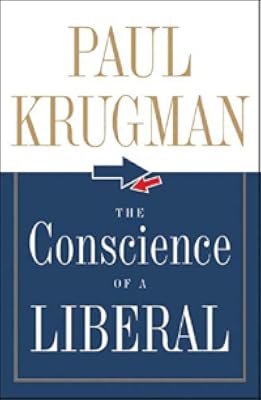
The Conscience of a Liberal
by Paul Krugman
On This Page
Description
Today's most widely read economist challenges America to reclaim the values that made it great. Here he studies the past eighty years of American history, from the reforms that tamed the harsh inequality of the Gilded Age to the unraveling of that achievement and the reemergence of immense economic and political inequality since the 1970s. Seeking to understand both what happened to middle-class America and what it will take to achieve a "new New Deal," Krugman has woven together a nuanced show more account of three generations of history with sharp political, social, and economic analysis. This book, written with Krugman's trademark ability to explain complex issues simply, may transform the debate about American social policy.--From publisher description. show lessTags
Recommendations



Member Reviews
I've been a regular reader of his always-interesting New York Times columns for years, but ever since I studied his work on trade and urban geography in grad school (coincidentally, the work that would gain him the 2008 Economics Nobel Prize), I've been a huge admirer of his serious economics work as well. The Conscience of a Liberal is a response of sorts to Barry Goldwaters's highly influential 1960 book The Conscience of a Conservative, making the case that if the United States is to remain a country where everyone can pursue their own happiness in maximum liberty and peace, the Reagan-era policies that benefit the rich few at the expense of the poor many must be reversed, and a new New Deal - chiefly the establishment of universal show more health care - is the best way to encourage opportunity and ensure that everyone can fully participate in the ever-changing American economy. It's also an enlightening history of the modern liberal and conservative movements that does a great job of showing the direct lineage from historical states' rights segregationists to modern health care reform opponents, and how calm debate and careful thinking can and should win out over narrow self-interest and greed. A good way to tell a good book is by how much it gives you to think about after you've finished, and The Conscience of a Liberal had me thinking about it for months afterwards. show less
Paul Krugman has been for a long time a lone beacon of sanity in the current US descent into darkness. I had high hopes for this book (which had generally good reviews) but am overall disappointed by the disjointed pieces that make up this book: a history of US income inequality in the 20th century (Gilded Age inequality, New Deal compression, rapid divergence by a growing class of ultra-rich since the Eighties), a paean to taxes and unions, an analysis of the rise of movement "conservatives", the Southern strategy and race in US politics, a plea and plan for government-funded health care and a surprisingly rosy outlook. The title "Conscience of a Liberal" is also a misnomer, as the book does neither discuss morale nor liberal values show more per se. The book dwells (apart from a few words on FDR's New Deal) mostly on conservative initiatives and Krugman's ideas for pushback (a health care plan, taxes and unions).
I have three issues with this book: nostalgia, picking the wrong fight and the easy way out.
Nostalgia. Krugman combines his description of US 20th century inequality with a nostalgic look at the Fifties and Sixties. I might not have personal recollections about that time, what I have read about (and increasingly looked at) that time period, it was everything but harmonious. The Krugmanian harmony was restricted to the white suburbs, the playground of organization man. The other America had to fight the battles of anti-communism (McCarthy anyone?) and civil rights. Krugman does not need to indulge in nostalgia to present his powerful arguments against income inequality. It would even help him to see some of the pernicious effects the unions inflicted on US competitiveness in the Sixties and Seventies. Better collective bargaining would help the poor in America. It is a fine line, however, between empowering unions and shackling management, protecting outdated work processes and jobs. A look at heavily unionized sectors (such as airlines and teaching) should give Krugman pause to think.
The wrong fight. Universal health care is yesterday's fight. The conservatives have intellectually lost this battle, all that remains is mopping up. Krugman was influential in winning this battle but this book is merely a coda. After the next presidential election, universal healthcare will come to all Americans, at last, in one form or another. Conservatives will guarantee that the system will be less efficient than in most other countries so that conservatives can preserve their mantra that government doesn't work.
The easy way out. Racism and the Southern strategy are the source of all evil in Krugman's view. The book's villain is Ronald Reagan who in Krugman's dictum led, as a race-baiting pied piper, the white Southerners from the Democratic to the Republican party. That shattered the alliance of Northern liberals and Southern transfer receivers. Krugman postulates declining racism and an increase of minority voters and concludes that the Republican strategy will fail. While race is a good predictor in the South, it cannot help why liberal Minnesota has become a swing state. Krugman neglects to mention the remarkable emergence of Southern economic power (Southwest Airlines, Walmart, Coca-Cola, even Enron) as well as the huge demographic shift to the South (Texas, Florida).
What I would have liked Krugman to discuss is the preponderant influence of the ultra-rich and corporations. He mentions trust-funded conservative think-tanks but does not dwell on media concentration nor on the demographics of US politicians themselves. A requirement for US politicians is a multi-million campaign fund, which restricts the possible candidates to rich people and dependents of certain institutions. Granted, the US has always been a rich man's country (starting with the Constitution which assigned the votes of those too poor to own even their own bodies to their owners). Most of the founding fathers were filthy rich. Those that were not (Tom Paine, Samuel Adams) were quickly pushed to the side lines. A government truly representative of the people might provide politics for the people. Given the entrenched opposition to a more equitable USA, there are no easy solutions. I wish Krugman had offered some more light. show less
I have three issues with this book: nostalgia, picking the wrong fight and the easy way out.
Nostalgia. Krugman combines his description of US 20th century inequality with a nostalgic look at the Fifties and Sixties. I might not have personal recollections about that time, what I have read about (and increasingly looked at) that time period, it was everything but harmonious. The Krugmanian harmony was restricted to the white suburbs, the playground of organization man. The other America had to fight the battles of anti-communism (McCarthy anyone?) and civil rights. Krugman does not need to indulge in nostalgia to present his powerful arguments against income inequality. It would even help him to see some of the pernicious effects the unions inflicted on US competitiveness in the Sixties and Seventies. Better collective bargaining would help the poor in America. It is a fine line, however, between empowering unions and shackling management, protecting outdated work processes and jobs. A look at heavily unionized sectors (such as airlines and teaching) should give Krugman pause to think.
The wrong fight. Universal health care is yesterday's fight. The conservatives have intellectually lost this battle, all that remains is mopping up. Krugman was influential in winning this battle but this book is merely a coda. After the next presidential election, universal healthcare will come to all Americans, at last, in one form or another. Conservatives will guarantee that the system will be less efficient than in most other countries so that conservatives can preserve their mantra that government doesn't work.
The easy way out. Racism and the Southern strategy are the source of all evil in Krugman's view. The book's villain is Ronald Reagan who in Krugman's dictum led, as a race-baiting pied piper, the white Southerners from the Democratic to the Republican party. That shattered the alliance of Northern liberals and Southern transfer receivers. Krugman postulates declining racism and an increase of minority voters and concludes that the Republican strategy will fail. While race is a good predictor in the South, it cannot help why liberal Minnesota has become a swing state. Krugman neglects to mention the remarkable emergence of Southern economic power (Southwest Airlines, Walmart, Coca-Cola, even Enron) as well as the huge demographic shift to the South (Texas, Florida).
What I would have liked Krugman to discuss is the preponderant influence of the ultra-rich and corporations. He mentions trust-funded conservative think-tanks but does not dwell on media concentration nor on the demographics of US politicians themselves. A requirement for US politicians is a multi-million campaign fund, which restricts the possible candidates to rich people and dependents of certain institutions. Granted, the US has always been a rich man's country (starting with the Constitution which assigned the votes of those too poor to own even their own bodies to their owners). Most of the founding fathers were filthy rich. Those that were not (Tom Paine, Samuel Adams) were quickly pushed to the side lines. A government truly representative of the people might provide politics for the people. Given the entrenched opposition to a more equitable USA, there are no easy solutions. I wish Krugman had offered some more light. show less
In The Conscience of a Liberal, Paul Krugman, Nobel Prize laureate in economics, provides a concise economic history of the United States since the 1920s, showing the direct connection between politics and the economy. He challenges the orthodox view that the economy is largely controlled by impersonal "market forces" and instead argues that political agendas and government policies driven by those agendas have had a major impact on economic conditions, especially in terms of the distribution of wealth and disparities in income. While economics has been described as the "dismal science", Krugman's writing is clear and very readable. He supports his arguments with ample statistical evidence, but in a non-wonkish style that can be readily show more understood by non-economists.
Krugman notes that we are moving into an age of economic inequality on a level not seen since the "long Gilded Age" which ended with the Great Depression and the advent of the New Deal. As in the Gilded Age, we now have a political system dominated by the economic orthodoxy of the Republican Party, friendly to corporations and the weatlhy and hostile to organized labor and the working class and largely indifferent to the middle class. The New Deal began what Krugman calls the "Great Compression", a redistribution of weatlth downward from the top to a rapidly expanding middle class. The creation of Social Security, and later Medicare, helped to provide economic security for millions of the most vulnerable and provided a boost to the economy in general. Then the massive spending of the Second World War brought the nation back to prosperity, creating almost full employment and further moving wealth to the middle class. The GI Bill and the growth of labor unions in the postwar decades were crucial in creating good-paying jobs for millions of veterans and elevating the majority of the population into the middle class.
But since the "Reagan revolution" of the 1980s, the GOP has been taken over by movement conservatism, which in turn has pulled the entire political spectrum farther to the right. The major parties once had a large area of ideological overlap in the center, but the new Republican Party has gone so far to the radical right that there is no longer any bipartisan center in Congress or in most state legislatures. Whereas, Krugman writes, Eisenhower Republicans had come to accept Social Security and other fundamental institutions created by the New Deal, the new Republicans are determined to undo all progressive economic policy enacted since the time of FDR. They have largely succeded in reducing taxes on the highest incomes to the lowest level in decades, reducing or eliminating most corporate income tax and drastically reducing the capital gains tax. At the same time, they have promoted the massive inflation of corporate CEO salaries and benefits so that American business executives are paid much more lavishly than their foreign counterparts in other prosperous nations, while the buying power of most American workers has stagnated for decades.
As Krugman argues, the economic policies of the GOP would be wildly unpopular, if they were presented nakedly in their true nature. But movement conservatives have brilliantly used a faux populism to disguise their economic agenda, getting millions of middle class, and even working class, voters to vote against their own interests. This is largely achieved through the "politics of mass distraction" as Krugman describes it. Central to this strategy has been the appeal to white supremacy, which converted millions of Southern Democrats into Republicans, creating the Southern base for the party that was once that of Lincoln. Movement conservatives have also harnessed the religious fanaticism of voters most concerned about such issues as abortion, sexuality, and prayer in public places, as well as "gun rights" and the "sanctity of marriage" and the traditional home life idealized in 1950s television sitcoms.
Krugman's Conscience of a Liberal was published five years ago, before the election of President Obama and the subsequent Tea Party backlash. The radicalization of the GOP has only gottem worse since then. But he also wrote before the emergence of Occupy Wall Street and the counter-offensive organized by labor unions in Wisconsin, Ohio and elsewhere. Although the economic disparity he decried in the book seems to be worsening, the genuine populist resistance to the dominant ideological agenda is gaining strength. Krugman provides both a dire warning and a call to action to restore economic fairness, and a more secure life for the vast majority, while we still have the means to do so through the power of the ballot. show less
Krugman notes that we are moving into an age of economic inequality on a level not seen since the "long Gilded Age" which ended with the Great Depression and the advent of the New Deal. As in the Gilded Age, we now have a political system dominated by the economic orthodoxy of the Republican Party, friendly to corporations and the weatlhy and hostile to organized labor and the working class and largely indifferent to the middle class. The New Deal began what Krugman calls the "Great Compression", a redistribution of weatlth downward from the top to a rapidly expanding middle class. The creation of Social Security, and later Medicare, helped to provide economic security for millions of the most vulnerable and provided a boost to the economy in general. Then the massive spending of the Second World War brought the nation back to prosperity, creating almost full employment and further moving wealth to the middle class. The GI Bill and the growth of labor unions in the postwar decades were crucial in creating good-paying jobs for millions of veterans and elevating the majority of the population into the middle class.
But since the "Reagan revolution" of the 1980s, the GOP has been taken over by movement conservatism, which in turn has pulled the entire political spectrum farther to the right. The major parties once had a large area of ideological overlap in the center, but the new Republican Party has gone so far to the radical right that there is no longer any bipartisan center in Congress or in most state legislatures. Whereas, Krugman writes, Eisenhower Republicans had come to accept Social Security and other fundamental institutions created by the New Deal, the new Republicans are determined to undo all progressive economic policy enacted since the time of FDR. They have largely succeded in reducing taxes on the highest incomes to the lowest level in decades, reducing or eliminating most corporate income tax and drastically reducing the capital gains tax. At the same time, they have promoted the massive inflation of corporate CEO salaries and benefits so that American business executives are paid much more lavishly than their foreign counterparts in other prosperous nations, while the buying power of most American workers has stagnated for decades.
As Krugman argues, the economic policies of the GOP would be wildly unpopular, if they were presented nakedly in their true nature. But movement conservatives have brilliantly used a faux populism to disguise their economic agenda, getting millions of middle class, and even working class, voters to vote against their own interests. This is largely achieved through the "politics of mass distraction" as Krugman describes it. Central to this strategy has been the appeal to white supremacy, which converted millions of Southern Democrats into Republicans, creating the Southern base for the party that was once that of Lincoln. Movement conservatives have also harnessed the religious fanaticism of voters most concerned about such issues as abortion, sexuality, and prayer in public places, as well as "gun rights" and the "sanctity of marriage" and the traditional home life idealized in 1950s television sitcoms.
Krugman's Conscience of a Liberal was published five years ago, before the election of President Obama and the subsequent Tea Party backlash. The radicalization of the GOP has only gottem worse since then. But he also wrote before the emergence of Occupy Wall Street and the counter-offensive organized by labor unions in Wisconsin, Ohio and elsewhere. Although the economic disparity he decried in the book seems to be worsening, the genuine populist resistance to the dominant ideological agenda is gaining strength. Krugman provides both a dire warning and a call to action to restore economic fairness, and a more secure life for the vast majority, while we still have the means to do so through the power of the ballot. show less
I have been a fan of Paul Krugman's since I was assigned his book Accidental Theorist in my Intro to Macro class in college. I was very excited when Conscience of a Liberal came out. And what a great education it was. It retaught me things I learned in middle and high school, but couldn't appreciate at the time about the New Deal and its effects. It has also helped me develop my ideas about health care and, while I don't agree with every point he makes about health care, it has helped me be able to better articulate my arguments. I honestly think every citizen of this country, regardless of party or beliefs, should read this. My only criticism of the book is I wish he had given it a more innocuous title so those that think calling show more someone a liberal is an insult might read this book as well. Just as a little side note related to this book, here is FDR's Madison Square Garden speech from October 31, 1936. show less
This is the problem. I did not learn that much from Krugman's book. I personally feel that one of its shortcomings is that Krugman writes for only one audience (I think a great writer could appeal to many audiences). I did learn a few more historical details about past administrations' policies (Nixon's ideas about SS and Medicare). Even though a lot of fiscally conservative folks dislike Krugman, I'd say that his analysis of history is pretty non-partisan.
Krugman takes the reader on a succinct and readable journey through of US economic history beginning from about 1900 up to the present. His focus is how the average (or more precisely median) worker has fared. Krugman recounts the great economic inequality in the pre-Great Depression era and demonstrates that nearly identical levels of inequality have returned.
Krugman’s primary argument is that US government policies and actions can be used to reduce economic inequality and that it did so in response to the Great Depression, through World War Two and beyond. He calls this era the Great Compression when the average CEO of a large company made about 30 times the income of an average worker rather than today’s multiplier of 300. He show more further argues that conservative political forces used Nixon’s Southern strategy to divide workers and attain power. Once there, these forces applied Friedman economics (and some made-up economics like the ‘supply-side’ craze) to government policies, declared war on unions, and deregulated across the board. Krugman presciently argued that the Republicans’ politics of racial division were nearing the end of the road as the demographics of the US changed.
Krugman expected the recent victory by a progressive Democrat in 2008. He sets forth several fairly specific policy recommendations for progressives (liberals who do things): universal health insurance, a more progressive tax structure, increase the minimum wage, and make union organizing easier. Part of his argument for giving priority to universal health insurance is that it will demonstrate that the government can indeed institute policies that make a person’s life better. After several decades of anti-government rhetoric, such a demonstration is necessary.
Krugman’s prescriptions are not a complete progressive agenda – he barely touches on the environment – but if President Obama and Congress institute Krugman’s ideas in the economic realm we will have a fairer society where the benefits of economic activity are more equitably shared. My personal feeling is they should act aggressively and swiftly on multiple fronts before the GOP has recovered its footing and to occupy the inevitable political counterattack busy with many challenges at once. show less
Krugman’s primary argument is that US government policies and actions can be used to reduce economic inequality and that it did so in response to the Great Depression, through World War Two and beyond. He calls this era the Great Compression when the average CEO of a large company made about 30 times the income of an average worker rather than today’s multiplier of 300. He show more further argues that conservative political forces used Nixon’s Southern strategy to divide workers and attain power. Once there, these forces applied Friedman economics (and some made-up economics like the ‘supply-side’ craze) to government policies, declared war on unions, and deregulated across the board. Krugman presciently argued that the Republicans’ politics of racial division were nearing the end of the road as the demographics of the US changed.
Krugman expected the recent victory by a progressive Democrat in 2008. He sets forth several fairly specific policy recommendations for progressives (liberals who do things): universal health insurance, a more progressive tax structure, increase the minimum wage, and make union organizing easier. Part of his argument for giving priority to universal health insurance is that it will demonstrate that the government can indeed institute policies that make a person’s life better. After several decades of anti-government rhetoric, such a demonstration is necessary.
Krugman’s prescriptions are not a complete progressive agenda – he barely touches on the environment – but if President Obama and Congress institute Krugman’s ideas in the economic realm we will have a fairer society where the benefits of economic activity are more equitably shared. My personal feeling is they should act aggressively and swiftly on multiple fronts before the GOP has recovered its footing and to occupy the inevitable political counterattack busy with many challenges at once. show less
I don't read Krugman's columns much, so didn't have many preconceived expectations. Thought he made a lot of interesting points, in particular about our country's financial history, but thought the evidence for many of his claims seemed sparse. In particular, many of his comments about the Republican party, if true -- I'm not 100% convinced, really scare me.
Members
- Recently Added By
Published Reviews
ThingScore 100
In all, Krugman has managed to pull together huge chunks of American social, political and economic history in a fairly brief space. He writes from a confidently liberal perspective, picking apart the "vast rightwing conspiracy" with considerable ingenuity.
added by mikeg2
Lists

LT picks: Blue Books
197 works; 39 members

Blue Books
20 works; 1 member

The Enlightened Economist
107 works; 1 member

Works referenced in Capital in the Twenty-First Century by Thomas Piketty
62 works; 2 members
Author Information

59+ Works 7,433 Members
Paul Krugman was born on February 28, 1953. He received a B.S. in economics from Yale University in 1974 and a Ph.D from MIT in 1977. From 1982 to 1983, he worked at the Reagan White House as a member of the Council of Economic Advisers. He taught at numerous universities including Yale University, MIT, UC Berkeley, the London School of Economics, show more and Stanford University before becoming a professor of economics and international affairs at Princeton University in 2000. He has written over 200 scholarly papers and 20 books including Peddling Prosperity; International Economics: Theory and Policy; The Great Unraveling; and The Conscience of a Liberal. Since 2000, he has written a twice-weekly column for The New York Times. He received the 1991 John Bates Clark Medal and the 2008 Nobel Memorial Prize in Economic Sciences. His title End This Depression Now! made The New York Times Best Seller List for 2012. (Bowker Author Biography) show less
Some Editions
Classifications
- Genres
- Economics, Nonfiction, General Nonfiction, Politics and Government, History
- DDC/MDS
- 339.220973 — Society, government, & culture Economics Macroeconomics and related topics Distribution Of Income And Wealth Economic Inequality United States
- LCC
- HC110 .I5 .K74 — Social sciences Economic history and conditions Economic history and conditions By region or country
- BISAC
Statistics
- Members
- 1,142
- Popularity
- 22,137
- Reviews
- 23
- Rating
- (4.02)
- Languages
- 10 — Czech, English, French, German, Italian, Japanese, Korean, Portuguese, Spanish, Turkish
- Media
- Paper, Audiobook, Ebook
- ISBNs
- 24
- ASINs
- 7