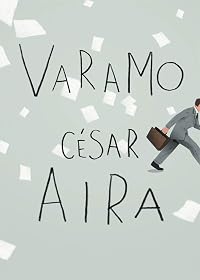
Varamo
by César Aira
On This Page
Description
"Varamo concerns a day in the life of a hapless government employee. After being paid by the ministry in counterfeit money, our unfortunate bureaucrat, Varamo, wanders around all night, then sits down and writes the most celebrated masterwork of modern Central American poetry, The Song of the Virgin Boy. What is odd is that Varamo, at fifty years old, 'hadn't previously written one sole verse, nor had it ever occurred to him to write one.'"--P. [4] of cover.Tags
Recommendations






Member Reviews
All writing seems silly when you analyse it. Varamo works for the government of Panama and one day he is paid his salary in counterfeit bills. He knows it when it happens, but does nothing. So we are already inside Varamo’s mind.
Aira tells us along the way that his third person narrative is in the school of “Free Indirect Style”.
But this is relevant since money and the Free Indirect Style are connected in the narrative. The first clue is the point of view – why would anyone be silly enough to say nothing when receiving a counterfeit bill from their employer? It explains character, but also propels plot. And Aira novels feel plotted, though they may or may not be. I can’t tell.
Free indirect style and money, are, in their show more respective domains, causes that operate at a level apart, above or below other causes
A long treatise on how the free indirect style affects this story continues:
The only possible, though tenuous justification, lies in the fact that the counterfeit bills, precisely because they are counterfeit, bring an element of irreducible materiality to a space of abstraction…
During a tortuous night of encounters, Varamo meets people who transform him, too, like his neighbours the Gongoras sisters, women he has never met, who live in his street. Everyone in Panama is racially mixed. Nothing is in fact an abstraction, but a meeting of blood, creeds, like the two oceans that bring east to west. Varamo’s family is Chinese on his mother’s side. The Gongoras are mixed blood, too, kept apart from others by innuendo, gossip and human miserliness. They bring him into a plot he must take part in.
Unplanned parties are always the most fun one of them says.
Having encountered them, Varamo is in a better place. Connection is really everything.
Later Varamo will write a long poem for publication. It seems writers are in demand by pirate publishers who meet in bars looking for content. It is the early 20thC. The Caribbean is still the domain of piracy and plunder, only writing and art are its focus.
Varamo is an anxious man, full of vulnerabilities. He is the perfect subject for the free indirect style. When reading books, we like to be transformed, if we are truly reading. Varamo is thankfully transformed by this book, too. His life is likely better after a day in Cesar Aira’s hands. And so are we as its reader. show less
Aira tells us along the way that his third person narrative is in the school of “Free Indirect Style”.
But this is relevant since money and the Free Indirect Style are connected in the narrative. The first clue is the point of view – why would anyone be silly enough to say nothing when receiving a counterfeit bill from their employer? It explains character, but also propels plot. And Aira novels feel plotted, though they may or may not be. I can’t tell.
Free indirect style and money, are, in their show more respective domains, causes that operate at a level apart, above or below other causes
A long treatise on how the free indirect style affects this story continues:
The only possible, though tenuous justification, lies in the fact that the counterfeit bills, precisely because they are counterfeit, bring an element of irreducible materiality to a space of abstraction…
During a tortuous night of encounters, Varamo meets people who transform him, too, like his neighbours the Gongoras sisters, women he has never met, who live in his street. Everyone in Panama is racially mixed. Nothing is in fact an abstraction, but a meeting of blood, creeds, like the two oceans that bring east to west. Varamo’s family is Chinese on his mother’s side. The Gongoras are mixed blood, too, kept apart from others by innuendo, gossip and human miserliness. They bring him into a plot he must take part in.
Unplanned parties are always the most fun one of them says.
Having encountered them, Varamo is in a better place. Connection is really everything.
Later Varamo will write a long poem for publication. It seems writers are in demand by pirate publishers who meet in bars looking for content. It is the early 20thC. The Caribbean is still the domain of piracy and plunder, only writing and art are its focus.
Varamo is an anxious man, full of vulnerabilities. He is the perfect subject for the free indirect style. When reading books, we like to be transformed, if we are truly reading. Varamo is thankfully transformed by this book, too. His life is likely better after a day in Cesar Aira’s hands. And so are we as its reader. show less
César Aira thrives on improvisation. His eighty or so novellas have been written, so the Argentine author recounts in an interview, one page at a time without rewriting or revision– then he move on to the next page - in other words, like a modern day Scheherazade, César makes it up as he goes along.
Which prompts the question: what kind of stories are we talking about here? Answer: whimsical, quirky, idiosyncratic, flighty. And heady, as if a few drops of Ludwig Wittgenstein or Jacques Derrida were added to the literary cocktail. If you are looking for straightforward storytelling, you'll have to look elsewhere since César takes time out for metaphysical asides, delightful digressions and erudite episodes.
Varamo might be César show more Aira’s all-time favorite among his books for a few distinct reasons: 1) a prime theme is the very act of improvisation; 2) toward the end of the story, Varamo assumes the identity of a writer; 3) Varamo is fifty-years old, the same age as César when he wrote this novella in 1999.
Varamo takes place in Colón, Panama in 1923 and opens with a civil servant lackey with that name handed his monthly salary of two hundred pesos. But, to his consternation, the two one-hundred peso bills are counterfeit. Huge upset to his routine. We follow our discombobulated grey-flannel flunky throughout his day, in the town square, at his home and then out on an evening excursion. The novella ends with some hack Panamanian publishers convincing Varamo to assume the mantle of a writer and provide them with a manuscript the very next day. Varamo does much more: he writes a celebrated masterpiece, The Song of the Virgin Child.
The eighty-nine pages of this New Directions publication, smoothly translated into English by Chris Andrews, covers the world of Varamo between the time he receives those counterfeit bills and the writing of his famous poem. So, to share some tangy tastes of what a reader is in store for, in the spirit of Cesar’s fickle fancies, I will link my comments with a number of Varamo quotes:
"Light was what made the world work; the world was Colón; Colón was the square. Light dissolved the worries created by its dark twin, thought. . . . . On the one hand light dissolved, and on the other it condensed: its action had produce those colored statues known as plants, people, animals, clouds and the earth." --------- In keeping with the world's mystical traditions, a recognition we have two natures, our particular material individuality and, more importantly, our eternal light nature connecting us with the entire cosmos.
"Varamo had always wondered how people managed to go on living. Now he thought he knew the answer: they could do it because they didn't have to wonder how they would change their counterfeit bills." --------- Such a mindset is a consequence of performing years of drudge-work, locked into a stale routine: thinking the psychic glue holding society together is workaday predictability. And over time, humdrum regularity becomes the alpha and omega, the very reason for rousing oneself out of bed in the morning. Reading between the lines, my sense is César Aira loathes such stagnation which is a blight on improvisation and the creative process.
"His hobby was embalming small animals. . . . The animals had to "turn out" well - whole, shiny, natural, strikingly posed - in other words, they had to turn out to be just as they'd been at the start, before the process began." --------- Ha! Even milquetoast Varamo has an eccentric side. His current project is producing a fish playing the piano. One of the quirkier, fascinating parts. Embalming as a metaphor for a clerk? For the citizens of Colón? For the Panamanian publishers? Questions to have fun with.
"Although this book takes the form of a novel, it is a work of literary history, not a fiction, because the protagonist existed, and he was the author of a famous poem that is studied to this day as a watershed in the development of the Spanish American avant-garde movements." ---------- Intriguing. Of course the narrator can claim "this book" isn't a fiction since, as narrator, he exists within the novella. But can we as readers make a similar claim? César obviously enjoyed playing these philosophic games.
"Free indirect style, which is the view from inside a character expressed in the third person, creates an impression of naturalness, and allows us to forget that we are reading fiction and that, in the real world, we never know what other people are thinking, or why they do what they do. . . . So, far from being just another literary technique, free indirect style is the key mechanism of trans-subjectivity, without which we would have no understanding of social interactions." --------- Now that's profound! Taking this line of thinking into historical context, we may ask: how influential was the birth of the novel in modern European civilization in empowering men and women with a capacity to analyze and criticize their society in new ways. More specifically, did novels fuel such isms as Marxism and socialism?
"Do you write?" Varamo smiled and said no, amused by the thought. It had never occurred to him. "But we're open to local writing, especially if it's the work of intelligent and cultured people like yourself. You wouldn't like to try?" Varamo replied that it was tempting. But he had no experience, he didn't even know the basics of the writer's craft." ---------- The humor of asking a clerk if he writes, suggesting that if a publisher is after money, they will publish books no matter how low the quality, as long as they can make profit. The connection of money and improvisation pops up again and again.
"In barbaric lands like the Americas, writers produced their best work before learning the craft, and nine times out of ten, their first book was the strongest, as well as being, in general, the only one they wrote." -------- I recall César speaking his mind about airport books: horror novels, detective novels, romance novels, crime novels, espionage novels, religious novels. With novels written by the likes of Tom Clancy and Pat Robertson, one can appreciate how a sensitive literary man such as César Aira can shake his head at the state of novel writing in the contemporary world.
None of my quotes are taken from the last ten page. These final pages are the sweetest of the sweet nectar. I urge you to partake of César's sumptuous feast. For connoisseurs of literature, every page of Varamo is a delight.
César Aira, Born 1949 show less
The back cover of this short novella compares it to Borges, which seems to be a common comparison among Argentine authors, at least the ones more available in English translation. Although if you had asked me, I would have said the book was 80 percent Chesterton (of The Man Who Was Thursday), 15 percent Nabokov (of Pale Fire), and at most 5 percent Borges. And a reasonably well executed version of that.
It describes less than twenty-four hours in the life of a Panamanian civil servant in the 1930s, beginning with his getting paid in counterfeit currency and ending with his writing what the novella describes as the greatest Central American poem. The book explains that this entire story is derived from textual evidence from the poem show more itself, often a single word or syllable, which allow the precise reconstruction of the sequence of events that resulted in the composition of the book itself. A sequence that includes a bizarre but memorable car "race", descriptions of golf club smugglers, the revelation of an underground anarchist society, and much more in a paranoid, hallucinatory vision. But it all has an internal logic. All that is missing (contra Pale Fire) is the poem itself. show less
It describes less than twenty-four hours in the life of a Panamanian civil servant in the 1930s, beginning with his getting paid in counterfeit currency and ending with his writing what the novella describes as the greatest Central American poem. The book explains that this entire story is derived from textual evidence from the poem show more itself, often a single word or syllable, which allow the precise reconstruction of the sequence of events that resulted in the composition of the book itself. A sequence that includes a bizarre but memorable car "race", descriptions of golf club smugglers, the revelation of an underground anarchist society, and much more in a paranoid, hallucinatory vision. But it all has an internal logic. All that is missing (contra Pale Fire) is the poem itself. show less
Another brilliant-but-brief piece of philosophical fiction from Aira. This was the last English-translation of his that I read (hopefully there are many more to come), and like the others that ND has produced, it has a nice mixture of realism, fantasy, and philosophy. Aira tells us the premise of the story early, within the first couple pages, and then produces a detailed unfolding of the story. He crafts the story so carefully, foreshadowing events within the first few pages, and then waiting until the final few to make the connection.
In his typical realist mode, he uses a government clerk--Varamo--as his protagonist, and the story revolves around how Varamo comes to write a poetic masterpiece over the period of a day. There are many show more philosophical meanderings which both foreshadow future events and spell out the points he is making in the story. The novel is almost a statement of the author's self-deprecation, or at least a statement about the publishing 'industry' (which the author may or may not consider himself part of). The way Varamo comes to his literary success is both funny and sad.
Aira does such a wonderful job of writing about such banal details, yet making these details seem almost other-worldly. The story itself is not very interesting, but by the connections he makes between the events told and the abstract ideas these events reveal, he creates something profound. And of course, his storytelling is excellent. show less
In his typical realist mode, he uses a government clerk--Varamo--as his protagonist, and the story revolves around how Varamo comes to write a poetic masterpiece over the period of a day. There are many show more philosophical meanderings which both foreshadow future events and spell out the points he is making in the story. The novel is almost a statement of the author's self-deprecation, or at least a statement about the publishing 'industry' (which the author may or may not consider himself part of). The way Varamo comes to his literary success is both funny and sad.
Aira does such a wonderful job of writing about such banal details, yet making these details seem almost other-worldly. The story itself is not very interesting, but by the connections he makes between the events told and the abstract ideas these events reveal, he creates something profound. And of course, his storytelling is excellent. show less
The back cover of this short novella compares it to Borges, which seems to be a common comparison among Argentine authors, at least the ones more available in English translation. Although if you had asked me, I would have said the book was 80 percent Chesterton (of The Man Who Was Thursday), 15 percent Nabokov (of Pale Fire), and at most 5 percent Borges. And a reasonably well executed version of that.
It describes less than twenty-four hours in the life of a Panamanian civil servant in the 1930s, beginning with his getting paid in counterfeit currency and ending with his writing what the novella describes as the greatest Central American poem. The book explains that this entire story is derived from textual evidence from the poem show more itself, often a single word or syllable, which allow the precise reconstruction of the sequence of events that resulted in the composition of the book itself. A sequence that includes a bizarre but memorable car "race", descriptions of golf club smugglers, the revelation of an underground anarchist society, and much more in a paranoid, hallucinatory vision. But it all has an internal logic. All that is missing (contra Pale Fire) is the poem itself. show less
It describes less than twenty-four hours in the life of a Panamanian civil servant in the 1930s, beginning with his getting paid in counterfeit currency and ending with his writing what the novella describes as the greatest Central American poem. The book explains that this entire story is derived from textual evidence from the poem show more itself, often a single word or syllable, which allow the precise reconstruction of the sequence of events that resulted in the composition of the book itself. A sequence that includes a bizarre but memorable car "race", descriptions of golf club smugglers, the revelation of an underground anarchist society, and much more in a paranoid, hallucinatory vision. But it all has an internal logic. All that is missing (contra Pale Fire) is the poem itself. show less
Genial. Junto con Un episodio en la vida de un pintor viajero y Embalse, me pareció una de las mejores novelas de Aira. El autor despliega todas sus armas literarias para sacar adelante una novela fascinante, que se devela como una pieza de investigación sobre el acto de creación mismo. Encontré los mismos elementos tan característicos y divertidos de Aira que aparecen en cada una de sus novelas. Seres imposibles y mágicos que aparecen a raíz de hechos fortuitos y no tanto, para desencadenar eventos inesperados y absurdos, pero que encierran una lógica interna implacable.
The stars were an overwhelming surprise. But since each scene was linked to the one that that had gone before, he continued to see the dominoes and dishes, twinkling among the constellations.
Came home last pondering when to begin the traditional chili verde, thought better of rushing in, fearful angels and all that. My better half was knitting and watching a PBS documentary on puffer fish and how the males make these ornate designs of ocean floor to attract potential mates. I ruminated on that and decided I didn't need a beer- recovering from Strep and prudence. I deal exclusively in shit parables. I had read half of Varamo previously but suddenly felt too knackered to complete the slim volume. I slept and dreamt I was chased in the show more streets and beaten as a communist.
Brilliant sun here today. Beethoven sonatas and espresso assisted in the chili prep. It was then that I finished the convoluted saga of a day in the life of civil servant become one time poet. The novella is a fascinating exercise. A miniature heavy in loose ends but somehow satisfying. 3.4 stars -- rounded up in the esprit of largesse. show less
Came home last pondering when to begin the traditional chili verde, thought better of rushing in, fearful angels and all that. My better half was knitting and watching a PBS documentary on puffer fish and how the males make these ornate designs of ocean floor to attract potential mates. I ruminated on that and decided I didn't need a beer- recovering from Strep and prudence. I deal exclusively in shit parables. I had read half of Varamo previously but suddenly felt too knackered to complete the slim volume. I slept and dreamt I was chased in the show more streets and beaten as a communist.
Brilliant sun here today. Beethoven sonatas and espresso assisted in the chili prep. It was then that I finished the convoluted saga of a day in the life of civil servant become one time poet. The novella is a fascinating exercise. A miniature heavy in loose ends but somehow satisfying. 3.4 stars -- rounded up in the esprit of largesse. show less
Members
- Recently Added By
Lists

Novels set over the course of a single day (or less)
72 works; 8 members

Favorite Books in Translation
320 works; 133 members
Author Information

169+ Works 5,013 Members
Some Editions
Awards and Honors
Work Relationships
Is contained in
Common Knowledge
- Original title
- Varamo
- Original publication date
- 1999
- Important places
- Colón, Panama
- First words
- One day in 1923, in the city of Colón (Panama), a third-class clerk, having finished his work, and, since it was payday, passed by the cashier's desk to collect his monthly salary, left the Ministry in which he was employed.
- Last words
- (Click to show. Warning: May contain spoilers.)Those who don't believe me can go and see for themselves.
- Original language
- Spanish
Classifications
- Genres
- General Fiction, Fiction and Literature
- DDC/MDS
- 863.64 — Literature & rhetoric Spanish Literature Spanish fiction 20th Century 1945-2000
- LCC
- PQ7798.1 .I7 .V3713 — Language and Literature French, Italian, Spanish and Portuguese literatures Spanish literature Provincial, local, colonial, etc. Spanish America
- BISAC
Statistics
- Members
- 254
- Popularity
- 127,686
- Reviews
- 11
- Rating
- (3.74)
- Languages
- 7 — Danish, Dutch, English, French, German, Greek, Spanish
- Media
- Paper, Ebook
- ISBNs
- 15
- ASINs
- 2