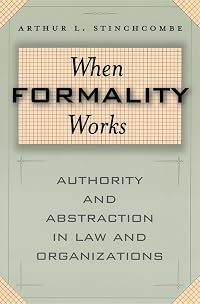
When Formality Works: Authority and Abstraction in Law and Organizations
by Arthur L. Stinchcombe
On This Page
Description
In this innovative exploration of the concept of formality, or governing by abstraction, Arthur Stinchcombe breathes new life into an idea that scholars have all but ignored in recent years. We have come to assume that governing our social activities by advance planning--by creating abstract descriptions of what ought to happen and adjusting these descriptions as situations change--is not as efficient and responsive as dealing directly with the real substance of the situation at hand. show more Stinchcombe argues the opposite. When a plan is designed to correct itself and keep up with the reality it is meant to govern, it can be remarkably successful. He points out a wide range of examples where this is the case, including architectural blueprints, immigration law, the construction of common law by appeals courts, Fannie Mae's secondary mortgage market, and scientific paradigms and programs. Arguing that formality has been misconceived as consisting mainly of its defects, Stinchcombe shows how formality, at its best, can serve us much better than ritual obedience to poorly laid plans or a romantic appeal to "real life." show lessTags
Member Reviews
formality--what is it, what's it good for, and when does it work well?
what it is is government by abstractions. as such it is easy to criticize in any particular case: an abstract category always fails to do justice to some particulars that we can, informally, point out. and so those urging informality can in any particular case feel they have a superior way of doing things.
but this misses what formality is good for. what's it good for, what justifies its use, is not in its handling of this case or that, but in handling all of the cases in a way that in aggregate serves some end.
very often you do not like the end being served: eg, the employee handbook says you may not wear shorts, notwithstanding the merits of the tasteful pair you show more are wearing. this is a grievance with the end (the policy), not the means (formality).
with all that said, we can get on to the more interesting question: given its ends, when does formality work well? stinchcombe lays out three criteria: (1) when it is accurate, (2) when it facilitates communication, and (3) when it provides the means for its own improvement. rendered schematically like this it can sound obvious but the illustrative examples he provides, especially from law courts, have many interesting quirks that are explained by scheme.
lower courts find facts and hear witnesses, fit the circumstances to established legal categories and rules, and then apply the law. the chief virtue here is that they treat "like cases" alike, where likeness is defined modulo the established legal categories. this can fail when the established law lacks "accuracy" -- ie, they are failing to attending to the detail in a way that subvert the substantive ends (policies) the law is meant to serve.
when this happens there are appellate courts. they can tweak the categories and rules to repair them and remand the case back to lower courts. this is an example of a formal system providing a mechanism for its own improvement. an analogy used: the rigidity and flexibility of the different courts is not unlike bones and muscles, jointly necessary to get anywhere.
architectural blueprints provide a case study that brings out other aspects of formality: communicability via conventions, compartmentalization of tasks, the ineradicable place of a craftsman's informal/tacit know-how in the final job of installing the sink.
there is some interesting discussion of another property of formality: the abstractions render particular cases into fungible units, and this creates something new and powerful -- liquidity. liquidity is desirable because it permits securitization, allowing us to a mange risks. your house meets the eligibility criteria for fire insurance, allowing you to pool risk with your neighbors. the shunting of wheat granular into abstract quality grades makes it possible to trade tons of the stuff as commodities, permitting society to allocate resources more efficiently over time and space.
again, "efficiency" of course is relative to substantive policy ends, which we know are very often bad/dumb due to living in an unjust society. but if we wish to live in a just one, we should appreciate the powerful instrumental rationality of government by abstractions. show less
what it is is government by abstractions. as such it is easy to criticize in any particular case: an abstract category always fails to do justice to some particulars that we can, informally, point out. and so those urging informality can in any particular case feel they have a superior way of doing things.
but this misses what formality is good for. what's it good for, what justifies its use, is not in its handling of this case or that, but in handling all of the cases in a way that in aggregate serves some end.
very often you do not like the end being served: eg, the employee handbook says you may not wear shorts, notwithstanding the merits of the tasteful pair you show more are wearing. this is a grievance with the end (the policy), not the means (formality).
with all that said, we can get on to the more interesting question: given its ends, when does formality work well? stinchcombe lays out three criteria: (1) when it is accurate, (2) when it facilitates communication, and (3) when it provides the means for its own improvement. rendered schematically like this it can sound obvious but the illustrative examples he provides, especially from law courts, have many interesting quirks that are explained by scheme.
lower courts find facts and hear witnesses, fit the circumstances to established legal categories and rules, and then apply the law. the chief virtue here is that they treat "like cases" alike, where likeness is defined modulo the established legal categories. this can fail when the established law lacks "accuracy" -- ie, they are failing to attending to the detail in a way that subvert the substantive ends (policies) the law is meant to serve.
when this happens there are appellate courts. they can tweak the categories and rules to repair them and remand the case back to lower courts. this is an example of a formal system providing a mechanism for its own improvement. an analogy used: the rigidity and flexibility of the different courts is not unlike bones and muscles, jointly necessary to get anywhere.
architectural blueprints provide a case study that brings out other aspects of formality: communicability via conventions, compartmentalization of tasks, the ineradicable place of a craftsman's informal/tacit know-how in the final job of installing the sink.
there is some interesting discussion of another property of formality: the abstractions render particular cases into fungible units, and this creates something new and powerful -- liquidity. liquidity is desirable because it permits securitization, allowing us to a mange risks. your house meets the eligibility criteria for fire insurance, allowing you to pool risk with your neighbors. the shunting of wheat granular into abstract quality grades makes it possible to trade tons of the stuff as commodities, permitting society to allocate resources more efficiently over time and space.
again, "efficiency" of course is relative to substantive policy ends, which we know are very often bad/dumb due to living in an unjust society. but if we wish to live in a just one, we should appreciate the powerful instrumental rationality of government by abstractions. show less
Ratings
Members
- Recently Added By
Author Information
11 Works 175 Members
Classifications
- Genres
- Politics and Government, Nonfiction, Sociology, Business
- DDC/MDS
- 340.115 — Society, government, & culture Law Law Theory Particular Topics Law, Justice, and Society
- LCC
- K370 .S75 — Law Jurisprudence. Philosophy and theory of law Schools of legal theory Sociology of law. Sociological jurisprudence
- BISAC
Statistics
- Members
- 12
- Popularity
- 1,877,861
- Reviews
- 1
- Rating
- (4.00)
- Languages
- English
- Media
- Paper
- ISBNs
- 2