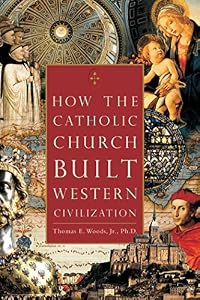
How the Catholic Church Built Western Civilization
by Thomas E. Woods, Thomas E. Woods (Author)
On This Page
Description
Ask someone today where Western Civilization originated, and he or she might say Greece or Rome. But what is the ultimate source of Western Civilization? Bestselling author and professor Thomas E. Woods, Jr. provides the long neglected answer: the Catholic Church. In the new paperback edition of his critically-acclaimed book, How the Catholic Church Built Western Civilization, Woods goes far beyond the familiar tale of monks copying manuscripts and preserving the wisdom of classical show more antiquity. Gifts such as modern science, free-market economics, art, music, and the idea of human rights come from the Catholic Church, explains Woods. In How the Catholic Church Built Western Civilization, you'll learn: - Why modern science was born in the Catholic Church. - How Catholic priests developed the idea of free-market economics five hundred years before Adam Smith. - How the Catholic Church invented the university. - Why what you know about the Galileo affair is wrong. - How Western law grew out of Church canon law. - How the Church humanized the West by insisting on the sacredness of all human life. No institution has done more to shape Western civilization than the two-thousand-year-old Catholic Church-and in ways that many of us have forgotten or never known. How the Catholic Church Built Western Civilization is essential reading for recovering this lost truth. show lessTags
Recommendations




Member Recommendations
by anonymous user
Member Reviews
My mother asked me to read this book, in return for her having read The Chalice and the Blade. I really wish I could have had an opportunity to discuss it with her.
It was interesting to see how involved the Church was in the fundamental pillars of civilization, but I don't agree with some of his statements, such as that pagan societies had no science. Overall I found his tone rather smug, which was irritating; he was quick to dismiss achievements of societies other than the Catholic as simply precursors of the "real" achievements of the Catholic Church.
In all, it would have been a fun debate, with me defending pagan achievements and Mom defending Catholic ones, until we reached some kind of middle ground.
It was interesting to see how involved the Church was in the fundamental pillars of civilization, but I don't agree with some of his statements, such as that pagan societies had no science. Overall I found his tone rather smug, which was irritating; he was quick to dismiss achievements of societies other than the Catholic as simply precursors of the "real" achievements of the Catholic Church.
In all, it would have been a fun debate, with me defending pagan achievements and Mom defending Catholic ones, until we reached some kind of middle ground.
How the Catholic Church Built Western Civilization is an apologetics treatise about how the Catholic Church contributed to the development of science, philosophy, art, and culture. For someone who has not read a lot of books on the subject - who wishes to be disabused of the belief that the Catholic Church shunned science and tried to halt the progression of culture - this book is an excellent introduction. It covers a wide variety of topics in a superficial survey of how the Church changed and promoted civilization. On the other hand, if you're like myself and are well-read on the subject, this book lacks depth. Although there was a wide variety of information discussed, there was very little that it discussed in greater detail than I show more already knew. Therefore, I would highly recommend this text to someone who'd like an introduction to the topic - it's well-written, well-researched, and interesting. But if you're looking for depth and detail, this may be worth just a quick read.
This audiobook was well-narrated by Barrett Whitener. No complaints there! show less
This audiobook was well-narrated by Barrett Whitener. No complaints there! show less
Despite the author’s impressive academic credits, this book is perhaps more of an apologetics text than a strictly scholarly treatise. While it certainly seems well-researched as far as it goes, the chapter on science in particular is oddly unsatisfactory in several ways. It would have been helpful, for example, to supplement the admittedly impressive and informative catalogue of Catholic scientists through the ages with some information of what proportion of active scientists they accounted for in any one era and how many non-Catholics were engaging in scientific research at the same time. Unfortunately, the book is completely silent on this point.
There are also some puzzling omissions of individual figures, most notably Gregor show more Mendel and Giordano Bruno. Both omissions seem odd. In the case of Mendel, even if his religious doctrine really was questionable, it was still the church that provided him with the time and opportunity to engage in his scientific research. As for Bruno, most people will recognise the name as that of a heretic burned at the stake even if they know nothing else about him – and as Woods was so anxious to set the record straight about the true nature of the Galileo case, it seems unclear why he chose not to do the same with Bruno, the more so as the heresy for which he was condemned was theological rather than scientific in nature.
Points such as these – coupled with the author’s rather indiscriminate disparagement of pretty much all forms of modern art – diminish what would otherwise have been a stronger book. Nevertheless, it remains an interesting read and an easy one, and can be recommended (though militant non-Catholics will likely loathe it) as a starting-point for engaging with this subject in more detail. For which endeavour the 132-item bibliography provided by the author should certainly prove useful. show less
There are also some puzzling omissions of individual figures, most notably Gregor show more Mendel and Giordano Bruno. Both omissions seem odd. In the case of Mendel, even if his religious doctrine really was questionable, it was still the church that provided him with the time and opportunity to engage in his scientific research. As for Bruno, most people will recognise the name as that of a heretic burned at the stake even if they know nothing else about him – and as Woods was so anxious to set the record straight about the true nature of the Galileo case, it seems unclear why he chose not to do the same with Bruno, the more so as the heresy for which he was condemned was theological rather than scientific in nature.
Points such as these – coupled with the author’s rather indiscriminate disparagement of pretty much all forms of modern art – diminish what would otherwise have been a stronger book. Nevertheless, it remains an interesting read and an easy one, and can be recommended (though militant non-Catholics will likely loathe it) as a starting-point for engaging with this subject in more detail. For which endeavour the 132-item bibliography provided by the author should certainly prove useful. show less
Although Christians are always referred to as "Catholics," (e.g., "Catholics" did good things while "non-Christians" did bad), this book is a treasure trove of scientific history. It brings together recent historical evidence into a single narrative. Very good for homeschooling.
No institution has done more to shape Western civilization than the two-thousand-year-old Catholic Churchand in ways that many of us have forgotten or never known. How the Catholic Church Built Western Civilization is essential reading for recovering this lost truth.
They don't wanna say it be like it do, but it is.
Great view of history
Members
- Recently Added By
Author Information

29+ Works 3,024 Members
Thomas E. Woods Jr. was born on August 1, 1972. He holds a BA degree in history from Harvard and his masters and PhD from Columbia University. He served as a history department faculty member at Suffolk County Community College in N.Y. until 2006 then moved on to resident scholar and senior faculty member of Ludwig Von Misses Institute in Alabama. show more He is a N.Y. Times bestselling author of 10 books such as Meltdown: A Free Market Look at Why the Stock Market Collapsed, The Economy Tanked and Government Bailout Will Make Things Worse and Nullification: How to resist Federal Tyranny in the 21st Century. He has also written for several scholarly periodicals such as Historical Review and Investors Daily. He won the $50, 000 first prize in the Templeton Enterprise Awards for 2006 for his book The Church and The Market. He has been the associate editor for the Latin Mass magazine for 11 years. He has also appeared on MSNBC's Scarborough County and Bloomberg Television. (Bowker Author Biography) show less
Common Knowledge
- Last words
- (Click to show. Warning: May contain spoilers.)The self-imposed historical amnesia of the West today cannot undo the past or the Church's central role in building Western civilization. "I am not Catholic," wrote French philosopher Simone Weil, "but I consider the Christian idea, which has its roots in Greek thought and in the course of the centuries has nourished all of our European civilization, as something that one cannot renounce without becoming degraded." That is a lesson that Western civilization, cut off more and more from its Catholic foundations, is in the process of learning the hard way.
Classifications
Statistics
- Members
- 866
- Popularity
- 31,158
- Reviews
- 11
- Rating
- (3.99)
- Languages
- 7 — Czech, Dutch, English, Italian, Portuguese, Russian, Spanish
- Media
- Paper, Audiobook, Ebook
- ISBNs
- 19
- ASINs
- 6