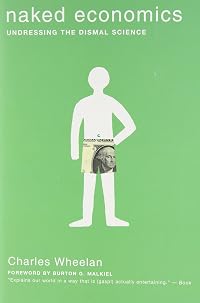
Naked Economics: Undressing the Dismal Science
by Charles Wheelan
On This Page
Description
In Naked Economics, journalist Charles Wheelan does "the impossible"-he makes economic principles relevant, interesting and fun. Brimming with scores of down-to-earth examples and sprinkled with humorous anecdotes, this comprehensive overview will keep listeners smiling and wide awake.Tags
Recommendations




Member Reviews
While many of the examples are woefully outdated (published 2002), the concepts are purely timeless. I laughed out loud a couple of times. Well, sometimes because of the outdated examples ("I recently visited a grocery store in Boulder, Colorado, that was experimenting with a self-serve checkout line."); but sometimes because he was just really (deliberately) funny.
And sometimes because I raise Angora goats, and the great mohair subsidy of 1955 that lasted for about 35 years was one of his great examples of the power of organized interests to get legislation on the books that is a boon for the interests but way outlives its usefulness and isn't big enough for any non-interested party to get worked up about enough to revoke. Although it show more seems some people got worked up about the mohair subsidy eventually, it just took 35 years. (We got into the hobby less than a decade too late to sit back and make a tidy living off of it.)
And sometimes I felt personal pride, while reading the whole chapter on the Federal Reserve. While it would be an overstatement to say we've forgotten 9/11, we've forgotten plenty of the details of those first weeks, months, and year of aftermath (again, publication date of this was 2002). "On September 11, 2001, hours after the terrorist attacks on the United States, the Federal Reserve issued the following statement: 'The Federal Reserve System is open and operating. The discount window is available to meet liquidity needs.'" This was his example of simple statements speaking loudly. A simple, calming statement, with not so calm people behind the scenes doing not so simple things to make it so.
What was fantastic about this book was that it had no ax to grind. It's facts and concepts. You judge. This is what government intervention can sometimes do for good. This is what it can sometimes do for ill. Know the basic economics presented in this book first; then maybe you can hold forth with an informed opinion. show less
And sometimes because I raise Angora goats, and the great mohair subsidy of 1955 that lasted for about 35 years was one of his great examples of the power of organized interests to get legislation on the books that is a boon for the interests but way outlives its usefulness and isn't big enough for any non-interested party to get worked up about enough to revoke. Although it show more seems some people got worked up about the mohair subsidy eventually, it just took 35 years. (We got into the hobby less than a decade too late to sit back and make a tidy living off of it.)
And sometimes I felt personal pride, while reading the whole chapter on the Federal Reserve. While it would be an overstatement to say we've forgotten 9/11, we've forgotten plenty of the details of those first weeks, months, and year of aftermath (again, publication date of this was 2002). "On September 11, 2001, hours after the terrorist attacks on the United States, the Federal Reserve issued the following statement: 'The Federal Reserve System is open and operating. The discount window is available to meet liquidity needs.'" This was his example of simple statements speaking loudly. A simple, calming statement, with not so calm people behind the scenes doing not so simple things to make it so.
What was fantastic about this book was that it had no ax to grind. It's facts and concepts. You judge. This is what government intervention can sometimes do for good. This is what it can sometimes do for ill. Know the basic economics presented in this book first; then maybe you can hold forth with an informed opinion. show less
Well-written primer on basic economic principles, including some brilliant analogies. Most impressively, it covers aspects of governance and the economy with a perspective that is at times "liberal" and at other points "conservative".
Lucid and amusing, Naked Economics provides an excellent, engaging introduction to the subject for the novices, math-phobes, and lovers of good writing among us. It's perfect for providing some conceptual understanding to those, like me, who remain curious about the workings of the world, yet whose formal education didn't take in what it should have. (Or who didn't take in what we should have, during them!) As the title playfully suggests, this is economics stripped of the impeding charts, equations, and graphs, leaving essential, exciting concepts visible in all their naked glory. They're bared to a point of great liveliness and accessibility.
I finished feeling a sense of comprehension I wish I could pay Wheelan for, far beyond the show more price of the book. Never again will my eyes glaze at a mention of the Federal Reserve; nor will I be confounded by the failure of certain bright and altruistic ideas I wanted to work; nor the success of peculiar, minor special interest groups; nor the continued dominance of McDonald's, to the detriment of the intriguing place next door (not that this one flummoxed me, but he does dissect it beautifully, in 'The Economics of Information'). Never again will I approach an economy dogged by the vague, yet dispiriting sense that within each only a fixed number of jobs does or could exist. And so on, ad infinitum.
I thought the chapter 'Trade and Globalization' especially illuminating, as Wheelan makes an excellent case for the benefits of international trade running both ways, even when they look disadvantageous to the poorer countries, or involve lost jobs in the wealthier. It's not without genuine downsides in the short term, and for individuals, which is neither minimized or overlooked; but he puts his points about the overall, long-term benefits with great clarity and good sense. I found that, like much else, not only lucid but bracing.
Much as I'll benefit by rereading (and reading other economics works), Naked Economics invites it, and lays enough groundwork that you can begin knowing nothing, and end not merely willing, but eager, to seek out more difficult books on the subject. show less
I finished feeling a sense of comprehension I wish I could pay Wheelan for, far beyond the show more price of the book. Never again will my eyes glaze at a mention of the Federal Reserve; nor will I be confounded by the failure of certain bright and altruistic ideas I wanted to work; nor the success of peculiar, minor special interest groups; nor the continued dominance of McDonald's, to the detriment of the intriguing place next door (not that this one flummoxed me, but he does dissect it beautifully, in 'The Economics of Information'). Never again will I approach an economy dogged by the vague, yet dispiriting sense that within each only a fixed number of jobs does or could exist. And so on, ad infinitum.
I thought the chapter 'Trade and Globalization' especially illuminating, as Wheelan makes an excellent case for the benefits of international trade running both ways, even when they look disadvantageous to the poorer countries, or involve lost jobs in the wealthier. It's not without genuine downsides in the short term, and for individuals, which is neither minimized or overlooked; but he puts his points about the overall, long-term benefits with great clarity and good sense. I found that, like much else, not only lucid but bracing.
Much as I'll benefit by rereading (and reading other economics works), Naked Economics invites it, and lays enough groundwork that you can begin knowing nothing, and end not merely willing, but eager, to seek out more difficult books on the subject. show less
Assumes that Japan's 'stagnated' GDP is a bad thing. Evades the question of minimum wage. No glossary, never defines tariffs, but claims that they're worse than a tax on groceries (which even fiscal conservatives know is a horribly regressive tax and not a good idea). Gives unsatisfactory explanations of every question I had, actually, as I browsed the index and looked at each referenced mention. Iow, not educational. Wheelan has an agenda and he wants us to take his word for it that everything he says is cool & ok; he makes the book an easy read by not exploring the pros & cons or consequences.
And, like the other 'introductory' books on economics that I've been trying to read, it's written on the wrong level for me. I know too much for show more introductions, and not enough to understand the finance pages of "The Economist" magazine.... I'm thinking I'll have to actually audit a few college courses to fill the gaps and deepen my understandings of the connections. show less
And, like the other 'introductory' books on economics that I've been trying to read, it's written on the wrong level for me. I know too much for show more introductions, and not enough to understand the finance pages of "The Economist" magazine.... I'm thinking I'll have to actually audit a few college courses to fill the gaps and deepen my understandings of the connections. show less
Economics is a confusing subject. It is filled with dry mathematical calculations and big confusing words. Naked Economics: Undressing the Dismal Science by Charles Wheelan does just as the title suggests. Mr. Wheelan, a former journalist for the well-respected The Economist magazine, is a talented author who treats the reader with a very enjoyable explanation of several basic concepts of economics. Boring statistics are few and far between in this book. Wheelan has included many amusing anecdotes that provide a perfect backdrop for his explanations, such as the time when he reluctantly became president of his small Chicago neighborhood board and how his ensuing political career, including a venture of running for the Senate, gives us show more an example of how economics and the demands of the people are closely related to the inner-workings of the American political world. He also manages to give the reader a wide perspective of the world, posing an age-old question that economists often ask to stimulate thought: “Who feeds Paris?” This question is designed to make one think about markets and how the various markets of the world are connected, creating an economy. The book also has many enjoyable points that one probably wouldn’t think about otherwise. For example, Wheelan says that smokers are good for the economy because they pay Social Security all of their lives but die early without reaping the benefits, leaving more for the rest of us.
Overall, I can say that I highly recommend this book to anybody interested in the subject of economics or even politics. However, I would not recommend this book to anybody who has any scholarly experience in the field, as it may seem too basic. To me, the book feels like the perfect summer reading assignment for an Economics 101 course. I knew absolutely nothing about economics prior to my reading of it, and now I feel as though I can hold an intelligent conversation about the subject. I very much enjoyed his humorous wit, and the only thing I can say I didn’t like would be the occasional droning explanations, but I suppose that these are inevitable during any discussion of economics. It may be painful to get through some parts, but Wheelan certainly does his best to soften the pain. Understanding basic economics is essential to truly understanding the workings of the modern world, so if you are clueless on the subject, I would suggest picking up this book immediately. show less
Overall, I can say that I highly recommend this book to anybody interested in the subject of economics or even politics. However, I would not recommend this book to anybody who has any scholarly experience in the field, as it may seem too basic. To me, the book feels like the perfect summer reading assignment for an Economics 101 course. I knew absolutely nothing about economics prior to my reading of it, and now I feel as though I can hold an intelligent conversation about the subject. I very much enjoyed his humorous wit, and the only thing I can say I didn’t like would be the occasional droning explanations, but I suppose that these are inevitable during any discussion of economics. It may be painful to get through some parts, but Wheelan certainly does his best to soften the pain. Understanding basic economics is essential to truly understanding the workings of the modern world, so if you are clueless on the subject, I would suggest picking up this book immediately. show less
I started reading this book feeling I was reasonably clever, and I finished this book realizing that I wasn't even fit for extremely stupid. Not that this book isn't good - it's too good, that's the problem, I think.
This book simplifies a lot of concepts, but still, with my slow mind, I had to keep going over bits, re-reading paragraphs to finally absorb it.
Now I've finished the book, I've got mixed feelings; I'm feeling guilty about feeling relieved that I've finished this book after 1 month and 2 days, but I'm kind of feeling like I should read more books like this one so that, eventually, I might be able to read it would pausing and re-reading.
This book simplifies a lot of concepts, but still, with my slow mind, I had to keep going over bits, re-reading paragraphs to finally absorb it.
Now I've finished the book, I've got mixed feelings; I'm feeling guilty about feeling relieved that I've finished this book after 1 month and 2 days, but I'm kind of feeling like I should read more books like this one so that, eventually, I might be able to read it would pausing and re-reading.
This is a great general-public book on economics. With humor and simple words, it explains the basis of economy : free-trade and state regulation, human capital, interest rates and inflation, etc. It is not written like an academic book with highly detailed outlines and a bunch of theoretical references, and it is nice and easy to read. It is a real good basis for economics 101 and even gives some notes to go further. Moreover, it is written by a Chicago-based correspondent for the Economist, so it is full of examples from Chicago life.
The author is sometimes described as a moderate liberal but to my point of view, he is really in favor of free-trade and speaks badly about left-wing activists and antiglobalization groups. He believes show more that social actor is fully rational and that the free-trade is fair for all : he seems to forget about cheating, insiders tradings, disinformation and others capitalist tricks and evils. So it is a great book for basic understanding of economic process but you’d better think twice about the big figure of capitalism and wars for profit. show less
The author is sometimes described as a moderate liberal but to my point of view, he is really in favor of free-trade and speaks badly about left-wing activists and antiglobalization groups. He believes show more that social actor is fully rational and that the free-trade is fair for all : he seems to forget about cheating, insiders tradings, disinformation and others capitalist tricks and evils. So it is a great book for basic understanding of economic process but you’d better think twice about the big figure of capitalism and wars for profit. show less
Members
- Recently Added By
Lists

My List
302 works; 1 member
Author Information

12 Works 3,447 Members
Charles Wheelan is the author of the best-selling Naked Statistics and Naked Economics and is a former correspondent for the Economist. He teaches public policy at Dartmouth College and lives in Hanover, New Hampshire, with his family.
All Editions
Some Editions
Awards and Honors
Work Relationships
Common Knowledge
- Original publication date
- 2002
- Dedication
- For Leah
- First words
- It is widely believed that Scotsman Thomas Carlyle labeled economics the "dismal science" well over one hundred years ago because it seemed boring, uninteresting, unclear, and full of "on the one hand, on the other hand."
- Last words
- (Click to show. Warning: May contain spoilers.)How could that possibly not be interesting?
- Blurbers
- Becker, Gary; Kogan, Deborah Copaken; Malkiel, Burton G.
- Disambiguation notice
- The revised edition (2010) is 338 pages before the index. The first edition (2002) is 244 pages before the index. Please do not combine the two.
Classifications
Statistics
- Members
- 1,005
- Popularity
- 25,863
- Reviews
- 20
- Rating
- (3.97)
- Languages
- 8 — Chinese, Czech, English, French, German, Spanish, Turkish, Portuguese (Portugal)
- Media
- Paper, Audiobook, Ebook
- ISBNs
- 20
- ASINs
- 7