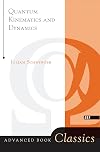
Quantum Kinematics and Dynamics
by Julian Schwinger
15 Members (3.00)
On This Page
Description
A classic from 1969, this book is based on a series of lectures delivered at the Les Houches Summer School of Theoretical Physics in 1955. The book outlines a general scheme of quantum kinematics and dynamics.Tags
Member Reviews
Members
- Recently Added By
Author Information
14 Works 342 Members
Julian Schwinger, an American physicist, developed his prowess for mathematics and physics at a very early age. At the age of 17, he received his B.A. from Columbia University and his Ph.D. three years later. By 1946 Schwinger had become a full professor at Harvard University. Schwinger's most notable contribution to physics was uniting show more electromagnetic theory and quantum dynamics into the theory of quantum electrodynamics (the foundations of which had been laid by Paul Dirac, Werner Heisenberg, and Wolfgang Pauli). During World War II, Schwinger, Richard Feynman, Sin-Itiro Tomonaga, and Frank Dyson developed the mathematical formulation of quantum electrodynamics to conform with Albert Einstein's theory of relativity. This new theory, which proved to be useful in measuring and explaining the behavior of atomic and subatomic particles, resulted in a Nobel Prize in physics for Feynman and Tomonaga in 1963. Schwinger also conducted significant research into the properties of synchrotron radiation, produced when a rapidly moving charged particle is diverted by a magnetic field. (Bowker Author Biography) show less
Classifications
Statistics
- Members
- 15
- Popularity
- 1,597,033
- Rating
- (3.00)
- Languages
- English
- Media
- Paper, Ebook
- ISBNs
- 7