Boundaries of the Soul
by June Singer
On This Page
Description
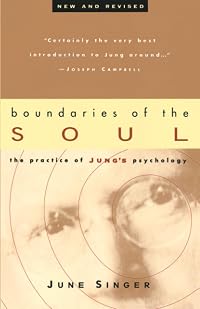
After thirteen printings and with nearly 100,000 copies in print since its publication twenty years ago, Boundaries Of The Soul has become recognized as THE classic introduction to Jung and the practice of Jung's psychology. The book has been described as "the clearest and most coherent exposition of Jung's total thought," by Robertson Davies, and Alan Watts has called Dr. Singer "one of the great masters of the art." Now, in a completely revised edition of Boundaries Of The Soul, Dr. show more Singer incorporates the latest developments in Jungian psychology over the last two decades, particularlv in the areas of masculine/feminine relationships, the use of psychotherapeutic drugs, and the evolution of Jung's concept and personality types and its application both clinically and in the world of business and industry. In addition, the case histories, so central to understanding many of Jung's concepts, have been re-examined and revised where necessary to correspond to the spirit of today's world. The updated edition of Boundaries Of The Soul should reaffirm the book's long-standing reputation as the best introduction to Jung's thought available. show lessTags
Recommendations



















Member Reviews
It must be emphasized that "Boundaries of the Soul" is as much a book about the nuts-and-bolts of the actual psychotherapeutic process -- right down to lengthy sections describing such topics as the nuances of a psychotherapist's waiting room -- as it an introduction to the conceptual framework of Jungian psychology.
Singer's systematic breakdown of Jungian psychology is actually very concise, informative and digestible, but in total comprises, perhaps, only a third of the content; the rest of the book explores the actual practice and experience of psychotherapy, and will likely only be of interest to prospective psychoanalysts or analysands.
That being said, despite the significant lack of brevity, I finished the book feeling that I had show more extracted a basic but clear understanding of Jungian psychology -- and there were actually quite a few literary gems of wisdom that I collected as well. Singer was a talented writer.
My only objective criticism of the book is that Singer periodically injected her feminist, egalitarian, some would even say cultural Marxist politics into the book. In several instances, she actually criticized Jung himself for not designing a psychology that was 100% compatible with her ideological beliefs, and she writes Jung off as being "a product of his era" whenever she disagrees with certain attitudes or beliefs of Jung's that were "patriarchal".
Well, perhaps I could level the same criticism at Singer: she was as much an ideological product of her era as Jung was of his. show less
Singer's systematic breakdown of Jungian psychology is actually very concise, informative and digestible, but in total comprises, perhaps, only a third of the content; the rest of the book explores the actual practice and experience of psychotherapy, and will likely only be of interest to prospective psychoanalysts or analysands.
That being said, despite the significant lack of brevity, I finished the book feeling that I had show more extracted a basic but clear understanding of Jungian psychology -- and there were actually quite a few literary gems of wisdom that I collected as well. Singer was a talented writer.
My only objective criticism of the book is that Singer periodically injected her feminist, egalitarian, some would even say cultural Marxist politics into the book. In several instances, she actually criticized Jung himself for not designing a psychology that was 100% compatible with her ideological beliefs, and she writes Jung off as being "a product of his era" whenever she disagrees with certain attitudes or beliefs of Jung's that were "patriarchal".
Well, perhaps I could level the same criticism at Singer: she was as much an ideological product of her era as Jung was of his. show less
This is a revised edition of a classic introduction to Jung and the practice of Jung's psychology. It incorporates the latest developments over the last two decades, particularly in the areas of male/female relationships, psychotherapeutic drugs, and applications to the business world and industry.
Introduction Analyst & Analysand Complexes by Day & Demons by Night From Associations to Archetypes Are Archetypes Necessary? Individuation: The Process of Becoming Whole Psychological Types: Key to Communications Persona & Shadow Anima & Animus Circumambulating the Self Understanding Our Dreams Dreaming the Dream Onward: Active Imagination Religion & Other Approaches to the Unknowable We Were Born Dying Notes List of Works Cited Index The Collected Works of C.G. Jung
"The clearest and most coherent exposition of Jung's total thought that I have ever encountered." Source: Robertson Davies
Ratings
Members
- Recently Added By
Author Information

13+ Works 1,071 Members
June Singer, Ph.D., is a Jungian analyst and the author of several books
Common Knowledge
- Epigraph
- You would not find out the boundaries of the soul even by traveling along every path: so deep a measure does it have.
- First words
- Introduction -- In teaching and lecturing and also in analytic practice I have heard again and again the question: "Why doesn't somebody write a book about the Jungian analytic process and how it works?"
- Quotations
- Thoughtful people are recognizing that Jung provides a bridge in our time between the scientific-intellectual aspects of life and the religious-nonrational aspects. Jung has faced the apparent dichotomy between abstraction an... (show all)d generalization on one side and the experience of immediate knowing on the other. Our culture, steeped in the principles of Aristotelian logic, finds it difficult to accept paradoxical thinking as valid. Too often it seems necessary to make a choice between the rationalistic-academic way of life or the anti-intellectual camp. Jung's greatness is in that he saw both of these as aspects of the same reality, as polar opposites on single axis. The challenge has been put to me to describe how Jung came to his position, and to explain how Jung's concepts have been integrated into my work as an analytical psychologist.
- Last words
- (Click to show. Warning: May contain spoilers.)It belongs to the unknowable.
- Blurbers
- Davies, Robertson
Classifications
Statistics
- Members
- 425
- Popularity
- 72,582
- Reviews
- 4
- Rating
- (3.78)
- Languages
- English
- Media
- Paper
- ISBNs
- 7
- ASINs
- 3