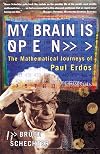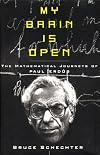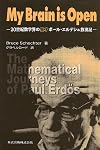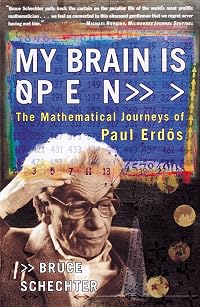
My Brain Is Open; The Mathematical Journeys of Paul Erdős
by Bruce Schechter
On This Page
Description
For over half a century, at almost any hour of the day, mathematicians the world over might answer a knock at the front door to find a short, frail man wearing thick eyeglasses and a rumpled suit, carrying a suitcase containing all his belongings in one hand and a bag full of papers in the other, who would announce, "My brain is open!" The visitor was Paul Erdos, one of the greatest mathematicians of the twentieth century and certainly the most eccentric. Having no home or job, and incapable show more of the most ordinary household tasks, Erdos was sustained by the generosity of colleagues and by his own belief in the beauty of mathematics. Erdos believed that the meaning of life was to prove and conjecture. He was fascinated by numbers and became one of the century's leading numbers theorists. He worked in fields of mathematics that would prove pivotal to the development of computer science, even though he had never touched a computer. He was the most prolific mathematician who ever lived, writing or collaborating on more than 1,500 papers with over 450 different collaborators. Witty, filled with the sort of mathematical puzzles that intrigued Erdos and continue to fascinate mathematicians today, My Brain Is Open is the story of this strange genius, and a journey in his footsteps through the intriguing world of mathematics, where universal truths await discovery like hidden treasures and where brilliant proofs are poetry. show lessTags
Recommendations














Member Reviews
Back when I was just an epsilon, I wanted to be a mathematician so there was a lot for me to appreciate in the story of Paul Erdős. He and I were attracted to the same kinds of mathematical problems--the so-called elementary ones which didn't require a lot of study just to understand what was being asked. Bruce Schechter, who I coincidentally once knew from the internet, does a great job of telling the story being careful to present the subject matter without presupposing much mathematical knowledge on the part of the reader, though I wonder if those who are not like me would follow along with all the details. I suppose if they chose to read the book in the first place, they probably would.
I am not so quick as Mr. Schechter to show more interpret Ramsey Theory as he does as being about the mathematical necessity of there being order in the universe. Nor do I think it significant in any way that I was acquainted with, not only Bruce Schechter, but another person mentioned in the book who it turns out was in my high school home room class even though Ramsey's theorem entails that out of a group of six people, there must be either three mutually acquainted or three complete strangers. Furthermore, I think that there are constellations in the sky, not because of Ramsey theory, as Mr. Schechter suggests but because of a different researcher, Wolfgang Köhler, (German, not Hungarian) who developed Gestalt Psychology which attempts to predict how we classify random data into configurations based on specific attributes. Perhaps this is because I have left mathematics behind for psychology, but I wonder now whether if I had met Erdős when I was an epsilon, I'd have remained with math instead. show less
I am not so quick as Mr. Schechter to show more interpret Ramsey Theory as he does as being about the mathematical necessity of there being order in the universe. Nor do I think it significant in any way that I was acquainted with, not only Bruce Schechter, but another person mentioned in the book who it turns out was in my high school home room class even though Ramsey's theorem entails that out of a group of six people, there must be either three mutually acquainted or three complete strangers. Furthermore, I think that there are constellations in the sky, not because of Ramsey theory, as Mr. Schechter suggests but because of a different researcher, Wolfgang Köhler, (German, not Hungarian) who developed Gestalt Psychology which attempts to predict how we classify random data into configurations based on specific attributes. Perhaps this is because I have left mathematics behind for psychology, but I wonder now whether if I had met Erdős when I was an epsilon, I'd have remained with math instead. show less
Fascinating book about one of the 20th century's most unusual charcaters and greatest mathematicians. For 40 years, Paul Erdos (pronounced air-dish), lived out of suitcases as he roamed the world seeking someone, anyone, to do math problems with. He announced himself by turning up on someone's doorstep claiming "My brain is open!", and expecting them to feed and accomodate him for a week or so while he mined their brains for maths problems and proofs. He called childen "epsilons", men, "slaves", women, "bosses", God,"Supreme Fascist", and said anyone who quit maths was "dead'. For all his eccentricity he was one of the most phenomenonal minds of the 20th century, his output in terms of papers and collaborations was extraordinary. In show more fact he had so many collaborators that a the "Erdos number" was created, to describe the degree of separation between him, his collaoborators and anyone who collaborated with his collaborators. This is a warm and often funny book, liberally spiced with mathematics, but (thankfully) not enough to deter maths dunces like myself. Highly recommended for anyone who loves math or just loves stories about quirky geniuses. show less
Although not a comprehensive biography, My Brain Is Open does offer a detailed portrait of Paul Erdős that conveys a sense of his personality and his love for math. Schechter explains enough of the math to provide the necessary context without interrupting the flow of the story.
A surprisingly great read. Erdos was truly eccentric, but a great human being. I never realized he even existed until this book unfolded his life story to me. If you love math, and interesting people who spend their lives entangled with math's enigmatic charms, this is a book for you.
Erdos is pronounced something like ' air - dish '
Erdos is pronounced something like ' air - dish '
Ratings
Members
- Recently Added By
Lists

In Our Time books
4,934 works; 2 members
Author Information
3 Works 321 Members
Some Editions
Awards and Honors
Common Knowledge
- Canonical title
- My Brain Is Open; The Mathematical Journeys of Paul Erdős
- Original publication date
- 1998
- People/Characters
- Paul Erdős
Classifications
Statistics
- Members
- 302
- Popularity
- 105,883
- Reviews
- 6
- Rating
- (4.01)
- Languages
- English, German, Greek, Japanese
- Media
- Paper
- ISBNs
- 7
- ASINs
- 1