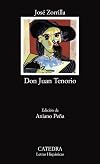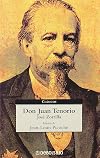
Don Juan Tenorio
by José Zorrilla
On This Page
Description
When Jose Zorrilla completed Don Juan Tenorio in 1844 little did he know that he had just written what would become the most popular Spanish play of all time. While the opening performance was a modest one, Zorrilla's interpretation of the legendary Don Juan myth was so well-liked by the public that, in a very short time, its success was overwhelming. Shortly after, Don Juan Tenorio became not only the most popular play in Spain, but in the entire Spanish-speaking world, and to this day it show more is considered the chief representative of Spanish Romantic theater and the masterpiece of all Don Juan adaptations. This new translation of Zorrilla's classic play is unique in mirroring not only the content, but also the way in which an audience would experience a performance of the most famous of libertines in Spanish. As such, it strives to keep the essence of each stanza intact, while reflecting the rhyme and stress-pattern of the original. Although the exigencies of meter and rhyme entail making some minor concessions when it comes to rendering the content, the way in which the play was written is such a crucial aspect that, without its playful octosyllabic lines, its easy rhymes, and its carefully-studied meter, we cannot speak of Don Juan Tenorio. Intended for a wide variety of readers, the translation is preceded by an introduction in which several key aspects of the play are addressed, and the main text is complemented with footnotes clarifying key passages, or offering additional information about the characters, the time-period, or the literary history of the Don Juan character. show lessTags
Recommendations







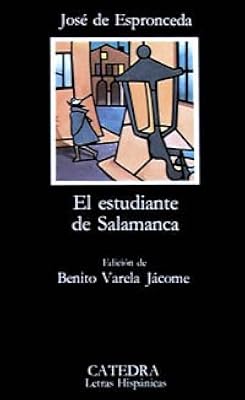









Member Recommendations
Sergio88 El origen del mito hispánico del Don Juan.
Member Reviews
Historia conocida, lances de comedia de enredo, algunos ripios de fácil hechura, versos más que oídos y, sin embargo, la agilidad de las escenas, lo cómico y canallesco de algunas situaciones, la profundidad filosófica y hasta teológica de algunos diálogos, los versos quebrados y otros repetidos con voluntaria insistencia hacen de éste drama una obra deliciosa. En él se encuentran, entre versos rimados con alegría y soltura, los temas de Lope (“Y un día, una hora quizá de imprevisión le bastara para que mi honor manchara”), de Calderón (“¿Qué más diáfano y sutil que las quimeras de un sueño?”), las manidas y aceptadas melancolías de Jorge Manrique, las alcahuetas de Fernando de Rojas, la Margarita de Goethe show more (“Yo mi alma he dado por ti, y Dios te otorga por mí tu dudosa salvación.”), el protestantismo luterano (“su fe nos salva”) entre monjas y comendadores católicos, el ateo convencido (“Más yo, que no creo que haya más gloria que esta mortal...”) y bravucón (“Y a fe que favor me harás, pues podré saber de ti si hay más mundo que el de aquí y otra vida, en que jamás, a decir verdad, creí”), el converso arrepentido (“¿Conque hay otra vida más y otro mundo , que el de aquí?¿Conque es verdad, ¡ay de mí!, lo que no creí jamás?”) y, en fin, el personaje de Tirso reinventado. show less
¿Se basa la YA en Don Juan Tenorio en algunos casos? Chico mujeriego (Don Juan) conoce chica (o la rapta(okno), como a Doña Inés) de la que se enamora y gracias a ese amor no vuelve a ser un mujeriego.
¡Qué libro entretenido! ¡Qué dramático! Qué... ¡qué romántico!
Libros de Matias y Carmen. Ed. Orbis - Historia de la Literatura española. Vol. 88
8467003332
Members
- Recently Added By
Lists

Spanische Romantik
6 works; 1 member
Author Information

59 Works 1,086 Members
Some Editions
Series
Belongs to Publisher Series
Work Relationships
Is contained in
Has the adaptation
Has as a student's study guide
Common Knowledge
- Canonical title*
- Don Juan Tenorio
- Original title
- Don Juan Tenorio; Traidor, inconfeso y mártir; El puñal del godo
- Original publication date
- 1844
- People/Characters
- Don Juan Tenorio; Don Luis Mejía; Don Gonzalo de Ulloa; Doña Inés de Ulloa; Don Diego Tenorio; Doña Ana de Pantoja (show all 20); Cristófano Buttarelli; Marcos Ciutti; Gastón; Brígida; Pascual; La Abadesa de las Calatravas de Sevilla; La tornera de las Calatravas de Sevilla; Don Rafael de Avellaneda; El Capitán Centellas; Lucía; Escultor; La estatua de Don Gonzalo; La sombra de Doña Inés.; Don Juan
- Important places*
- Sevilla, Andalucía, España; Hostería del Laurel, Sevilla, Andalucía, España; Calle de Doña Zoripeana, Sevilla, Andalucía, España; Convento de la Virgen, Sevilla, Andalucía, España; Quinta de Don Juan, Sevilla, Andalucía, España; Panteón, Sevilla, Andalucía, España (show all 7); Casa de Don Juan, Sevilla, Andalucía, España
- Important events*
- Noche de Carnaval
- Dedication*
- Al Señor
DON FRANCISCO LUÍS DE VALLEJO
en prenda de buena memoria,
su mejor amigo.
José Zorrilla - Original language*
- Español
*Some information comes from Common Knowledge in other languages. Click "Edit" for more information.
Classifications
Statistics
- Members
- 766
- Popularity
- 36,812
- Reviews
- 21
- Rating
- (3.72)
- Languages
- 7 — Chinese, English, French, German, Italian, Portuguese (Portugal), Spanish
- Media
- Paper, Audiobook, Ebook
- ISBNs
- 136
- ASINs
- 16