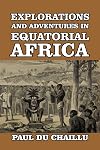
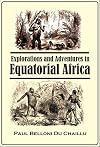
Explorations and Adventures in Equatorial Africa
by Paul B. Du Chaillu
On This Page
Description
One of the most famous early white explorers of central West Africa, the American Paul du Chaillu won fame for confirming the existence of the gorilla--and for his accurate and breathtaking descriptions of the life, customs and behavior of Africans in the pre-colonial era. This work contains vivid and uncensored descriptions of native African cannibalism, tribal warfare, witchdoctors, superstition, and technology. His astute observations were even used by Oxford University professor John R. show more Baker in a section on African cognitive ability in his classic work Race.Du Chaillu was an unbiased observer, who genuinely felt sympathy with the Africans, and wrote down what he saw, without embellishment or exaggeration.His description of African slavery in particular, is highly relevant, written as it was against the backdrop of the then still ongoing Atlantic Slave Trade:"In the first place, I ought to state that its [the African slave trade] existence has no connection at all with the foreign slave-trade. There were slaves held here long before a barracoon was built on the coast . . . Nor is it continued because of the present foreign slave-trade. It has an independent existence, and is ruled by laws of its own."No better illustration could be given of the way in which the slave system has ingrafted itself upon the life and policy of these tribes than this, that, from the seashore to the farthest point in the interior which I was able to reach, the commercial unit of value is a slave. As we say dollar, as the English say pound sterling, so these Africans say slave."This masterpiece of anthropology is no dry read, but an exciting tale of adventure in an era when the author was literally the first white man many of these interior tribes had ever seen.This new edition has been completely reset and contains all 80 illustrations and maps which accompanied the original work. show lessTags
Recommendations


















Member Reviews
They must love this book in Gabon. I should think there are quite a number of people who can identify ancestors by name. Statistically, they’re probably descended from King Bango. Paralysed down one side but still perfectly capable for siring 600 children. You really don’t need any connection to the country to enjoy it though. The only reason I knew where Gabon was is because I know where the equator is. There’s something interesting, though not necessarily pleasant, on every page.
His travels were funded by the Academy of Natural Sciences so he takes a great interest in seeing the local fauna… and killing it. He kills a number of gorillas, including nursing mothers. It seems to have upset him (‘I felt like a murderer’) show more almost as much as it upset me reading about it. Didn’t stop him doing it though.
His other interests are the locals, the lay of the land, its produce, and whether it would be good for agriculture. I suppose this would be of interest to people in the West who wanted to enslave the population in situ. Luckily the West never piled in and took over Africa. Phew! That was a close one.
There are a number of clues that Du Chaillu is not altogether on board with these plans. He’s actually rather subversive. He sometimes gives the party line, only to immediately undermine it, as in this description of the Fan:
‘Their foreheads do not seem so compressed; but it is curious that in many the head runs up into a kind of point or sugar-loaf. This indicates a low scale of intelligence; but it must be said, to these people’s credit, that they are in some things much more ingenious than their neighbours. They extract iron from the ore, and show great ingenuity, with such poor implements as they have, in making their weapons’.
There’s also one passage of very fine writing which I can’t find now and is too long to quote anyway where he’s sitting contemplating this unblemished Eden and it’s possible destruction by agriculture when a snake drops on him.
Some of the tribes in the hinterland think that Du Chaillu can create the cloth and beads that he uses as currency by an act of will.
‘Whereupon, to my astonishment, a slave was handed over to me bound, and Remandji said, “Kill him for your evening meal; he is tender and fat, and you must be hungry.”
… I shook my head …
“We always heard you white men eat men. Why do you buy our people? Why do you come from nobody knows where, and carry off our men, and women, and children? …”
It was a difficult matter to explain to the king that he was much mistaken, and that we do not eat our slaves. The whole matter, from his point of view, was absurd. “If we did not eat them, what did we want them for?” was his incessant question; nor could his majesty be, by any skill of mine, inducted into the mysteries of our labour system, and of its rules of demand and supply.”
There’s such a brutal irony in this, that those slaves have been worked to death producing the very cloth that Du Chaillu is using to secure passage from one village to the next.
When he got back to the States he was accused of lies and incompetence. The introduction in my copy suggests there may have been a religious motive. The Origin of Species was published the year he returned with the first complete specimen of a gorilla ever seen in the West and it may have disturbed people. His Wikipedia page suggests that there may have been racist motives. He was mixed race and passing, and his secret may have been discovered in some quarters.
Either way, there’s no way anyone could know whether or not his mapping was accurate. Following his route on a modern map is difficult as these are trackless jungles, but he does seem to have got himself turned about on his southern journey. Still, all he had was a compass and sometimes a sight-line of no more than a few feet. He’s done a better job than I could do mapping my home town.
All-in-all a remarkable achievement. The physical endurance of it. He didn’t even have a pith helmet and his only medicines were quinine, arsenic, and alcohol. Quite apart from that, the social dexterity he must have displayed. Mungo Park got himself killed. show less
His travels were funded by the Academy of Natural Sciences so he takes a great interest in seeing the local fauna… and killing it. He kills a number of gorillas, including nursing mothers. It seems to have upset him (‘I felt like a murderer’) show more almost as much as it upset me reading about it. Didn’t stop him doing it though.
His other interests are the locals, the lay of the land, its produce, and whether it would be good for agriculture. I suppose this would be of interest to people in the West who wanted to enslave the population in situ. Luckily the West never piled in and took over Africa. Phew! That was a close one.
There are a number of clues that Du Chaillu is not altogether on board with these plans. He’s actually rather subversive. He sometimes gives the party line, only to immediately undermine it, as in this description of the Fan:
‘Their foreheads do not seem so compressed; but it is curious that in many the head runs up into a kind of point or sugar-loaf. This indicates a low scale of intelligence; but it must be said, to these people’s credit, that they are in some things much more ingenious than their neighbours. They extract iron from the ore, and show great ingenuity, with such poor implements as they have, in making their weapons’.
There’s also one passage of very fine writing which I can’t find now and is too long to quote anyway where he’s sitting contemplating this unblemished Eden and it’s possible destruction by agriculture when a snake drops on him.
Some of the tribes in the hinterland think that Du Chaillu can create the cloth and beads that he uses as currency by an act of will.
‘Whereupon, to my astonishment, a slave was handed over to me bound, and Remandji said, “Kill him for your evening meal; he is tender and fat, and you must be hungry.”
… I shook my head …
“We always heard you white men eat men. Why do you buy our people? Why do you come from nobody knows where, and carry off our men, and women, and children? …”
It was a difficult matter to explain to the king that he was much mistaken, and that we do not eat our slaves. The whole matter, from his point of view, was absurd. “If we did not eat them, what did we want them for?” was his incessant question; nor could his majesty be, by any skill of mine, inducted into the mysteries of our labour system, and of its rules of demand and supply.”
There’s such a brutal irony in this, that those slaves have been worked to death producing the very cloth that Du Chaillu is using to secure passage from one village to the next.
When he got back to the States he was accused of lies and incompetence. The introduction in my copy suggests there may have been a religious motive. The Origin of Species was published the year he returned with the first complete specimen of a gorilla ever seen in the West and it may have disturbed people. His Wikipedia page suggests that there may have been racist motives. He was mixed race and passing, and his secret may have been discovered in some quarters.
Either way, there’s no way anyone could know whether or not his mapping was accurate. Following his route on a modern map is difficult as these are trackless jungles, but he does seem to have got himself turned about on his southern journey. Still, all he had was a compass and sometimes a sight-line of no more than a few feet. He’s done a better job than I could do mapping my home town.
All-in-all a remarkable achievement. The physical endurance of it. He didn’t even have a pith helmet and his only medicines were quinine, arsenic, and alcohol. Quite apart from that, the social dexterity he must have displayed. Mungo Park got himself killed. show less
Ratings
Members
- Recently Added By
Lists

Geography and Travel from The Book-Lover
291 works; 1 member
Author Information

33+ Works 266 Members
Series
Belongs to Publisher Series
Classifications
- Genres
- Nonfiction, Travel, Anthropology, General Nonfiction, Science & Nature, Biography & Memoir
- DDC/MDS
- 916.6 — History & geography Geography & travel Geography of and travel in Africa West Africa
- LCC
- DT356 .D82 — History of Europe, Asia, Africa and Oceania Africa History of Africa Central Sub-Saharan Africa
- BISAC
Statistics
- Members
- 49
- Popularity
- 616,819
- Reviews
- 1
- Rating
- (4.50)
- Languages
- English, Swedish
- Media
- Paper, Ebook
- ISBNs
- 5
- ASINs
- 6