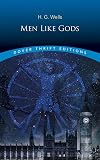
Men Like Gods
by H. G. Wells
On This Page
Description
In the summer of 1921, a disenchanted journalist escapes the rat race for a drive in the country. But Mr. Barnstaple's trip exceeds his expectations when he and other motorists are swept 3,000 years into the future. The inadvertent time travelers arrive in a world that corresponds exactly to Barnstaple's ideals: a utopian state, free of crime, poverty, war, disease, and bigotry. Unfettered by the constraints of government and organized religion, the citizens lead rich, meaningful lives, show more passed in pursuit of their creative fancies. Barnstaple's traveling companions, however, quickly contrive a scheme to remake the utopia in the image of their twentieth-century world. A century after its initial publication, H. G. Wells's novel offers an enduringly relevant look at an ideal society. Conceived in the aftermath of World War I, it reflects the failings of human nature but offers hope for the future, when men and women may live like gods. show lessTags
Recommendations


















Member Reviews
A fine novel presenting a mirrored view of humanity through the reflection of an ideal world. In this book Wells pits his earthly characters as infectious agents in an advanced civilisation that has itself progressed beyond what they refer to as 'The Age of Confusion", this age of confusion is a reference to earthly politics, social moors, sex, religion, education, industrialisation, and capitalism, to name a few of the more discussed references in the novel. In my opinion this world presented by Wells is not a socialistic or communistic simulacrum, as these concepts are also critiqued towards the end of the story. I think the underlying theme is colonisation - not unlike what tribal communities experienced with missionaries attempting show more to civilise them through religion. Wells writes, 'Man was no longer crippled and compelled; it was recognised that he was fundamentally an animal and that his daily life must follow the round of appetites satisfied and instincts released. The daily texture of Utopian life was woven of various and interesting foods and drinks, of free entertaining exercise and work, of sweet sleep and of the interest and happiness of fearless and spiteless lovemaking.' Mr. Barnstaple whose spontaneous need to 'get away from it all' becomes a literal adventure into his own idealistic world. The story is a blend of action, adventure, social and political commentary, with a science fiction plot. All in all it's a tidy tale, with some astute observations on the crudeness of humanity. There are some fine witty moments with Mr. Barnstaple's interactions with his fellow human travellers, (as more then one earthling enters Utopia), especially to do with a very irritating priest. show less
This novel, set in 1921 and published in 1923 is in a subgenre you don’t see much now -- utopian science fiction. Yes, I did say ‘utopian.’ You may be more familiar with this subgenre’s ugly brother, dystopian science fiction. The latter has more shock value so it gets more attention, but I prefer the older, wiser sibling.
The essential difference between utopian and dystopian fiction that I see is their different perceptions of humanity. Although both begin with the premise that the human race has problems, utopian fiction posits that, in the course of time, mankind will solve them. Dystopian fiction, on the other hand, posits that humanity, if it is lucky, might survive.
I don’t read fiction to be shocked. I can get that from show more the news. I read fiction to be entertained. Occasionally I come across novels that also present a new thought or uncommon perspective, and I consider these welcome bonuses. ‘Men Like Gods’ provides all of these.
The protagonist, Mr. Barnstaple (no first name) is stressed and in desperate need of a holiday. The way he contrives to get away unaccompanied by wife of children, is humorous and charming, in an understated British way, as are his musings on the events of the time. He succeeds in escaping by himself in his little yellow car with no specific destination in mind but ends up much farther away than he could have imagined. A scientific experiment in an alternate dimension goes awry, and Barnstaple and a few others on the road that day find themselves in a strange land with clean air, tame animals, and beautiful people who enjoy unparalleled personal freedom. He’s obviously not in England anymore. The rest of the novel explores how he and his fellow Earthlings react to this strange utopia and how the Utopians react to them.
Considering this book was written almost a century ago, and making certain allowances for that, one thing that struck me was how relevant it remains. There are passages about droughts, famines, and fighting going on around the world that sound almost as if they could be referring to today. This description of economic concerns especially caught my attention:
‘... The great masses of population that had been blundered into existence, swayed by damaged and decaying traditions and amenable to the crudest suggestions, were the natural prey and support of every adventurer with a mind blatant enough and a conception of success coarse enough to appeal to them. The economic system, clumsily and convulsively reconstructed to meet the new conditions of mechanical production and distribution, became more and more a cruel and impudent exploitation of the multitudinous congestion of the common man by the predatory acquisitive few. That all too common common man was hustled through misery and subjection from his cradle to his grave; he was cajoled and lied to, he was bought, sold and dominated by an impudent minority, bolder and no doubt more energetic, but in all other respects no more intelligent than himself.’
The economic system he speaks of is, essentially, the one we still have; one in which common people simply trying to survive can be economically used and abused by those with wealth, power, and low morals. Although, on the bright side, we do have laws and regulations in place now to mitigate the worst examples of such things.
Then there was this about the media of the time:
‘...newspapers had ceased to be impartial vehicles of news; they omitted, they mutilated, they misstated. They were no better than propaganda rags.’
This claim especially seems appropriate to some of today’s media outlets.
What you won’t see in this novel is a detailed description of how the civilization in this alternate universe got from something like early Twentieth Century Earth to a free and peaceful utopia, although the process is said to have taken three thousand years. The point is that people not unlike us were able to overcome things like superstition, prejudice, selfish ambition, and violence. They were able to work together to build a better society in which each individual is free to think, act, and explore the mysteries of the world as they wish.
I won’t say the utopia presented here is exactly one that I would imagine or hope for, but it does seem attractive and maybe even possible. The ideas the novel presents are certainly worth thinking about, in any case, and the story is enjoyable in its own right. I highly recommend it. show less
The essential difference between utopian and dystopian fiction that I see is their different perceptions of humanity. Although both begin with the premise that the human race has problems, utopian fiction posits that, in the course of time, mankind will solve them. Dystopian fiction, on the other hand, posits that humanity, if it is lucky, might survive.
I don’t read fiction to be shocked. I can get that from show more the news. I read fiction to be entertained. Occasionally I come across novels that also present a new thought or uncommon perspective, and I consider these welcome bonuses. ‘Men Like Gods’ provides all of these.
The protagonist, Mr. Barnstaple (no first name) is stressed and in desperate need of a holiday. The way he contrives to get away unaccompanied by wife of children, is humorous and charming, in an understated British way, as are his musings on the events of the time. He succeeds in escaping by himself in his little yellow car with no specific destination in mind but ends up much farther away than he could have imagined. A scientific experiment in an alternate dimension goes awry, and Barnstaple and a few others on the road that day find themselves in a strange land with clean air, tame animals, and beautiful people who enjoy unparalleled personal freedom. He’s obviously not in England anymore. The rest of the novel explores how he and his fellow Earthlings react to this strange utopia and how the Utopians react to them.
Considering this book was written almost a century ago, and making certain allowances for that, one thing that struck me was how relevant it remains. There are passages about droughts, famines, and fighting going on around the world that sound almost as if they could be referring to today. This description of economic concerns especially caught my attention:
‘... The great masses of population that had been blundered into existence, swayed by damaged and decaying traditions and amenable to the crudest suggestions, were the natural prey and support of every adventurer with a mind blatant enough and a conception of success coarse enough to appeal to them. The economic system, clumsily and convulsively reconstructed to meet the new conditions of mechanical production and distribution, became more and more a cruel and impudent exploitation of the multitudinous congestion of the common man by the predatory acquisitive few. That all too common common man was hustled through misery and subjection from his cradle to his grave; he was cajoled and lied to, he was bought, sold and dominated by an impudent minority, bolder and no doubt more energetic, but in all other respects no more intelligent than himself.’
The economic system he speaks of is, essentially, the one we still have; one in which common people simply trying to survive can be economically used and abused by those with wealth, power, and low morals. Although, on the bright side, we do have laws and regulations in place now to mitigate the worst examples of such things.
Then there was this about the media of the time:
‘...newspapers had ceased to be impartial vehicles of news; they omitted, they mutilated, they misstated. They were no better than propaganda rags.’
This claim especially seems appropriate to some of today’s media outlets.
What you won’t see in this novel is a detailed description of how the civilization in this alternate universe got from something like early Twentieth Century Earth to a free and peaceful utopia, although the process is said to have taken three thousand years. The point is that people not unlike us were able to overcome things like superstition, prejudice, selfish ambition, and violence. They were able to work together to build a better society in which each individual is free to think, act, and explore the mysteries of the world as they wish.
I won’t say the utopia presented here is exactly one that I would imagine or hope for, but it does seem attractive and maybe even possible. The ideas the novel presents are certainly worth thinking about, in any case, and the story is enjoyable in its own right. I highly recommend it. show less
I was iffy about this at the beginning but I ended up really appreciating the story of a man thrust into a Utopian future. Ultimately, I think it was about the despair Wells felt at the end of WWI when whatever hopes he had for the future were disappointed. And yet, it is filled with his optimism and determination that education and science could create a perfect society. Goofy and profound, in its way.
This is a "science" fantasy novel of ideas, not action or science as such. It basically functions as a vehicle for Wells's belief in the need for a scientific, rationalist, socialist world government. There are some interesting comments here about Wells's views on the immediate post-WWI world political situation, but the protagonist Mr Barnstaple's gushing enthusiasm for the Utopia he has been thrown into tends to grate. He seems wilfully to ignore key gaps in logic such as who, if there is no governing authority, makes decisions between conflicting priorities in society; it is all brushed away with assertions that all decisions are referred to experts in the relevant field and anyone can criticise anyone else as much as they like as show more long as they don't insult them or lie about them, so it all supposedly works out smoothly. The earnest naivety will strike any modern reader as rather ridiculous, even if they have basic sympathy for a lot of what Wells says about contemporary Earth society. The other characters from Earth thrown into the parallel world along with Mr Barnstaple are simple caricatures of early 20th century politicians, newspaper magnates, society ladies or Church of England curates. Despite these criticisms, this was an interesting read and I would recommend it to anyone already familiar with Wells to some extent, though not to anyone looking for a classic of late 19th/early 20th century science fiction or fantasy similar to his much more famous works. show less
3.5
Often fun/interesting, but devoid of any real story and a bit preachy. There are more characters than needed and none of them fleshed out too well, but really the whole thing is an ideas book and it delivers them in a witty fashion. Paced better than I expected, though it does meander a bit towards the end.
Known to be one of Wells' "Utopian" novels, I expected it to flop for me, but I actually really enjoyed it. In The Days of the Comet and The Dream come under the same umbrella and are pretty much the two worst books of his I've read.
Often fun/interesting, but devoid of any real story and a bit preachy. There are more characters than needed and none of them fleshed out too well, but really the whole thing is an ideas book and it delivers them in a witty fashion. Paced better than I expected, though it does meander a bit towards the end.
Known to be one of Wells' "Utopian" novels, I expected it to flop for me, but I actually really enjoyed it. In The Days of the Comet and The Dream come under the same umbrella and are pretty much the two worst books of his I've read.
"Rotation through the F dimension" is this vintage Wellsian novel's trick for moving between parallel universes reminiscent of the "braneworlds" sometimes suggested by the string theories of today's physics. Wells's obvious purpose, besides simply telling a story, was to condemn the sorry state of human society in this world (Earth) by contrasting it with the far more advanced society in a particular parallel world ("Utopia"). He did this very well and, I'd say, with great appropriateness both for his time and for ours.
My reactions to reading this book in 1996. Spoilers follow.
Another utopian work by Wells though here the frame is more imaginative than Wells’ In the Days of the Comet or A Modern Utopia.
Here Wells uses (in an early example of such but not the first I believe) the device of a parallel universe. His wittily described protagonist Mr. Barnstaple as a put upon socialist who blunders, while on vacation, into the utopia of a parallel dimension. Utopia is on another Earth that has evolved over 3,000 years from a society like ours.
Barnstaple is accompanied by several annoying characters including a politician named Catskill who argues that man is better off with nature’s and society’s ills since he appreciates it more during the brief show more pain free moments (the-banging-your-head-against-the-wall-because-it-feels-so-good-when-you-stop school of philosophy). Father Amerton seems to be a creation of Freudian psychology (specifically the notion of a reaction formation) in that the utopians interpret his objections to their sexual promiscuity and lack of marriage as signs of a perverted mind. The travelers to this utopia – except for Mr. Barnstaple – engage in a silly, arrogantly presumptive attempt to conquer utopia and are killed or recaptured (they are quarantined for bringing disease to Utopia in a reversal of the invader-aliens-downed-by-disease theme of Wells' The War of the Worlds). Barnstaple genuinely likes thisutopia (and its women) but the inhabitants (except for a boy interested in history and a woman with an unhealthy need to care for someone after the death of her family) have little time for someone they regard as a primitive. He eventually, to sacrifice for and to feel like a utopian, returns to our dimension (blazing the way for his fellow Earthers and utopian cross-dimensional travel).
The novel ends, as so much of Wells later post-1903 sf, with a call to build Utopia – a task Barnstaple embraces. The religious imagery usually seen in Wells’ utopian works is especially strong here with the phrase “Promised Land” and the oblique allusion to Isaiah’s prophecy of the lamb lying down with the wolf. show less
Another utopian work by Wells though here the frame is more imaginative than Wells’ In the Days of the Comet or A Modern Utopia.
Here Wells uses (in an early example of such but not the first I believe) the device of a parallel universe. His wittily described protagonist Mr. Barnstaple as a put upon socialist who blunders, while on vacation, into the utopia of a parallel dimension. Utopia is on another Earth that has evolved over 3,000 years from a society like ours.
Barnstaple is accompanied by several annoying characters including a politician named Catskill who argues that man is better off with nature’s and society’s ills since he appreciates it more during the brief show more pain free moments (the-banging-your-head-against-the-wall-because-it-feels-so-good-when-you-stop school of philosophy). Father Amerton seems to be a creation of Freudian psychology (specifically the notion of a reaction formation) in that the utopians interpret his objections to their sexual promiscuity and lack of marriage as signs of a perverted mind. The travelers to this utopia – except for Mr. Barnstaple – engage in a silly, arrogantly presumptive attempt to conquer utopia and are killed or recaptured (they are quarantined for bringing disease to Utopia in a reversal of the invader-aliens-downed-by-disease theme of Wells' The War of the Worlds). Barnstaple genuinely likes thisutopia (and its women) but the inhabitants (except for a boy interested in history and a woman with an unhealthy need to care for someone after the death of her family) have little time for someone they regard as a primitive. He eventually, to sacrifice for and to feel like a utopian, returns to our dimension (blazing the way for his fellow Earthers and utopian cross-dimensional travel).
The novel ends, as so much of Wells later post-1903 sf, with a call to build Utopia – a task Barnstaple embraces. The religious imagery usually seen in Wells’ utopian works is especially strong here with the phrase “Promised Land” and the oblique allusion to Isaiah’s prophecy of the lamb lying down with the wolf. show less
Members
- Recently Added By
Lists

Readers Guide to Steampunk
65 works; 1 member
Author Information

1,553+ Works 108,902 Members
H. G. Wells was born in Bromley, England on September 21, 1866. After a limited education, he was apprenticed to a draper, but soon found he wanted something more out of life. He read widely and got a position as a student assistant in a secondary school, eventually winning a scholarship to the Royal College of Science in South Kensington, where show more he studied biology. He graduated from London University in 1888 and became a science teacher. He also wrote for magazines. When his stories began to sell, he left teaching to write full time. He became an author best known for science fiction novels and comic novels. His science fiction novels include The Time Machine, The War of the Worlds, The Wonderful Visit, The Island of Doctor Moreau, The Invisible Man, The First Men in the Moon, and The Food of the Gods. His comic novels include Love and Mr. Lewisham, Kipps: The Story of a Simple Soul, The History of Mr. Polly, and Tono-Bungay. He also wrote several short story collections including The Stolen Bacillus, The Plattner Story, and Tales of Space and Time. He died on August 13, 1946 at the age of 79. (Bowker Author Biography) show less
Series
Belongs to Publisher Series
Ullstein H. G. Wells (20254)
Work Relationships
Common Knowledge
- Canonical title*
- Hombres como dioses
- Original title
- Men Like Gods
- Original publication date
- 1923
*Some information comes from Common Knowledge in other languages. Click "Edit" for more information.
Classifications
Statistics
- Members
- 340
- Popularity
- 93,189
- Reviews
- 11
- Rating
- (3.52)
- Languages
- 6 — English, French, German, Italian, Polish, Spanish
- Media
- Paper, Audiobook, Ebook
- ISBNs
- 41
- ASINs
- 18