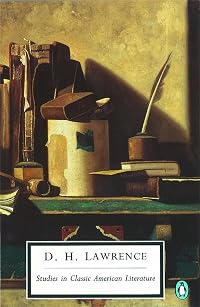
Studies in Classic American Literature
by D. H. Lawrence
On This Page
Description
Studies in Classic American Literature is a work of literary criticism by the English writer D. H. Lawrence. It was first published by Thomas Seltzer in the United States in August 1923. The British edition was published in June 1924 by Martin Secker. The authors discussed include Benjamin Franklin, Hector St. John de Crevecoeur, James Fenimore Cooper, Edgar Allan Poe, Nathaniel Hawthorne, Richard Henry Dana, Jr., Herman Melville, and Walt Whitman.Tags
Recommendations
















Member Reviews
It is apparent from this book of criticism that Lawrence was someone who was in constant tension with his surroundings. I believe he wrote the book while living in voluntary exile in New Mexico, which makes his stinging criticism of the first several American authors he considers a little hard to swallow. He is absolutely merciless in his treatment of Benjamin Franklin, and Fenimore Cooper comes off little better. Right when the American reader has had about as much as he or she can stand of the pompous and cynical Lawrence, one encounters the chapter on Hawthorne's Scarlet Letter, in which Lawrence expresses deep appreciation of the allegorical quality of the work (not without taking a few potshots at Hawthorne, of course). The final show more chapter on Moby Dick sealed it for me. Lawrence's enthusiasm for a work I haven't really considered in 10 or 12 years prompted me to buy a more robust edition and launch into it once again. All in all, this is a fine and provoking work of literary criticism in my opinion. show less
This is a remarkable book. Lawrence by turns reveals contempt, condescension, sympathy and admiration for America. And the book is as much about America and the American Mind (whatever that may be) as it is strictly about American Literature. The literature acts as a lens which Lawrence uses to focus his considerable and intense mental energy on the American psyche and character.
You never quite know if he likes us or loathes us or is merely amused by us. That among other things is what makes this book special and highly entertaining. That and Lawrence's pointed characterizations and observations.
About Benjamin Franklin:
"He was a little model, was Benjamin. Doctor Franklin. Snuff-colored little man!"
James Fennimore Cooper:
"... Best stick show more to National Grouch. The great American grouch.
Cooper had it, gentleman as he was."
A very curious observation in the chapter on Edgar Allan Poe:
"It is love that causes the neuroticism of the day. It is love that is the prime cause of tuberculosis."
On Nathaniel Hawthorne:
"The absolute duplicity of that blue-eyed Wunderkind of a Nathaniel. The American wonder child, with his magical allegorical insight."
In the chapter on Dana's "Two Years Before the Mast" (which makes me want to read that book):
"This is what Dana wanted: a naked fighting experience with the sea."
...
"And his own soul is as the soul of the albatross.
It is a storm-bird. And so is Dana."
...
"So Dana sits and Hamletizes by the Pacific--chief actor in the play of his own existence."
Finally, Lawrence brings up dualism more than once in his commentary and then exemplifies it himself in his own attitudes and judgments. Speaking of "Moby Dick" he says:
"It is a great book." Then immediately after that:
"At first you are put off by the style. It reads like journalism. It seems spurious. You feel Melville is trying to put something over you. It won't do."
All in all, a brilliant piece of commentary that bears re-reading. It took me 46 years to get around to my second reading - I suspect I'll read it the third time before that long a time elapses again. show less
You never quite know if he likes us or loathes us or is merely amused by us. That among other things is what makes this book special and highly entertaining. That and Lawrence's pointed characterizations and observations.
About Benjamin Franklin:
"He was a little model, was Benjamin. Doctor Franklin. Snuff-colored little man!"
James Fennimore Cooper:
"... Best stick show more to National Grouch. The great American grouch.
Cooper had it, gentleman as he was."
A very curious observation in the chapter on Edgar Allan Poe:
"It is love that causes the neuroticism of the day. It is love that is the prime cause of tuberculosis."
On Nathaniel Hawthorne:
"The absolute duplicity of that blue-eyed Wunderkind of a Nathaniel. The American wonder child, with his magical allegorical insight."
In the chapter on Dana's "Two Years Before the Mast" (which makes me want to read that book):
"This is what Dana wanted: a naked fighting experience with the sea."
...
"And his own soul is as the soul of the albatross.
It is a storm-bird. And so is Dana."
...
"So Dana sits and Hamletizes by the Pacific--chief actor in the play of his own existence."
Finally, Lawrence brings up dualism more than once in his commentary and then exemplifies it himself in his own attitudes and judgments. Speaking of "Moby Dick" he says:
"It is a great book." Then immediately after that:
"At first you are put off by the style. It reads like journalism. It seems spurious. You feel Melville is trying to put something over you. It won't do."
All in all, a brilliant piece of commentary that bears re-reading. It took me 46 years to get around to my second reading - I suspect I'll read it the third time before that long a time elapses again. show less
I always think of this book as "the book where Lawrence makes an utter twat of himself". He takes apart every darling of American literature with verve, passion, sarcastic wit, and unbridled bias. What's not to love?
Owning a first edition is pretty awesome as well. *grin*
Owning a first edition is pretty awesome as well. *grin*
Took me nearly a month to finish this tripe.
While Lawrence does have a few interesting things to say, much of this book is itinerant rambling. He tries to establish the thread of a theme throughout American literature that "knowing" a thing is equivalent to killing it, but after the first few chapters, he seems to frequently forget his Grand Unifying Theme only to bring it up sporadically thereafter.
I understand there is a critical edition that includes various drafts of the writings – I can't in good conscience call these "essays" – in this book, including four versions of the Whitman piece (the finished version and three drafts). God save anyone who is forced to read that edition.
While Lawrence does have a few interesting things to say, much of this book is itinerant rambling. He tries to establish the thread of a theme throughout American literature that "knowing" a thing is equivalent to killing it, but after the first few chapters, he seems to frequently forget his Grand Unifying Theme only to bring it up sporadically thereafter.
I understand there is a critical edition that includes various drafts of the writings – I can't in good conscience call these "essays" – in this book, including four versions of the Whitman piece (the finished version and three drafts). God save anyone who is forced to read that edition.
So irritating I had to quit after the introduction and half the Franklin chapter. At least through that point, Lawrence is patronizing and smug, and offers nothing in the way of tangible analysis of his subject. This only keeps out of the fully 'pernicious' category out of respect for the fact that it dares to present American literature as actually worthy of study, not a widespread view ca. 1923.
I read [Studies in Classic American Literature] by D.H. Lawrence for the British Author Challenge. Lawrence wrote this in while he lived in the United States, a set of critical essays begun in 1917. Chapters include;
1. The Spirit of Place
2. Benjamin Franklin
3. Hector St. John de Crevecoeur
4. Fennimore Cooper's White Novels
5. Fennimore Cooper's Leather Stocking
6. Edgar Allan Poe
7. Nathaniel Hawthorn and the Scarlet Letter
8. Hawthorne's Blithdale Romance
9. Dana's Two Years Before the Mast
10. Herman Melville's Typee and Omoo
11. Herman Melville's Moby Dick
12. Whitman
In reviewing Wiki, apparently this review of Melville is credited in reviving his literary work. As to be expected, Lawrence saw sexuality in a lot of these writings. He show more reviewed the women of Fennimore Cooper and Hawthorne.
You can find this pdf on line if you would want to read it. show less
1. The Spirit of Place
2. Benjamin Franklin
3. Hector St. John de Crevecoeur
4. Fennimore Cooper's White Novels
5. Fennimore Cooper's Leather Stocking
6. Edgar Allan Poe
7. Nathaniel Hawthorn and the Scarlet Letter
8. Hawthorne's Blithdale Romance
9. Dana's Two Years Before the Mast
10. Herman Melville's Typee and Omoo
11. Herman Melville's Moby Dick
12. Whitman
In reviewing Wiki, apparently this review of Melville is credited in reviving his literary work. As to be expected, Lawrence saw sexuality in a lot of these writings. He show more reviewed the women of Fennimore Cooper and Hawthorne.
You can find this pdf on line if you would want to read it. show less
First edition. ix, [i], 264 pp. 1 vols. 8vo. In Dust Jacket. The first serious literary study of American literature, notable for its early assessment of Herman Melville. A minor landmark from Lawrence's most fertile years, and a striking Twenties dust jacket. Roberts A25a Original blue cloth, stamped in gilt. Very good copy (some fading as usual), in very good dust jacket (tiny marginal losses to spine ends and at back flap fold)
Members
- Recently Added By
Published Reviews
ThingScore 50
Lawrence’s attack on Franklin in his Studies in Classical American Literature ought to be read, but it is a typical misfire. Lawrence, one supposes, could not forgive another Puritan for knowing more about sex than he did, and before Franklin’s irony, urbanity and benevolence, Lawrence cuts an absurd figure, rather like that of a Sunday School teacher who has gone to a social dressed up as show more a howling dervish, when fancy dress was not requested. There is of course something in Lawrence’s diatribe; it is the criticism by the man whose life is all poetry of the man whose life is all prose. show less
added by SnootyBaronet
Lists

Harold Bloom - The Western Canon: D. The Chaotic Age
833 works; 24 members
Author Information

895+ Works 60,630 Members
D(avid) H(erbert) Lawrence was born on September 11, 1885. His father was a coal miner and Lawrence grew up in a mining town in England. He always hated the mines, however, and frequently used them in his writing to represent both darkness and industrialism, which he despised because he felt it was scarring the English countryside. Lawrence show more attended high school and college in Nottingham and, after graduation, became a school teacher in Croyden in 1908. Although his first two novels had been unsuccessful, he turned to writing full time when a serious illness forced him to stop teaching. Lawrence spent much of his adult life abroad in Europe, particularly Italy, where he wrote some of his most significant and most controversial novels, including Sons and Lovers and Lady Chatterly's Lover. Lawrence and his wife, Frieda, who had left her first husband and her children to live with him, spent several years touring Europe and also lived in New Mexico for a time. Lawrence had been a frail child, and he suffered much of his life from tuberculosis. Eventually, he retired to a sanitorium in Nice, France. He died in France in 1930, at age 44. In his relatively short life, he produced more than 50 volumes of short stories, poems, plays, essays, travel journals, and letters, in addition to the novels for which he is best known. (Bowker Author Biography) show less
Some Editions
Series
Belongs to Publisher Series
Anchor Books (5)
Common Knowledge
- Original publication date
- 1923
- Canonical DDC/MDS
- 810.4
Classifications
Statistics
- Members
- 638
- Popularity
- 45,484
- Reviews
- 9
- Rating
- (3.48)
- Languages
- 7 — Chinese, Czech, Danish, English, French, Italian, Swedish
- Media
- Paper, Audiobook, Ebook
- ISBNs
- 25
- ASINs
- 29