On This Page
Description
Bilodo lives a solitary daily life, routinely completing his post round every day and returning to his empty Montreal apartment. But he has found a way to break the cycle - Bilodo has taken to stealing people's mail, steaming open the envelopes and reading the letters inside. And so it is he comes across Segolene's letters. She is corresponding with Gaston, a master poet, and their letters are each composed of only three lines. They are writing each other haikus. The simplicity and elegance show more of their poems move Bilado and he begins to fall in love with her. But one day, out on his round, he witnesses a terrible and tragic accident. Just as Gaston is walking up to the post-box to mail his next haiku to Segolene, he is hit by a car and dies on the side of the road. And so Bilodo makes an extraordinary decision - he will impersonate Gaston and continue to write to Segolene under this guise. But how long can the deception continue for? show lessTags
Recommendations






























Member Recommendations

Member Reviews
The Peculiar Life of a Lonely Postman is a strange tale, but compelling in its strangeness. Author Denis Thériault's background in screenwriting enhances the imagery conjured by his words, and each place in the story is like a film set, each character like an actor viewed by an audience.
As I started to read, I was initially plunged into a world that seemed to date from the first half of the 20th century. The narrative style had a similar clipped feeling to novels of the jazz age. And then Call of Duty and Halo were mentioned. Suddenly the book took on a new shape for me. It became the literary equivalent of Jeunet and Caro films. There is a sepia tint around its edges, an old fashioned cut to its cloth.
There's also a quiet, mildly show more nightmarish menace to the story. There's a quote from a review on the back that likens it to Kafka, but it reminded me more of Paul Auster.
Bilodo is the twenty-seven year old titular postman. His life is a ritual of sorting and delivering letters. He has never received a personal letter, and develops an extra ritual that involves secretly taking such letters home with him, steaming them open to read them, before resealing them for delivery the next day. Bilodo falls in love with one of the correspondents whose letters he intercepts, and the novel explores obsession, infatuation, the circularity of life, using haiku and tanka as both medium and message. show less
As I started to read, I was initially plunged into a world that seemed to date from the first half of the 20th century. The narrative style had a similar clipped feeling to novels of the jazz age. And then Call of Duty and Halo were mentioned. Suddenly the book took on a new shape for me. It became the literary equivalent of Jeunet and Caro films. There is a sepia tint around its edges, an old fashioned cut to its cloth.
There's also a quiet, mildly show more nightmarish menace to the story. There's a quote from a review on the back that likens it to Kafka, but it reminded me more of Paul Auster.
Bilodo is the twenty-seven year old titular postman. His life is a ritual of sorting and delivering letters. He has never received a personal letter, and develops an extra ritual that involves secretly taking such letters home with him, steaming them open to read them, before resealing them for delivery the next day. Bilodo falls in love with one of the correspondents whose letters he intercepts, and the novel explores obsession, infatuation, the circularity of life, using haiku and tanka as both medium and message. show less
Love is a many-splendored—and weird—thing
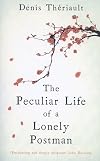
The Peculiar Life of a Lonely Postman by Denis Thériault (Hesperus Press, $14.95).
Québécois novelist Denis Thériault explores the all-too-narrow line between love and obsession in The Peculiar Life of a Lonely Postman, translated from the French by Liedewy Hawke. The titular postman, Bilodo, is self-isolated, ignoring opportunities to expand his social circle so that he can pursue his lonely passion: He steams open letters and reads them before delivery. Since letters are now rare, he treasures each one, but ever since he ran across the correspondence between the sensitive Ségolène and the aging scholar Grandpré, conducted entirely in haiku, he has been nothing short of obsessed by it. show more When Bilodo witnesses the accidental death in the street of Grandpré, rather than inform the object of his affections, Ségolène, he opts to continue the epistolary love affair. Bilodo’s grip on reality fails as his poetic skills increase, and Thériault takes readers on a fabulous and absurd ride through a love gone mad.
Reviewed on Lit/Rant: www.litrant.tumblr.com show less
The Peculiar Life of a Lonely Postman by Denis Thériault (Hesperus Press, $14.95).
Québécois novelist Denis Thériault explores the all-too-narrow line between love and obsession in The Peculiar Life of a Lonely Postman, translated from the French by Liedewy Hawke. The titular postman, Bilodo, is self-isolated, ignoring opportunities to expand his social circle so that he can pursue his lonely passion: He steams open letters and reads them before delivery. Since letters are now rare, he treasures each one, but ever since he ran across the correspondence between the sensitive Ségolène and the aging scholar Grandpré, conducted entirely in haiku, he has been nothing short of obsessed by it. show more When Bilodo witnesses the accidental death in the street of Grandpré, rather than inform the object of his affections, Ségolène, he opts to continue the epistolary love affair. Bilodo’s grip on reality fails as his poetic skills increase, and Thériault takes readers on a fabulous and absurd ride through a love gone mad.
Reviewed on Lit/Rant: www.litrant.tumblr.com show less
The Peculiar Life of a Lonely Postman depicts how loneliness can affect a person and lead to a variety of displaced - peculiar - actions. It is a lovely novella sheathed in a quiet drama of deception, apprehension, love, lust, and pain. Ironically, it renders the reader uncannily on the side of deception, such are the pathos of its protagonist, Bilodo the Postman. Add to that Haikus, philosophy and humor, and you have a delightfully dark and quirky story. Be prepared to devour this lovely, all-consuming tale in one sitting as it is impossible to put down.
Incidentally, a sequel to this novella, The Postman’s Fiancee, is due for publication this year. Will it bring a close to Bilodo ‘s besotted journey, or will it add another layer show more to this curious and comic tale? I eagerly anticipate it's arrival! show less
Incidentally, a sequel to this novella, The Postman’s Fiancee, is due for publication this year. Will it bring a close to Bilodo ‘s besotted journey, or will it add another layer show more to this curious and comic tale? I eagerly anticipate it's arrival! show less
 This review was written for LibraryThing Early Reviewers.
Bilodo the postman found comfort in his life in a unique way. While it certainly wasn’t an ethical thing to do, Bilodo would sometimes slip a letter into his pocket instead of delivering it and would steam it open in the privacy of his own home that evening. He would read the letter, make a copy to keep and then mail the letter on to its proper recipient. Bilodo lived vicariously through these letters. When he opens up a letter with only a haiku in it, he’s pulled into the world of Segolene and Gaston Grandpre, who write to each other in poetry.
This is truly a lovely little book. The book is only a little over 100 pages and yet the author is able to fully flesh out the characters and make you care about them. I loved reading the show more many haikus that are scattered throughout the book and never knew how passionate a short haiku could be. There’s a tragic love story at the heart of this book that will remind you of Cyrano de Bergerac. The book is quirky, it’s charming, it’s funny, it’s tragic and it’s quite a feat for the author to gather together such a compelling story with so few words, much like a haiku itself. This book was originally published in France and I’m delighted to read that its sequel, The Postman’s Fiancee, will be published later this year.
This novella is just about as perfect as you can get. Highly recommended.
This book was given to me by the publisher through Library Thing in return for an honest review. show less
This is truly a lovely little book. The book is only a little over 100 pages and yet the author is able to fully flesh out the characters and make you care about them. I loved reading the show more many haikus that are scattered throughout the book and never knew how passionate a short haiku could be. There’s a tragic love story at the heart of this book that will remind you of Cyrano de Bergerac. The book is quirky, it’s charming, it’s funny, it’s tragic and it’s quite a feat for the author to gather together such a compelling story with so few words, much like a haiku itself. This book was originally published in France and I’m delighted to read that its sequel, The Postman’s Fiancee, will be published later this year.
This novella is just about as perfect as you can get. Highly recommended.
This book was given to me by the publisher through Library Thing in return for an honest review. show less
This review was written for LibraryThing Early Reviewers.Based on the advance reviews, which described this book, variously, as beguiling (The Independent), quirky and charming (Guardian), delightful (Times Literary Supplement) and enchanting (John Burnside), I was expecting something akin to the adorable French comedy, Amelie. What I got was something far more poignant, philosophical, dark and complex.
It’s the story of Bilodo, an introverted young postman who “borrows” personal correspondence from people on his route to steam open, read and deliver the following day. As a result of this questionable practice, he becomes obsessed with a young lady in Guadeloupe who exchanges haiku with an eccentric middle-aged professor. When the professor meets with a sudden and tragic end, Bilodo show more studies the art of haiku and, masquerading as her pen-pal, begins to correspond with her in his place. This all makes the character sound pretty creepy, but he’s presented in a very sympathetic light and my reaction to his pursuit seemed to swing between pity and inspiration. Most of the time, I found myself rooting for him.
Immediately after finishing this, I read the sequel, The Postman’s Fiancee (which by the end of the first part, seemed a frankly doubtful prospect), which I highly recommend. The sequel fills in some blanks about Bilodo’s life and, ultimately, brings his saga full circle, so to speak.
This is a short but dense novel filled with humor, pathos and lots of [Asian] philosophical musing. It can be enjoyed for its odd story alone or, if one chooses to dig a bit deeper, for what it has to say about personal connection and the human condition. show less
It’s the story of Bilodo, an introverted young postman who “borrows” personal correspondence from people on his route to steam open, read and deliver the following day. As a result of this questionable practice, he becomes obsessed with a young lady in Guadeloupe who exchanges haiku with an eccentric middle-aged professor. When the professor meets with a sudden and tragic end, Bilodo show more studies the art of haiku and, masquerading as her pen-pal, begins to correspond with her in his place. This all makes the character sound pretty creepy, but he’s presented in a very sympathetic light and my reaction to his pursuit seemed to swing between pity and inspiration. Most of the time, I found myself rooting for him.
Immediately after finishing this, I read the sequel, The Postman’s Fiancee (which by the end of the first part, seemed a frankly doubtful prospect), which I highly recommend. The sequel fills in some blanks about Bilodo’s life and, ultimately, brings his saga full circle, so to speak.
This is a short but dense novel filled with humor, pathos and lots of [Asian] philosophical musing. It can be enjoyed for its odd story alone or, if one chooses to dig a bit deeper, for what it has to say about personal connection and the human condition. show less
This review was written for LibraryThing Early Reviewers.Le style du roman m'a un peu rappelé Gros-Câlin d'Émile Ajar (Romain Gary): L'histoire est légère et se lit facilement, le personnage principal amène la sympathie (malgré ses tendances à lire le courrier des autres) et le tout est un peu absurde, tout en restant un livre fort agréable à lire. Les haikus peuplant l'histoire sont un vrai plaisir pour les yeux et le coeur ainsi que fort bien écrits.
Le fond philosophique dans lequel baigne le récit était aussi une belle surprise. Certes, nous lisons un roman qui se veut plaisant, mais cela ne change pas le fait qu'il puisse rester instructif et nous faire travailler un peu les méninges.
Donc, si vous cherchez une lecture facile, courte et intelligente, je vous recommande ce show more livre sans hésiter!
*SPOILERS QUI SUIVENT*
Donc, si vous n'avez pas lu le livre et êtes intéressé à le faire, arrêtez-vous ici parce que la suite contient mon passage préféré du livre et donc, un spoiler.
Comme je le disais, le roman pousse quand même à réfléchir sur la vie, tout en restant léger et amusant à lire. Le passage qui suit reflète bien le fond de ma pensée:
La mort de Grandpré ne suscita que peu d'émoi dans le quartier car on ne le connaissait guère. Au Madelinot, Tania déposa un oeillet sur la table qu'il occupait ordinairement lorsqu'il venait boire un café. Ce fut tout. C'était donc ainsi qu'on passait dans la vie, constata Bilodo: fortuitement, sans créer de remous, sans que perdure le sillage, comme une hirondelle traverse le ciel, et aussi vite était-on oublié que l'écureuil écrasé par mégarde sur la route.
C'était ainsi.
Thériault parle ici d'un sujet important qui vient chercher tout les humains: La mort et, notamment, la trace que l'on laisse (ou que l'on ne laisse pas) derrière nous lorsque l'on s'éteint. Or, prenant un sujet aussi profond, il arrive quand même à glisser une note comique en le comparant à un écureuil écrasé sur la route. Ce petit extrait tout seul illustre parfaitement le ton du livre.
En bref, Le facteur émotif a été un de mes coups de coeur de l'été et je vous le recommande! show less
Le fond philosophique dans lequel baigne le récit était aussi une belle surprise. Certes, nous lisons un roman qui se veut plaisant, mais cela ne change pas le fait qu'il puisse rester instructif et nous faire travailler un peu les méninges.
Donc, si vous cherchez une lecture facile, courte et intelligente, je vous recommande ce show more livre sans hésiter!
*SPOILERS QUI SUIVENT*
Donc, si vous n'avez pas lu le livre et êtes intéressé à le faire, arrêtez-vous ici parce que la suite contient mon passage préféré du livre et donc, un spoiler.
Comme je le disais, le roman pousse quand même à réfléchir sur la vie, tout en restant léger et amusant à lire. Le passage qui suit reflète bien le fond de ma pensée:
La mort de Grandpré ne suscita que peu d'émoi dans le quartier car on ne le connaissait guère. Au Madelinot, Tania déposa un oeillet sur la table qu'il occupait ordinairement lorsqu'il venait boire un café. Ce fut tout. C'était donc ainsi qu'on passait dans la vie, constata Bilodo: fortuitement, sans créer de remous, sans que perdure le sillage, comme une hirondelle traverse le ciel, et aussi vite était-on oublié que l'écureuil écrasé par mégarde sur la route.
C'était ainsi.
Thériault parle ici d'un sujet important qui vient chercher tout les humains: La mort et, notamment, la trace que l'on laisse (ou que l'on ne laisse pas) derrière nous lorsque l'on s'éteint. Or, prenant un sujet aussi profond, il arrive quand même à glisser une note comique en le comparant à un écureuil écrasé sur la route. Ce petit extrait tout seul illustre parfaitement le ton du livre.
En bref, Le facteur émotif a été un de mes coups de coeur de l'été et je vous le recommande! show less
Absolutely wonderful! Part Sisyphus, part "Groundhog Day", and very mystical! Intrigued? A lonely postman lives vicariously through the mail of others. Think that's quirky? Just the beginning! This novella was a quick and totally engrossing read. All teasing aside, life, love, loneliness, mysticism, are all addressed in a beautifully poetic manner, using the vehicle of the Japanese poetry forms, haiku and tanka. I know this may all sound disjointed, but the book is so poignant that it hurt. Please treat yourself to this read. I am moving on to its sequel immediately!
Members
- Recently Added By
Author Information

9 Works 369 Members
Some Editions
Awards and Honors
Series

Belongs to Publisher Series
dtv premium (24743)
Common Knowledge
- Canonical title
- The Peculiar Life of a Lonely Postman
- Original title
- La facteur émotif
- Alternate titles
- The Postman's Round
- Original publication date
- 2005
- People/Characters
- Bilodo; Ségolène; Gaston Grandpré; Robert; Tania; Madame Brochu
- Important places
- Guadeloupe, France; Montréal, Québec, Canada
- Epigraph*
- Tourbillonnant comme l'eau
contre le rocher
le temps fait des boucles - Dedication
- To Louise and Guy
- First words
- Swirling like water against rugged rocks, time goes around and around
- Last words
- (Click to show. Warning: May contain spoilers.)"Enso," he moaned as the last breath of life abandoned him.
- Publisher's editor*
- XYZ éditeur
- Blurbers
- Burnside, John
- Original language
- French
*Some information comes from Common Knowledge in other languages. Click "Edit" for more information.
Classifications
Statistics
- Members
- 271
- Popularity
- 119,278
- Reviews
- 34
- Rating
- (3.62)
- Languages
- 8 — Czech, Dutch, English, French, German, Italian, Portuguese, Spanish
- Media
- Paper, Ebook
- ISBNs
- 21
- ASINs
- 5