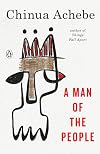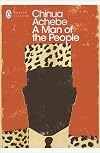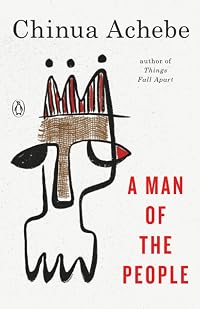
A Man of the People
by Chinua Achebe
On This Page
Description
By the renowned author of Things Fall Apart, this novel foreshadows the Nigerian coups of 1966 and shows the color and vivacity as well as the violence and corruption of a society making its own way between the two worlds.Tags
Recommendations










Member Reviews
Thoroughly entertaining.
I love the way the narrator works in this one. His eyes are open, he sees the corruption around him, he knows right and wrong, but he never really does any better.
It's hard to pin him down at first. He is very intelligent, decent-seeming. A skeptic amongst believers. He observes the corruption in his state and he is rightly disgusted by it. But identifying the bad guys does not automatically make you the good guy. He can hem and haw moralistically to us about what a sleaze Nanga is, but his actions tell a different story; he only decides to take a stand against Nanga when his own masculine pride is insulted. Gradually, we see that our man is no better than a mini-Nanga; the joke is that he's just not as good at show more it. I think it's a funny joke. show less
I love the way the narrator works in this one. His eyes are open, he sees the corruption around him, he knows right and wrong, but he never really does any better.
It's hard to pin him down at first. He is very intelligent, decent-seeming. A skeptic amongst believers. He observes the corruption in his state and he is rightly disgusted by it. But identifying the bad guys does not automatically make you the good guy. He can hem and haw moralistically to us about what a sleaze Nanga is, but his actions tell a different story; he only decides to take a stand against Nanga when his own masculine pride is insulted. Gradually, we see that our man is no better than a mini-Nanga; the joke is that he's just not as good at show more it. I think it's a funny joke. show less
Saying: A mad man may sometimes speak a true word
All writing could be seen as the occasional true word spoken by a mad man. Perhaps this saying is true of this whole story, in which what is true, like power, is not always so.
Chinua Achebe’ A Man of the People is full of such sayings. They are more than local colour; these sayings are a unifying element of the narrative. The story could be a coming of age for young Odili, the school teacher narrator who is hurled into the heart of local politics during the 1960s post-independence Nigeria. It could be a strange quest for a wife story as Odili is often more inspired by love than politics and makes serendipitous mistakes based on his interest in woman – he has a doe-eyed approach to show more even the ‘good time’ girl who propels him to act against Man of the People or Chief Nanga, Minister for Culture and Odili’s former teacher, local power broker.
Another saying: If Alligator comes out of the water one morning and tells you that crocodile is sick; can you doubt his story?
Power is fluid, and change is always likely. Except when power is held it always seems impenetrable. This is as much a story of old vs young, the past vs the changing present. Truth might seem fluid too in a place where corruption is alternatively viewed as 10% off contracts for party purposes and the local population gets a little slice for voting in the form of badly needed public works. So not all is as it seems.
Another saying: a man of worth never gets up to unsay what he said yesterday
Reality is often spoken as truth. Everyone tries to do their best in the world. Wealth and power are not easily obtained or held onto. Truth is obscured. Odili’s father speaks those words yet made a fortune to have several wives and much drink based on being the local translator from local dialect to English and back again. In translation perhaps much truth can be lost and much power gained.
Odili clashes with his father when he is advised not to go head to head with his former teacher in the local election. But MP Nanga has offered Odili the use of his luxury "10%" mansion in the city for a tryst with a "good time girl". Odili mistakenly thinks she was his girlfriend. When the chief takes her by deception, Odili gets mad seeks revenge. But then Odili also has fallen in love with the young, educated ‘second wife’ of MP Nanga to be: Edna. There aren't any sayings about love in this novel. Usually it is sacrificed for the battle of old vs young, past vs change.
Odili has in fact disliked his former teacher since the MP took up with the band of populists to overthrow the previous government thought to have too many intellectuals. Prompting the saying entered into Hansard in parliament: They have bitten the finger with which their mother fed them. This debate within the novel early is about the hybridised society of colonialism and its intellectual legacy vs the local authority and culture. Each saying reminds us that wisdom is hard earned, not only learned at University where Odili is being sent on scholarship by his benefactor MP. Even Odili is momentary seduced by what power offers.
Saying: A man who has just come in from the rain and dried his body and put on dry clothes is more reluctant to go out again than another who has been indoors all the time.
I like this one, it speaks so much about how some can cope with change and others stay still. Odili receives advice like this as his pride and anger take over. People can too easily get comfortable with their power, too. MP Nanga may well discover this himself.
Power always has its day in some form all the time. It is stable because it is desired. It confers the sort of authority gained in this my favourite saying:
In our country a long American car driven by a white-uniformed chauffer and flying a Ministerial flag could pass through the eye of a needle
Foreign or colonial power, political power, local power and male power are all contained in that saying. No women are in the back seat of that Cadillac in this novel, by the way. They can be first, second or fifth wives under local custom. Power and money go hand in hand.
Another saying: What money will do in this land wears a hat.
I like that one, too. It goes hand in hand with human needs and desires:
Some people’s belly is like the earth. It is never so full that it cannot take another corpse
I’ll leave you with one last saying, not essential to the story at first sight. It is about Edna’s mother. Odili is pursuing Edna to her home town and finds out the mother is unwell in hospital. Of course, since Edna is 'second wife' to be of MP Nanga, the mother is receiving his support. Odili doesn't reveal his purpose, so he pretends to be the emissary of the MP. The mother has been in hospital for three weeks to which is said:
but her body has not been hers since the beginning of rainy season
But then the same could be said of everyone possessed by some power or drive.
This is book 31 of the Heinemann African Writers Series. I was given this book by our retiring lecturer in 1986 who taught a course called The Stirring of the Masses in Black Africa. Our lecturer gave away all his books saying he doesn’t plan to read any more academic works. Academia was a job to him. He aimed to let go of power in all his teaching using a Socratic type of method, believing in debate, discussion, searching rather than authority and dogma. I miss that. show less
All writing could be seen as the occasional true word spoken by a mad man. Perhaps this saying is true of this whole story, in which what is true, like power, is not always so.
Chinua Achebe’ A Man of the People is full of such sayings. They are more than local colour; these sayings are a unifying element of the narrative. The story could be a coming of age for young Odili, the school teacher narrator who is hurled into the heart of local politics during the 1960s post-independence Nigeria. It could be a strange quest for a wife story as Odili is often more inspired by love than politics and makes serendipitous mistakes based on his interest in woman – he has a doe-eyed approach to show more even the ‘good time’ girl who propels him to act against Man of the People or Chief Nanga, Minister for Culture and Odili’s former teacher, local power broker.
Another saying: If Alligator comes out of the water one morning and tells you that crocodile is sick; can you doubt his story?
Power is fluid, and change is always likely. Except when power is held it always seems impenetrable. This is as much a story of old vs young, the past vs the changing present. Truth might seem fluid too in a place where corruption is alternatively viewed as 10% off contracts for party purposes and the local population gets a little slice for voting in the form of badly needed public works. So not all is as it seems.
Another saying: a man of worth never gets up to unsay what he said yesterday
Reality is often spoken as truth. Everyone tries to do their best in the world. Wealth and power are not easily obtained or held onto. Truth is obscured. Odili’s father speaks those words yet made a fortune to have several wives and much drink based on being the local translator from local dialect to English and back again. In translation perhaps much truth can be lost and much power gained.
Odili clashes with his father when he is advised not to go head to head with his former teacher in the local election. But MP Nanga has offered Odili the use of his luxury "10%" mansion in the city for a tryst with a "good time girl". Odili mistakenly thinks she was his girlfriend. When the chief takes her by deception, Odili gets mad seeks revenge. But then Odili also has fallen in love with the young, educated ‘second wife’ of MP Nanga to be: Edna. There aren't any sayings about love in this novel. Usually it is sacrificed for the battle of old vs young, past vs change.
Odili has in fact disliked his former teacher since the MP took up with the band of populists to overthrow the previous government thought to have too many intellectuals. Prompting the saying entered into Hansard in parliament: They have bitten the finger with which their mother fed them. This debate within the novel early is about the hybridised society of colonialism and its intellectual legacy vs the local authority and culture. Each saying reminds us that wisdom is hard earned, not only learned at University where Odili is being sent on scholarship by his benefactor MP. Even Odili is momentary seduced by what power offers.
Saying: A man who has just come in from the rain and dried his body and put on dry clothes is more reluctant to go out again than another who has been indoors all the time.
I like this one, it speaks so much about how some can cope with change and others stay still. Odili receives advice like this as his pride and anger take over. People can too easily get comfortable with their power, too. MP Nanga may well discover this himself.
Power always has its day in some form all the time. It is stable because it is desired. It confers the sort of authority gained in this my favourite saying:
In our country a long American car driven by a white-uniformed chauffer and flying a Ministerial flag could pass through the eye of a needle
Foreign or colonial power, political power, local power and male power are all contained in that saying. No women are in the back seat of that Cadillac in this novel, by the way. They can be first, second or fifth wives under local custom. Power and money go hand in hand.
Another saying: What money will do in this land wears a hat.
I like that one, too. It goes hand in hand with human needs and desires:
Some people’s belly is like the earth. It is never so full that it cannot take another corpse
I’ll leave you with one last saying, not essential to the story at first sight. It is about Edna’s mother. Odili is pursuing Edna to her home town and finds out the mother is unwell in hospital. Of course, since Edna is 'second wife' to be of MP Nanga, the mother is receiving his support. Odili doesn't reveal his purpose, so he pretends to be the emissary of the MP. The mother has been in hospital for three weeks to which is said:
but her body has not been hers since the beginning of rainy season
But then the same could be said of everyone possessed by some power or drive.
This is book 31 of the Heinemann African Writers Series. I was given this book by our retiring lecturer in 1986 who taught a course called The Stirring of the Masses in Black Africa. Our lecturer gave away all his books saying he doesn’t plan to read any more academic works. Academia was a job to him. He aimed to let go of power in all his teaching using a Socratic type of method, believing in debate, discussion, searching rather than authority and dogma. I miss that. show less
Chinua Achebe almost effortlessly build such beautiful characters. Let's look at Odili- upright, scornful of the direction his country is taking, yet happy with his little assignment at the Grammar School. Then the possibility of a scholarship comes along and his 'dissent' starts turning into action. He decides he needs this scholarship anti the current theme of Western educated elite being treated like pariahs. He almost 'dissents' by going and living with Chief Nanga and his family- someone he is shown to have developed a detest for- and admires his multi-bungalow, flushed-toilets lifestyle. A minor dissent is trying to bring his girlfriend Elsie and her friend home for the gentleman's company. And then of course that fateful incident show more which leaves him like someone 'with an elephant carcass on their head toeing around for a grasshopper' (I only remember this one but the book is full of such delightful local similes). He then dissents by joining the 'left-leaning intellectuals led common people party' (as described in a beautiful introduction by Karl Maier) and contesting the chief's seat and vying for the affection of his upcoming wife. What follows is tragic and yet beautiful.
Odili is such a real character- full of interesting twists and turns and choices.
This is the first Chinua Achebe book I've read and definitely won't be the last. show less
Odili is such a real character- full of interesting twists and turns and choices.
This is the first Chinua Achebe book I've read and definitely won't be the last. show less
Voltaképpen jó kis könyv ez, ha úgy olvasom, mint keserű tanmesét a posztkolonialista Fekete-Afrikáról, a mindent átszövő korrupcióról, a populista értelmiségellenességről, és arról, hogy a nép, istenadta nép hogyan fekszik le a hatalomnak, ugyanannak a hatalomnak, amit aztán otthon a négy fal között a sárga földig legyaláz, és amit százszor is megtagad majd, ha egyszer fordul a kocka. Mondjuk ez a tanmese így belegondolva nem csak Fekete-Afrikáról szól – de csitulj, te értékelő, aki mindig ugyanoda lyukadna ki, ha a polgári jóízlés időnként nem szabna gátat agitátori hajlamainak. Zárójel bezárva. Ráadásul ez a regény olyan szempontból is tanulságos, hogy érzékletesen (bár show more bújtatva) megjeleníti a hidegháború hatását egyes afrikai államokra: a kormánypártok suskusai felett pár zsíros koncesszióért szemet hunyó, és őket támogató nyugatot, valamint a feltörekvő jó szándékú kispártokat, akik a kisembert képviselnék – szintén külföldi pénzből, ami lehet tippelni, honnan csordogál.
Ugyanakkor ez a könyv regénynek sajna elég harmatos – csak úgy hemzseg az olyan elemektől, amikre egy józan életű irodalmi szerkesztő azt mondaná, hogy: „Na ezt visszaadom, Bélám, dolgozzál még rajta kicsit”. Csupa ígéretes mellékszál, mint amilyen az elbeszélő és a miniszter közötti ambivalens mester és tanítvány viszony, ami magnetikus vonzalomból indul, hogy aztán engesztelhetetlen ellenségeskedéssé váljon… vagy az elbeszélő és apja közötti feszültség… de ezek csak kidolgozatlan vázlatok maradnak, mert Achebének úgy fest, elment minden energiája a népnevelésre. Kár érte. show less
Ugyanakkor ez a könyv regénynek sajna elég harmatos – csak úgy hemzseg az olyan elemektől, amikre egy józan életű irodalmi szerkesztő azt mondaná, hogy: „Na ezt visszaadom, Bélám, dolgozzál még rajta kicsit”. Csupa ígéretes mellékszál, mint amilyen az elbeszélő és a miniszter közötti ambivalens mester és tanítvány viszony, ami magnetikus vonzalomból indul, hogy aztán engesztelhetetlen ellenségeskedéssé váljon… vagy az elbeszélő és apja közötti feszültség… de ezek csak kidolgozatlan vázlatok maradnak, mert Achebének úgy fest, elment minden energiája a népnevelésre. Kár érte. show less
Excellent and honest look at human nature.
A lot of human weakness cleverly and honestly exposed. I wanted to grab Odili, the narrator, and shake him.
But we are guided not to judge him from a distance but rather look at him as a mirror: Achebe hints that this person is not a million miles away from himself (Odili wants to write a novel about the first white men who came to his people). For me this is a signal that I am not to take this as an indictment of any one person or group of people but of all of us.
[spoiler]
This might be why the character feels so real and familiar despite being so duplicitous and self-centred and disloyal. I can't call him a coward, he is brave enough at times, but it didn't cross his mind to defend Elise when show more she was raped, or to stand by her or support her. He seems to see everyone as a means to an end and I don't think there is a single point in the book where he shows any genuine concern for another human being. (Correct me if I am wrong!)
Despite all this he is well able to see almost everything that is vile in Cheif Nanga, he thinks clearly and has a strong sense of what is right. Or is he just waiting for "his turn to eat"? He is very skilled at seeing what is wrong with the world and never stops to look at what might be wrong with him. His chief motivations are sex, revenge and greed. But through all this he manages to truly believe he is a noble man.
[/spoiler].
Some interesting quotes:
[spoiler]
"This man had used his position to enrich himself and they would ask you—as my father did—if you thought that a sensible man would spit out the juicy morsel that good fortune placed in his mouth."
"But we are eating too. They are bringing us water and they promise to bring us electricity. We did not have those things before; that is why I say we are eating too."
"Not what I have but what I do is my kingdom" - Thomas Carlyle quote
There is a bit about voting for someone just because they come from the same village as you, which is also rampant in Ireland and I assume that's the case everywhere. He calls it "primitive loyalty" which seems appropriate.
"Some people's belly is like the earth. It is never so full that it will not take another corpse."
"What money will do in this land wears a hat."
"I could tell by watching his face that his final state of knowledge was achieved through an act of will."
"She had been like a dust particle in the high atmosphere around which the water vapour of my thinking formed its globule of rain."
"As a rule I don't like suffering to no purpose. Suffering should be creative, should give birth to something good and lovely."
[/spoiler] show less
A lot of human weakness cleverly and honestly exposed. I wanted to grab Odili, the narrator, and shake him.
But we are guided not to judge him from a distance but rather look at him as a mirror: Achebe hints that this person is not a million miles away from himself (Odili wants to write a novel about the first white men who came to his people). For me this is a signal that I am not to take this as an indictment of any one person or group of people but of all of us.
[spoiler]
This might be why the character feels so real and familiar despite being so duplicitous and self-centred and disloyal. I can't call him a coward, he is brave enough at times, but it didn't cross his mind to defend Elise when show more she was raped, or to stand by her or support her. He seems to see everyone as a means to an end and I don't think there is a single point in the book where he shows any genuine concern for another human being. (Correct me if I am wrong!)
Despite all this he is well able to see almost everything that is vile in Cheif Nanga, he thinks clearly and has a strong sense of what is right. Or is he just waiting for "his turn to eat"? He is very skilled at seeing what is wrong with the world and never stops to look at what might be wrong with him. His chief motivations are sex, revenge and greed. But through all this he manages to truly believe he is a noble man.
[/spoiler].
Some interesting quotes:
[spoiler]
"This man had used his position to enrich himself and they would ask you—as my father did—if you thought that a sensible man would spit out the juicy morsel that good fortune placed in his mouth."
"But we are eating too. They are bringing us water and they promise to bring us electricity. We did not have those things before; that is why I say we are eating too."
"Not what I have but what I do is my kingdom" - Thomas Carlyle quote
There is a bit about voting for someone just because they come from the same village as you, which is also rampant in Ireland and I assume that's the case everywhere. He calls it "primitive loyalty" which seems appropriate.
"Some people's belly is like the earth. It is never so full that it will not take another corpse."
"What money will do in this land wears a hat."
"I could tell by watching his face that his final state of knowledge was achieved through an act of will."
"She had been like a dust particle in the high atmosphere around which the water vapour of my thinking formed its globule of rain."
"As a rule I don't like suffering to no purpose. Suffering should be creative, should give birth to something good and lovely."
[/spoiler] show less
I confess I never really understood Achebe's popularity until very recently. [b:Things Fall Apart|37781|Things Fall Apart|Chinua Achebe|http://d.gr-assets.com/books/1352082529s/37781.jpg|825843] was simply average to me, an interesting little yam fable but not of much apparent depth.
I abandoned that misconception after reading A Man of the People. Here, Achebe shows more clearly what I had missed. He is a savvy chronicler of language, personality, and greed. He writes with affectionate and mocking detail.
The story revolves around a young educated man, Odili, and his relationship with Chief Nanga, a corrupt, swaggering Minister of Culture in an unnamed country. Odili tries at first to become friends with Nanga. After a falling out, show more Odili plans an elaborate revenge, involving Nanga's young wife and the recent elections.
It is easy to say, "This book is an allegory" - there's politics as the most brutal infighting, the young and educated versus the old and traditional, the power and brutishness of corruption, and so forth. But the story is a bit more subtle than that. Internal tyrants join in with the external ones in the great Scramble for power. Our heroes tell little lies about themselves to make themselves look better. Achebe savors personal tics, details, dialects, and especially little ironies.
Of course, there was a coup, in Achebe's own Nigeria. The book mirrored reality so well that Achebe had to flee for his life, after the government suspected that Achebe must have been a conspirator. This, of course, is the greatest possible irony an author can aspire(?) for.
A short yet pungent look on disillusionment and even hope.
Rest in Peace. show less
I abandoned that misconception after reading A Man of the People. Here, Achebe shows more clearly what I had missed. He is a savvy chronicler of language, personality, and greed. He writes with affectionate and mocking detail.
The story revolves around a young educated man, Odili, and his relationship with Chief Nanga, a corrupt, swaggering Minister of Culture in an unnamed country. Odili tries at first to become friends with Nanga. After a falling out, show more Odili plans an elaborate revenge, involving Nanga's young wife and the recent elections.
It is easy to say, "This book is an allegory" - there's politics as the most brutal infighting, the young and educated versus the old and traditional, the power and brutishness of corruption, and so forth. But the story is a bit more subtle than that. Internal tyrants join in with the external ones in the great Scramble for power. Our heroes tell little lies about themselves to make themselves look better. Achebe savors personal tics, details, dialects, and especially little ironies.
Of course, there was a coup, in Achebe's own Nigeria. The book mirrored reality so well that Achebe had to flee for his life, after the government suspected that Achebe must have been a conspirator. This, of course, is the greatest possible irony an author can aspire(?) for.
A short yet pungent look on disillusionment and even hope.
In such a regime, I say, you died a good death if your life had inspired someone to come forward and shoot your murderer in the chest-without asking to be paid.
Rest in Peace. show less
I seem to have read Achebe’s best books (Things Fall Apart, Arrow of God) first (unintentionally). I have no idea what remains in store but the next two I read (No Longer at Ease and this) are distinctly not as good--or perhaps I should say, more accurately, that I did not enjoy them anywhere near as much. This book relates the story of Odili Samalu, a one-time student of Chief Nanga, who is now a highly successful, highly corrupt Minister of Culture. The two reunite, fall out, and then run for a seat in Parliament—against each other. Although the characters are complete and completely believable individuals, the story is so predictable as to be depressing. Odili is a member of the idealistic, rising generation; Nanga is the older, show more entrenched (and traditional) generation. But Nanga uses his position and the corruption of the new government to increase his own wealth and power. The focus of the book is political corruption in a newly independent (and unnamed) African country, Odili’s growing awareness of it, and its pervasiveness. The book was published in 1966 and brought Achebe into serious trouble with the authorities. As a result, he and his family fled to the region that would secede and become Biafra the following year. Worth reading because of who wrote it but I can’t particularly recommend it. show less
Members
- Recently Added By
Published Reviews
Lists

Best Political Fiction
92 works; 12 members

Best African Books
126 works; 46 members

Anthony Burgess 99 Post War Novels
99 works; 7 members

Books Read in 2021
5,361 works; 114 members

current
52 works; 1 member

politics
6 works; 1 member
Author Information

61+ Works 32,991 Members
Albert Chinualumogu Achebe was born on November 16, 1930 in Ogidi, Nigeria. He studied English, history and theology at University College in Ibadan from 1948 to 1953. After receiving a second-class degree, he taught for a while before joining the Nigeria Broadcasting Service in 1954. He was working as a broadcaster when he wrote his first two show more novels, and then quit working to devote himself to writing full time. Unfortunately his literary career was cut short by the Nigerian Civil War. During this time he supported the ill-fated Biafrian cause and served abroad as a diplomat. He and his family narrowly escaped assassination. After the civil war, he abandoned fiction for a period in favor of essays, short stories, and poetry. His works include Things Fall Apart, Arrow of God, No Longer at Ease, A Man of the People, Anthills of the Savannah, and There Was a Country. He also wrote four children's books including Chike and the River and How the Leopard Got His Claws. In 2007, he won the Man Booker International Prize for his "overall contribution to fiction on the world stage." He also worked as a professor of literature in Nigeria and the United States. He died following a brief illness on March 21, 2013 at the age of 82. (Bowker Author Biography) show less
Some Editions
Awards and Honors
Notable Lists
Series
Belongs to Publisher Series
Anchor Books (A594)
Common Knowledge
- Canonical title*
- Le démagogue
- Original title
- A man of the people
- Original publication date
- 1966
- People/Characters
- Odili; M.C. Nanga
- Important places
- Nigeria; Africa
- Dedication
- For Chris
- First words
- "No one can deny that Chief the Honourable M. A. Nanga, M.P., was the most approachable politician in the country..."
- Quotations
- Most of the hunters reserved their precious powder to greet the Minister's arrival- the price of gunpowder like everything else having doubled again and again in the four years since this government took controls.
As I sto... (show all)od in one corner of the vast tumult waiting for the the arrival of the Minister I felt intense bitterness welling up in my mouth. Here were silly, ignorant villagers dancing themselves lame and waiting to blow off their gunpowder in honor of one of those who had started the country off down the slopes of inflation.
I don't know if this happens to other people but the knowledge that i am listened to attentively works in a sort of vicious circle to improve the quality of what I have to say.
It was strange perhaps that a man who had so much on his mind should find time to pay attention to these small inconsequential things; it was like the man in the proverb who was carrying the carcass of the elephant on his hea... (show all)d and searching with his toes for a grasshopper. But that was how it happened. It seems that no thought- no matter how great- had the power to exclude all others.
The people themselves as we have seen had become even more cynical than their leaders and were apathetic in the bargain. 'Let them eat' was the people's opinion, 'After all when white men eat did we commit suicide?'. Of cours... (show all)e not. And where is the all-powerful white man today? He came, he ate and he went. But we are still around. The important thing then is to stay alive; if you do you will outlive your present annoyance. The great thing, as old people have told us, is reminiscence; and only those who survive can have it. Besides, if you survive, who knows? It may be your turn to eat tomorrow. Your son may bring home your share. - Last words
- (Click to show. Warning: May contain spoilers.)For I honestly do believe that in the fat-dripping, gummy, eat-and-let-eat regime just ended…in such a regime, I say you died a good death if your life had inspired someone to come forward and shoot your murderer in the chest — without asking to be paid.
- Blurbers
- Wilson, Angus; Burgess, Anthony
*Some information comes from Common Knowledge in other languages. Click "Edit" for more information.
Classifications
Statistics
- Members
- 989
- Popularity
- 26,702
- Reviews
- 17
- Rating
- (3.64)
- Languages
- 12 — Danish, Dutch, English, Finnish, French, Indonesian, Italian, Japanese, Norwegian (Bokmål), Spanish, Swedish, Turkish
- Media
- Paper, Audiobook, Ebook
- ISBNs
- 26
- ASINs
- 14