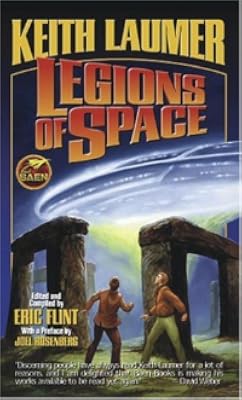
Legions of Space
by Keith Laumer
On This Page
Description
An omnibus edition containing two complete novels and four short novellas features A Trace of Memory, in which a drifter named Legion, hired by an amnesiac millionaire, finds himself on a prehistoric starship en route to the unknown, and Planet Run, written with Gordon R. Dickson, about two ancientTags
Recommendations



































Member Reviews
Reading this book was sort of like exercising. I didn’t really want to start reading it but, once I did, I found I was enjoying it. Then tedium started to set in and, by the end of the book, I was happy to be done. Once it was over, I was glad I had read it. This is one of the many sixties-era science fiction compilations that were available at the Baen Free Library when I went on an e-book downloading spree a few years back. These types of books usually fall into one of two categories for me – “surprisingly good but with some dull parts” or else “just plain horribly dull”. This book was the former.
Legions of Space consists of two short novels with four short stories sandwiched in-between them. The short stories were very show more short, and pretty mediocre. I already can barely remember what they were about without going back to the book to glance at them. I liked one of the novels a lot, but I wasn’t crazy about the other.
The first novel, A Trace of Memory, was where the “surprisingly good” came in. The story interested me from the beginning – we meet our main character as he’s about to rob a store. Events soon take a strange turn and he gets caught up trying to help a mysterious, rich gentleman who has amnesia. This gentleman has a journal with centuries’ worth of entries, all written in the same hand, and the earliest entries are written in an unknown language. The story bounces around in different directions (in a controlled, logical manner) as one problem is resolved and leads to a new one. Each new direction rekindled my interest and curiosity in what would happen next. There were a few plot holes, I guess, but nothing I couldn’t overlook. I had a lot of fun reading this story and it took up nearly half of the book. If I were rating this story alone, I would probably give it four stars.
The second novel, Planet Run, was the last story in the book. This one was ok, but nothing special. We follow two men as they work together to try to stake a claim on land found on the last “frontier” planet within human’s reach. There’s fierce and deadly competition, and one of the two men has no experience whatsoever with this type of a situation so he gets them into various sorts of trouble. I didn’t care for either character, and there wasn’t anything about the story that really captured my imagination. There was one interesting twist in the story, but it wasn’t something that changed the direction of the story – it just changes the reader’s perspective about what’s going on.
I had hoped this anthology would help me make up my mind about the author, Keith Laumer. I had read one of his other compilations, A Plague of Demons & Other Stories, last year. I had a similar reaction to that one – there was one story that I quite enjoyed,and the rest were ok but nothing special. I still have four more of his compilations, plus the first book in his 15+ book Retief series. If I hadn’t liked this book I probably would have crossed them all off my list, but I’m still undecided so I’ll probably try one of the other compilations in the future. show less
Legions of Space consists of two short novels with four short stories sandwiched in-between them. The short stories were very show more short, and pretty mediocre. I already can barely remember what they were about without going back to the book to glance at them. I liked one of the novels a lot, but I wasn’t crazy about the other.
The first novel, A Trace of Memory, was where the “surprisingly good” came in. The story interested me from the beginning – we meet our main character as he’s about to rob a store. Events soon take a strange turn and he gets caught up trying to help a mysterious, rich gentleman who has amnesia. This gentleman has a journal with centuries’ worth of entries, all written in the same hand, and the earliest entries are written in an unknown language. The story bounces around in different directions (in a controlled, logical manner) as one problem is resolved and leads to a new one. Each new direction rekindled my interest and curiosity in what would happen next. There were a few plot holes, I guess, but nothing I couldn’t overlook. I had a lot of fun reading this story and it took up nearly half of the book. If I were rating this story alone, I would probably give it four stars.
The second novel, Planet Run, was the last story in the book. This one was ok, but nothing special. We follow two men as they work together to try to stake a claim on land found on the last “frontier” planet within human’s reach. There’s fierce and deadly competition, and one of the two men has no experience whatsoever with this type of a situation so he gets them into various sorts of trouble. I didn’t care for either character, and there wasn’t anything about the story that really captured my imagination. There was one interesting twist in the story, but it wasn’t something that changed the direction of the story – it just changes the reader’s perspective about what’s going on.
I had hoped this anthology would help me make up my mind about the author, Keith Laumer. I had read one of his other compilations, A Plague of Demons & Other Stories, last year. I had a similar reaction to that one – there was one story that I quite enjoyed,and the rest were ok but nothing special. I still have four more of his compilations, plus the first book in his 15+ book Retief series. If I hadn’t liked this book I probably would have crossed them all off my list, but I’m still undecided so I’ll probably try one of the other compilations in the future. show less
Having never read this before I jumped at the opportunity to grab up the E-book of Legions of Space by Keith Laumer.
Once again Keith pulls through with a timeless tale. This time he rivals Robert Heinlein with a flawed hero who pulls out all stops to stay alive. No matter how hard life has kicked him Legion has a way of surviving and eventually coming out on top.
This has a bit of Heinlein's Glory Road and Philip Jose Farmers Green Odyssey.
Told only the way Keith Laumer can tell it.
Once again Keith pulls through with a timeless tale. This time he rivals Robert Heinlein with a flawed hero who pulls out all stops to stay alive. No matter how hard life has kicked him Legion has a way of surviving and eventually coming out on top.
This has a bit of Heinlein's Glory Road and Philip Jose Farmers Green Odyssey.
Told only the way Keith Laumer can tell it.
Two novellas, four short stories.
Laumer is a strong believer in "mind over matter", and does a pretty good job of showing how that works in reality. He ocassionally even manages to show that it doesn't cover every problem, but for that, I suggest you read his biography: http://www.keithlaumer.com/biography.htm.
The Choice shows a fairly common trait of human nature. I suggest you ignore the fact that two of the characters are military.
Planet Run shows a young man waking up to some of the hard realities of life, but what cut me to the bone was Henry pushing on, pushing ever on with something that had lost meaning to him: life.
Laumer is a strong believer in "mind over matter", and does a pretty good job of showing how that works in reality. He ocassionally even manages to show that it doesn't cover every problem, but for that, I suggest you read his biography: http://www.keithlaumer.com/biography.htm.
The Choice shows a fairly common trait of human nature. I suggest you ignore the fact that two of the characters are military.
Planet Run shows a young man waking up to some of the hard realities of life, but what cut me to the bone was Henry pushing on, pushing ever on with something that had lost meaning to him: life.
Ratings
Members
- Recently Added By
Author Information

266+ Works 17,460 Members
Keith Laumer was born John Keith Laumer in Syracuse, New York on June 9, 1925. Before becoming a full-time writer, he was an officer in the U.S. Air Force and a U.S. diplomat. He is best known for the Bolo stories and Retief series. His other works include The Other Side of Time, A Trace of Memory, Dinosaur Beach, and A Plague of Demons. He show more suffered a stroke in 1971, which negatively affected the quality of his work and his career declined. He was also a model airplane enthusiast, and published two dozen designs between 1956 and 1962 in the magazines Air Trails, Model Airplane News, Flying Models, and Aero Modeler. In 1960, he published How to Design and Build Flying Models. He died on January 23, 1993 at the age of 67. (Bowker Author Biography) show less
Some Editions
Work Relationships
Classifications
Statistics
- Members
- 152
- Popularity
- 215,341
- Reviews
- 4
- Rating
- (3.79)
- Languages
- English
- Media
- Paper
- ISBNs
- 1