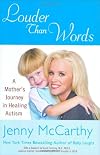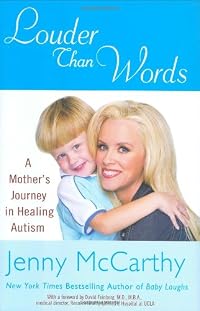
Louder Than Words: A Mother's Journey in Healing Autism
by Jenny McCarthy
On This Page
Description
Known for her extreme honesty in her previous books about the everyday trials of pregnancy, motherhood, marriage, and divorce, actress McCarthy has developed a national fan base that has taken her to the bestseller lists; but few have known that her son, Evan, has autism. Here, she takes this revelation to parents across the country, starting a dialogue on this complex condition. Writing with raw humor and honesty, McCarthy shares her son's symptoms and her attempts to sort through the maze show more of conflicting medical theories, shedding much-needed light on autism through her own heartbreak, struggle, and ultimately hopeful example of how a parent can shape her child's life and happiness.--From publisher description. show lessTags
Recommendations
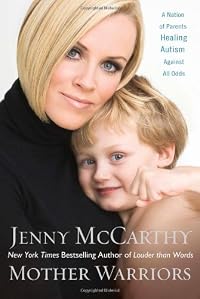




Member Reviews
First off, I just wanted to make my own comment about the horrible reviews for this book. They all seem to say the same thing: That Jenny McCarthy is an idiot for telling people there is a cure for autism, that no one should ever read this book because it is SO unlikely/unrealistic, that she's bias, that she doesn't present the case from all sides.. etc.
To them I say: You clearly didn't read this book and someone ought to back hand you with the book.
She is bias, yes. Her case is very rare, yes. All the more reasons for her to share it. As she says dozens of times in this book, it is about having faith and trying your hardest for your child. She talks about how lucky she was to have the money to do aggressive therapy and how show more heart-breaking it was to watch other mother's children not progress at all using the same therapies.
This book is not a clinical research book or some Fix-It Guide. It is meant to open your eyes to the reality of autism, in her own words and only be her own experiences with it. I thought this book was unbelievably tender and loving and real. She left out no ugly parts or details and there is no "Normal" Evan that is magically cured from Evil Autism. He makes a triumphant and rare recovery from being stock in a non-communicative world but still suffers from many stims and complications attributed to his autism.
She wrote this book to give parents hope that autism isn't always a crippling life-sentence for their children, she wrote it to tell them about different therapies she tried and places they can go to find funding and support.
Read this book for what it is: A Mother desperate to reclaim her lost child and going to the ends of Earth to do so. I cannot stress enough how many times she acknowledges that some of therapies she did are not for everyone, that she is well aware of the many theories that cause autism and that she just found the one that she related to most - not that it was the right one or the only one. show less
To them I say: You clearly didn't read this book and someone ought to back hand you with the book.
She is bias, yes. Her case is very rare, yes. All the more reasons for her to share it. As she says dozens of times in this book, it is about having faith and trying your hardest for your child. She talks about how lucky she was to have the money to do aggressive therapy and how show more heart-breaking it was to watch other mother's children not progress at all using the same therapies.
This book is not a clinical research book or some Fix-It Guide. It is meant to open your eyes to the reality of autism, in her own words and only be her own experiences with it. I thought this book was unbelievably tender and loving and real. She left out no ugly parts or details and there is no "Normal" Evan that is magically cured from Evil Autism. He makes a triumphant and rare recovery from being stock in a non-communicative world but still suffers from many stims and complications attributed to his autism.
She wrote this book to give parents hope that autism isn't always a crippling life-sentence for their children, she wrote it to tell them about different therapies she tried and places they can go to find funding and support.
Read this book for what it is: A Mother desperate to reclaim her lost child and going to the ends of Earth to do so. I cannot stress enough how many times she acknowledges that some of therapies she did are not for everyone, that she is well aware of the many theories that cause autism and that she just found the one that she related to most - not that it was the right one or the only one. show less
Before I get into the content, I want to say a couple quick things about the general qualities of the book. I haven't read any of McCarthy's other books, and I was pleasantly surprised by her simple--yet very effective--writing style. Even though we are very different people, I found her narrative voice to be very relatable, and I don't think the book would have worked without her brutal honesty. The plot construction was simple and easy to follow.
I'm doing character research on autism and grabbed this book off the library shelf on a whim. I went into it expecting to roll my eyes, as I, like everyone else, has heard the supposed link between vaccines and autism be spit on by the medical community time and time again. As it stands after show more reading the book, I'm not sure what to think. I believe that the methods she tried really did help her son. I appreciated McCarthy's repeated statements that she knows what she tried won't work for everyone and that every autistic child responds differently to different things. Perhaps what really made it work for me was comparing autism to cancer, insofar as there are so many different types and it has so many different effects on so many different people. From what my (albeit limited) research has told me thus far, this sounds like an accurate comparison to draw, if only because the medical research just hasn't been done.
The statistics at the end of the book made me pause and stare in disbelief. 1 in 150 kids has autism yet autism research has only one-fifth of the private funding of leukemia, which affects only 1 in 25,000? Are you kidding me?! That's outrageous! Even if every autism treatment this book endorses is complete hokum, those numbers alone should be shouted from every rooftop. Forget the outrageous medical costs just to get autism diagnosed; there is far too little known about the causes and possible treatments, and nothing is going to get figured out with that kind of money. Not going to lie, it kind of makes me afraid to have kids.
Regardless of the medical soundness, after reading this book, I have nothing but admiration for parents of autistic children. I have no children of my own yet, so it's difficult to imagine the stresses of normal parenting, much less the pressures of raising a child with special needs. I have nothing but sympathy for parents who struggle with having an autistic child; again, I have no base of reference, but I imagine having a sick child must be worse when you don't know what caused it, what can help it, and/or who to trust in a huge, widely varied sea of voices. Perhaps most surprisingly, I found I have nothing but respect for McCarthy herself. I commend the initiative she showed in educating herself and doing everything she could to help her son. I applaud her willingness to put her entire life on hold to make healing her son her whole life. Even some of the smaller details, such as the respect she showed the Mormons and their faith in their repeated visits, impressed me. I thought she went a bit far near the beginning of the book screaming and swearing at nurses and other assorted hospital personnel, but even then I couldn't judge her too harshly. I would hope to behave better in a similar situation, but who can really know until they're there? Maybe if it was my son seizing every hour, I'd have torn the place apart.
All in all, I'm glad I didn't just put this book back on the shelf. McCarthy really succeeded in pulling me into her world and making me feel an inkling of the hardships parents of autistic children face. I hope someday when I have kids of my own, I will be similarly willing to trust my gut, educate myself, and help them through whatever challenges we may face. show less
I'm doing character research on autism and grabbed this book off the library shelf on a whim. I went into it expecting to roll my eyes, as I, like everyone else, has heard the supposed link between vaccines and autism be spit on by the medical community time and time again. As it stands after show more reading the book, I'm not sure what to think. I believe that the methods she tried really did help her son. I appreciated McCarthy's repeated statements that she knows what she tried won't work for everyone and that every autistic child responds differently to different things. Perhaps what really made it work for me was comparing autism to cancer, insofar as there are so many different types and it has so many different effects on so many different people. From what my (albeit limited) research has told me thus far, this sounds like an accurate comparison to draw, if only because the medical research just hasn't been done.
The statistics at the end of the book made me pause and stare in disbelief. 1 in 150 kids has autism yet autism research has only one-fifth of the private funding of leukemia, which affects only 1 in 25,000? Are you kidding me?! That's outrageous! Even if every autism treatment this book endorses is complete hokum, those numbers alone should be shouted from every rooftop. Forget the outrageous medical costs just to get autism diagnosed; there is far too little known about the causes and possible treatments, and nothing is going to get figured out with that kind of money. Not going to lie, it kind of makes me afraid to have kids.
Regardless of the medical soundness, after reading this book, I have nothing but admiration for parents of autistic children. I have no children of my own yet, so it's difficult to imagine the stresses of normal parenting, much less the pressures of raising a child with special needs. I have nothing but sympathy for parents who struggle with having an autistic child; again, I have no base of reference, but I imagine having a sick child must be worse when you don't know what caused it, what can help it, and/or who to trust in a huge, widely varied sea of voices. Perhaps most surprisingly, I found I have nothing but respect for McCarthy herself. I commend the initiative she showed in educating herself and doing everything she could to help her son. I applaud her willingness to put her entire life on hold to make healing her son her whole life. Even some of the smaller details, such as the respect she showed the Mormons and their faith in their repeated visits, impressed me. I thought she went a bit far near the beginning of the book screaming and swearing at nurses and other assorted hospital personnel, but even then I couldn't judge her too harshly. I would hope to behave better in a similar situation, but who can really know until they're there? Maybe if it was my son seizing every hour, I'd have torn the place apart.
All in all, I'm glad I didn't just put this book back on the shelf. McCarthy really succeeded in pulling me into her world and making me feel an inkling of the hardships parents of autistic children face. I hope someday when I have kids of my own, I will be similarly willing to trust my gut, educate myself, and help them through whatever challenges we may face. show less
I had to overcome several barriers in approaching this book. First of all, it's by Jenny McCarthy. Second, I learned of this book by the furor it created on online autism communities, especially after the Oprah appearance. Third, I knew going into it that she suspects vaccines are the cause of autism for her child, and I don't think enough evidence supports that statement.
That said, I read it, and it wasn't a horrible book. My little guy is high-functioning autistic and turns 3 a week from today and will also be starting special needs preschool this week. My son and Jenny McCarthy's son have several things in common, such as their incredible memories and the knack for finding shapes rather than the complete picture (during testing, my show more son was supposed to identity which picture had a car - he pointed to the car, but identified the circles and rectangles). I know exactly how it feels to see your child asked the simplest of questions and have them instead focus on placing objects in a tidy row. However, I am very thankful that I don't have to deal with seizures or the weakened immune system. I don't think I could handle that.
I do envy her money and her access to the best of care. The cost of gluten-free casein-free foods is horrible and they are not easily available. I can't hop on a plane to get the best doctor in the US, or pay out of pocket for therapists. The bureaucracy in Arizona for getting care is atrocious; my son kept getting lost in the system, and has been eligible for four months but no therapists are available. When Jenny McCarthy speaks of the "window" for getting care and making improvements, I know exactly what she means, and I am frustrated and enraged at how little help there is in getting help.
I don't know if autism can be "healed." That subtitle bothers me some. Is it like an alcoholic being an alcoholic, even after being sober for twenty years? I just want my son to function and be able to make eye contact with other people, drink out of a cup, or eat a wider variety of foods. Is that asking for "healing?" My husband read through this book as well, and has now vowed to take a more active approach in helping. show less
That said, I read it, and it wasn't a horrible book. My little guy is high-functioning autistic and turns 3 a week from today and will also be starting special needs preschool this week. My son and Jenny McCarthy's son have several things in common, such as their incredible memories and the knack for finding shapes rather than the complete picture (during testing, my show more son was supposed to identity which picture had a car - he pointed to the car, but identified the circles and rectangles). I know exactly how it feels to see your child asked the simplest of questions and have them instead focus on placing objects in a tidy row. However, I am very thankful that I don't have to deal with seizures or the weakened immune system. I don't think I could handle that.
I do envy her money and her access to the best of care. The cost of gluten-free casein-free foods is horrible and they are not easily available. I can't hop on a plane to get the best doctor in the US, or pay out of pocket for therapists. The bureaucracy in Arizona for getting care is atrocious; my son kept getting lost in the system, and has been eligible for four months but no therapists are available. When Jenny McCarthy speaks of the "window" for getting care and making improvements, I know exactly what she means, and I am frustrated and enraged at how little help there is in getting help.
I don't know if autism can be "healed." That subtitle bothers me some. Is it like an alcoholic being an alcoholic, even after being sober for twenty years? I just want my son to function and be able to make eye contact with other people, drink out of a cup, or eat a wider variety of foods. Is that asking for "healing?" My husband read through this book as well, and has now vowed to take a more active approach in helping. show less
As a whole, I found this book to be wonderful, raw and honest, sometimes painfully so (for her, not for the reader-- the honest served to give great creditability to the book). Unfortunately, I found McCarthy to be a bit preachy at times, as though she believed that she was the only parent who was doing right by their child. However, by the end of the book she conceded that what had worked for her son wouldn't work for every child with autism, which gave the entire work a much better tone, as though she were a parent sharing her story of success rather than a celebrity telling people how to "save" their children.
While the writing is not really remarkable, the story is phenomenal! My esteem for Jenny McCarthy has just gone way up. What an incredible mom. As she shares her experience learning about her son's autism, she shares tons of information for other moms in the same boat. After reading this book, I will be researching vaccines more carefully before automatically agreeing to have my kids vaccinated. McCarthy also had amazingly positive results by changing her son's diet and introducing supplements. This is a really worthwhile read all-around.
This was an interesting account of Ms. McCarthy's journey to help her son become healthy. I don't know a lot about the controversy surrounding her views on autism, but I think she was honest about how she felt during the experience of Evan's most frightening health crises and she offers hope to others who may be struggling with similar situations. I don't know a lot about autism, but it seems to me that her son suffered from more than just this disorder. Yeast infection afflicts many who aren't autistic, so that portion of her treatment of her son seems to be something other than autism. In addition, Evan showed signs of autism from an early age, even before some of the more disturbing symptoms began, which leads me to think that show more perhaps his allergies complicated some of his reactions. Still, I admire her determination to find out what was going on with her son and get him the help he needed and be willing to try anything that might work. As a side note, I am a member of the "Mormon" church (or The Church of Jesus Christ of Latter-day Saints). I found her references to her experiences with the Mormons to be amusing! I appreciate that she was willing to give those Mormon missionaries a listen (speaking as a former missionary who appreciated the "kindness of strangers"). We're probably not as strait-laced as Ms. McCarthy thinks we are, though certainly there are choices that she has made in her personal life that we try to avoid. And I have to take exception to the idea that we teach "fire and brimstone" to anyone who doesn't join the Mormon church. We don't really believe in that for anyone, although we do believe that God wants more for his children and then we often want for ourselves! All in all, a straightforward and plain speaking book about one parent's experience with autism so far. Good luck to Ms. McCarthy and Evan as they continue their journey with autism. show less
I saw the youtube version of Jenny on the Oprah show. I was a para-educator working with a child with Aspergers. He was very smart and manipulative. Which showed the forethought of his thinking. But only when his diet was clean. I always knew when his parents allowed him to eat something he shouldn't, because he became a zombie or in a fog and couldn't think clearly. I felt so sorry for him when this happened, but then I became frustrated with the parents for allowing it.
But about the book: the word healing on the front is misleading. Healing can mean cure and it can also mean mending or getting well.
Jenny writes her journey of her son's diagnosis and the experience of the flaws in the medical world. She didn't get support from her show more husband and the doctor's weren't any better. I hope she's fired her the old pediatrician.
In the end she explains why she thinks her son Evan got Austism; he was born with a weakened immune system and when he received his vaccinations his body attacked itself which made him vulnerable to common illnesses which he had to take antibiotics for. The antibiotics stripped his gut, which caused yeast build up which led to leaky gut syndrome.
There's still debate over whether Autism is only a brain dysfunction.
Always question the doctors. You're the parent and you know your child better than a doctor. Do not let them bully you, they are infallible.
There are a ton of questions and not enough answers and not enough money designated. But it is an epidemic and getting worse at alarming rates!
If it starts with a weakened immune system then let's start with that question: why are so many children being born with a weakened immune system?
It's a good book. Is it the be all and end all for parents with Autism? No. It's Jenny's experience and how she dealt with it and what she's done with the information she's acquired. At the end of the book there are url's and if you don't want to read the book then just write down the information at the end. show less
But about the book: the word healing on the front is misleading. Healing can mean cure and it can also mean mending or getting well.
Jenny writes her journey of her son's diagnosis and the experience of the flaws in the medical world. She didn't get support from her show more husband and the doctor's weren't any better. I hope she's fired her the old pediatrician.
In the end she explains why she thinks her son Evan got Austism; he was born with a weakened immune system and when he received his vaccinations his body attacked itself which made him vulnerable to common illnesses which he had to take antibiotics for. The antibiotics stripped his gut, which caused yeast build up which led to leaky gut syndrome.
There's still debate over whether Autism is only a brain dysfunction.
Always question the doctors. You're the parent and you know your child better than a doctor. Do not let them bully you, they are infallible.
There are a ton of questions and not enough answers and not enough money designated. But it is an epidemic and getting worse at alarming rates!
If it starts with a weakened immune system then let's start with that question: why are so many children being born with a weakened immune system?
It's a good book. Is it the be all and end all for parents with Autism? No. It's Jenny's experience and how she dealt with it and what she's done with the information she's acquired. At the end of the book there are url's and if you don't want to read the book then just write down the information at the end. show less
Members
- Recently Added By
Author Information

13+ Works 1,774 Members
Jenny McCarthy was born in Chicago, Illinois on November 1, 1972. She studied nursing at Southern Illinois University Carbondale before being accepted as a Playboy model in 1993. Following her ensuing popularity, she moved to Los Angeles and hosted Hot Rocks and then Singled Out. McCarthy has also starred in The Jenny McCarthy Show, appeared in show more numerous films, and guest starred on many television shows. She promotes autism awareness through her activism and has written several books, including Belly Laughs, Mother Warriors, and Healing and Preventing Autism, which was co-written with Dr. Jerry Kartzinel. (Bowker Author Biography) show less
Awards and Honors
Distinctions
Common Knowledge
- People/Characters
- Jenny McCarthy; Evan
- Important places
- Resnick Neuropsychiatric Hospital at UCLA
- Dedication
- Evan:
When I asked you what you wanted to
be when you grew up, you said, "A flower."
I can't think of anything better.
You are the most beautiful flower I have
ever seen, and I'm the luckiest mom in... (show all) the
world to be able to watch you bloom into the
most radiant flower God has ever made.
I love you.
Mommy - First words
- The moment I opened my eyes that morning, I had an uncomfortable feeling.
- Last words
- (Click to show. Warning: May contain spoilers.)And because of faith . . . the window is now open.
Classifications
- Genres
- Nonfiction, Biography & Memoir, General Nonfiction
- DDC/MDS
- 618.92858820092 — Applied Science & Technology Medicine & health Gynecology, obstetrics, pediatrics, geriatrics Pediatrics & Geriatrics Pediatric Care Diseases of nervous system and mental disorders
- LCC
- RJ506 .A9 .M4253 — Medicine Pediatrics Pediatrics Diseases of children and adolescents Mental disorders. Child psychiatry
- BISAC
Statistics
- Members
- 265
- Popularity
- 121,650
- Reviews
- 13
- Rating
- (3.49)
- Languages
- English, French
- Media
- Paper, Audiobook, Ebook
- ISBNs
- 17
- ASINs
- 4