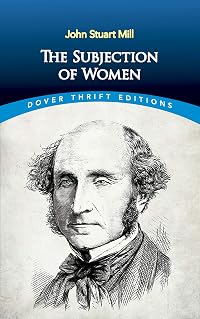
The Subjection of Women
by John Stuart Mill
On This Page
Description
John Stuart Mill's 1869 essay The Subjection of Women argues for equality between the sexes, putting forward ideas that were an affront to many at the time. His wife, Harriet Taylor Mill, is credited with co-authoring the essay. The Subjection of Women puts forward a detailed and passionate opposition to the social and legal inequalities imposed on women by society. Mill saw that he was going against the grain of the time, but argued that such inequality was a past relic from a time when show more might equaled right and that it had no place in the modern world. Inequality between the sexes limited human development as it made half of humanity unable to contribute to society outside of their own homes.. show less
Tags
Recommendations













Member Reviews
In a rather accessible extended essay, Mill argues for the emancipation of women both for the betterment of society and the personal benefit of women. What struck me most about Mill's essay is his clarity and conciseness. He lays out his thesis: "The principle which regulates the existing social relations between the two sexes - the legal subordination of one sex to the other - is wrong in itself, and now one of the chief hindrances to human improvement; and...it ought to be replaced by a principle of perfect equality, admitting no power or privilege on the one side, nor disability on the other." And what follows this direct - and entirely supportable - opinion is an organized, clear, and interesting look at the subjugation of women to show more men and the limits it places on progress.
This essay is extremely accessible because of its clarity, important because of its subject matter, and entertaining because of the bits of snark. In other words, buy it. show less
This essay is extremely accessible because of its clarity, important because of its subject matter, and entertaining because of the bits of snark. In other words, buy it. show less
If it were not for archaic words such as "burthen" (burden) and "rainment (clothing)"; the necessity to counteract arguments from phrenology; and the use of the figurative "Mrs Grundy" (an archaic Mrs Bucket); one might be reading a contemporary argument for diversity and greater opportunities for women. Mill exerts his authority by challenging then-dominant ideas (such as phrenology and assumptions about biology then-untested) and then reconciles this absurdity for the modern reader by suggesting that while such things are unknown, and he has little time for these, he can still argue away their objections to his central thesis. Mill was far ahead of his time and his arguments took some time to materialise in universal suffrage and show more equality of opportunity for women, but the central message, then radical, is now part of political discourse. I intend to focus on James Fitzjames Stephen now to see how Stephen deals with Mill's authoritative works on liberty. show less
An active and energetic mind, if denied liberty, will seek for power: refused the command of itself, it will assert its personality by attempting to control others. To allow to any human beings no existence of their own but what depends on others, is giving far too high a premium on bending others to their purposes. Where liberty cannot be hoped for, and power can, power becomes the grand object of human desire; those to whom others will not leave the undisturbed management of their own affairs, will compensate themselves, if they can, by meddling for their own purposes with the affairs of others.
http://nwhyte.livejournal.com/1703651.html
Mill's argument here is in favour of political equality between the sexes, in particular that woman should be allowed to vote, a proposition to which he gently demolishes all the opposing arguments. He is less passionate than Wollstonecraft but has better one-liners:
"Women who read, much more women who write, are, in the existing constitution of things, a contradiction and a disturbing element... "
"...laws and institutions require to be adapted, not to good men, but to bad."
"If no one could vote for a Member of Parliament who was not [themselves] a fit candidate, the government would be a narrow oligarchy indeed."
I was also struck by his invocation of women rulers throughout history, in show more particular:
"The Emperor Charles the Fifth, the most politic prince of his time, who had as great a number of able men in his service as a ruler ever had, and was one of the least likely of all sovereigns to sacrifice his interest to personal feelings, made two princesses of his family successively Governors of the Netherlands, and kept one or other of them in that post during his whole life (they were afterwards succeeded by a third). Both ruled very successfully, and one of them, Margaret of Austria, as one of the ablest politicians of the age." show less
Mill's argument here is in favour of political equality between the sexes, in particular that woman should be allowed to vote, a proposition to which he gently demolishes all the opposing arguments. He is less passionate than Wollstonecraft but has better one-liners:
"Women who read, much more women who write, are, in the existing constitution of things, a contradiction and a disturbing element... "
"...laws and institutions require to be adapted, not to good men, but to bad."
"If no one could vote for a Member of Parliament who was not [themselves] a fit candidate, the government would be a narrow oligarchy indeed."
I was also struck by his invocation of women rulers throughout history, in show more particular:
"The Emperor Charles the Fifth, the most politic prince of his time, who had as great a number of able men in his service as a ruler ever had, and was one of the least likely of all sovereigns to sacrifice his interest to personal feelings, made two princesses of his family successively Governors of the Netherlands, and kept one or other of them in that post during his whole life (they were afterwards succeeded by a third). Both ruled very successfully, and one of them, Margaret of Austria, as one of the ablest politicians of the age." show less
Written in 1861 and first published in 1869, though an arduous read, this was way ahead of it’s time. Although incredibly forward thinking, it is still a product of the 19th century, and it shows occasionally.
The author gets a lot of criticism for the few times that he does a disservice to the current women of his time, in an attempt to do a service to the potential women of the future. If you follow his train of thought long enough, he always has valid reasoning for his argument. Mainly, that women of his time haven’t been given an opportunity to be educated, and have had their place in society shaped by a society that hasn’t given them a chance to exercise their will, and are therefore, in their current state, not yet the equals show more of men in some regards. It was the truth of the time, and ultimately, it always becomes a hopeful statement toward the potential of women that may exist in the future, if society would change the rules that have been imposed on them. The whole point of the book is to affect change.
He’s very clear that women absolutely can and should be fully equal to men, and argues his point with great wit. I think that some misunderstand this, or simply don’t have the patience or vocabulary to read through his admittedly difficult writing, to understand what he is ultimately saying. After all, a seemingly disparaging statement made toward the current women of 1861 might not be completely followed up and shown in actuality to be a representation of the repressive circumstances in which women have been shaped, until several pages later. His paragraphs are that long. It’s hard to follow.
Mill's writing is terribly long winded. His sentences sometimes drawing on for hundreds of words, and paragraphs that are often 3-4 pages long. He could’ve used a good editor. I imagine that an abridged version of this text might carry twice the punch than it does in its current form. show less
The author gets a lot of criticism for the few times that he does a disservice to the current women of his time, in an attempt to do a service to the potential women of the future. If you follow his train of thought long enough, he always has valid reasoning for his argument. Mainly, that women of his time haven’t been given an opportunity to be educated, and have had their place in society shaped by a society that hasn’t given them a chance to exercise their will, and are therefore, in their current state, not yet the equals show more of men in some regards. It was the truth of the time, and ultimately, it always becomes a hopeful statement toward the potential of women that may exist in the future, if society would change the rules that have been imposed on them. The whole point of the book is to affect change.
He’s very clear that women absolutely can and should be fully equal to men, and argues his point with great wit. I think that some misunderstand this, or simply don’t have the patience or vocabulary to read through his admittedly difficult writing, to understand what he is ultimately saying. After all, a seemingly disparaging statement made toward the current women of 1861 might not be completely followed up and shown in actuality to be a representation of the repressive circumstances in which women have been shaped, until several pages later. His paragraphs are that long. It’s hard to follow.
Mill's writing is terribly long winded. His sentences sometimes drawing on for hundreds of words, and paragraphs that are often 3-4 pages long. He could’ve used a good editor. I imagine that an abridged version of this text might carry twice the punch than it does in its current form. show less
Disappointing in that he fails so superbly at the reality behind why women are not more visible in all the arts and professions. It is not ability or talent or industry or effort or attempts...is it systematic blockage at every turn by rules, customs, religion, laws and men in general. Still, it should be required reading in schools with someone critical of every point that is contrary to reality.
Best reading I've done on the subject! Wonderful clarity of thought and expression, and shockingly relevant. I would describe it as the original #heforshe (published in 1869?!?)
Members
- Recently Added By
Lists

Filosofía - Clásicos
217 works; 1 member

Política - Clásicos
164 works; 2 members

CCE 100 Great Books List
145 works; 8 members

How to Read a Book's Recommended Reading List
309 works; 10 members

Books Read in 2015
3,299 works; 129 members
New Lifetime Reading Plan by Fadiman and Major
225 works; 5 members

essays
6 works; 1 member
Author Information

299+ Works 19,747 Members
John Stuart Mill, Classical economist, was born in 1806. His father was the Ricardian economist, James Mill. John Stuart Mill's writings on economics and philosophy were prodigious. His "Principles of Political Economy, With Some of Their Applications to Social Philosophy," published in 1848, was the leading economics textbook of the show more English-speaking world during the second half of the 19th century. Some of Mill's other works include "Considerations on Representative Government," "Auguste Comte and Positivism," "The Subjection of Women," and "Three Essays on Religion." John Mill died in 1873. (Bowker Author Biography) show less
Some Editions
Awards and Honors
Notable Lists
Series
Belongs to Publisher Series
Work Relationships
Common Knowledge
- Canonical title
- The Subjection of Women
- Original publication date
- 1869
Classifications
- Genres
- Nonfiction, Sexuality and Gender Studies, General Nonfiction, Philosophy, Politics and Government, History
- DDC/MDS
- 305.4 — Society, government, & culture Social sciences, sociology & anthropology Social group - Age, Gender, Ethnicity Women
- LCC
- HQ1596 .M52 — Social sciences The family. Marriage, Women and Sexuality The Family. Marriage. Women Women. Feminism
- BISAC
Statistics
- Members
- 1,091
- Popularity
- 23,424
- Reviews
- 14
- Rating
- (4.08)
- Languages
- 12 — Czech, Dutch, English, Finnish, French, German, Icelandic, Italian, Norwegian (Bokmål), Portuguese, Spanish, Swedish
- Media
- Paper, Audiobook, Ebook
- ISBNs
- 106
- UPCs
- 1
- ASINs
- 22