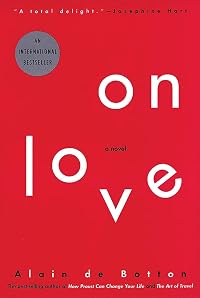
Essays in Love
by Alain de Botton
On This Page
Description
A man and a woman meet over casual conversation on a flight from Paris to London, and so begins a love story-from first kiss to first argument, elation to heartbreak, and everything in between. Each stage of the relationship is illuminated with starling clarity, as novelist and philosopher Alain de Botton explores young love and its emotions, often felt but rarely understood.Tags
Recommendations













Member Recommendations

Member Reviews
This book is suffocating. It sucks up all the air and leaves you shriveled up and heaving in the corner. Not because it is so emotionally disturbing but because it takes up so much mental / intellectual space, leaving little for the reader to untangle and tease out, so fully and formidably does the narrator examine the underlying thoughts and emotions of the protagonist and his lover. It is perhaps too comprehensive, too instructive; in the end, the reader leaves with an almost mathematical understanding of love.
This is a widely highlightable book. The author has a way with language that I very, very rarely encounter, as perfect as language can get, every word delivering a specific meaning, every sentence assembling itself into the show more exact spot in the edifice. It's a love manual that nearly acknowledges itself as such, a philosopher laying out anecdotes from his own life as evidence for his theories, and that play of memoir v. philosophy was gratifying (but also, very rarely, grating.)
Yet, while the book didn't necessarily seize me and burrow into me and shake me on a fundamental level, it's a great one. I admire the author for his thoughtfulness, for his openness, for his exquisite style. I admire him for the way he can wax so eloquently of the enchanting mundanity of a relationship, before launching into a playfulness that is a hallmark of great writers (and people):
"Then I noticed a small plate of complimentary marshmallows near Chloe’s elbow and it suddenly seemed clear that I didn’t love Chloe so much as marshmallow her. What it was about a marshmallow that should suddenly have accorded so perfectly with my feelings toward her, I will never know, but the word seemed to capture the essence of my amorous state with an accuracy that the word 'love,' weary with overuse, simply could not aspire to." show less
This is a widely highlightable book. The author has a way with language that I very, very rarely encounter, as perfect as language can get, every word delivering a specific meaning, every sentence assembling itself into the show more exact spot in the edifice. It's a love manual that nearly acknowledges itself as such, a philosopher laying out anecdotes from his own life as evidence for his theories, and that play of memoir v. philosophy was gratifying (but also, very rarely, grating.)
Yet, while the book didn't necessarily seize me and burrow into me and shake me on a fundamental level, it's a great one. I admire the author for his thoughtfulness, for his openness, for his exquisite style. I admire him for the way he can wax so eloquently of the enchanting mundanity of a relationship, before launching into a playfulness that is a hallmark of great writers (and people):
"Then I noticed a small plate of complimentary marshmallows near Chloe’s elbow and it suddenly seemed clear that I didn’t love Chloe so much as marshmallow her. What it was about a marshmallow that should suddenly have accorded so perfectly with my feelings toward her, I will never know, but the word seemed to capture the essence of my amorous state with an accuracy that the word 'love,' weary with overuse, simply could not aspire to." show less
The ending has some emotional resonance, but otherwise this book is just banal (like most of De Botton's work, dare I say). It's clear that 'Philosopher' is being used solely as a brand to market his books rather than as any kind of meaningful descriptor. It's just a boring novel with some Sunday Supplement musings.
The most annoying thing is how it aims to speak about the 'universality of love', but its only lens is two middle-class heterosexual North London creative economy types, and the rest of the world doesn't get a look in. It's just infuriating.
The most annoying thing is how it aims to speak about the 'universality of love', but its only lens is two middle-class heterosexual North London creative economy types, and the rest of the world doesn't get a look in. It's just infuriating.
Alain de Botton writes with wit and pithiness that makes this book not only an entertaining read, but truly an enlightening look at the ups and downs of the falling in love. Very few books have crossed the line between love and philosophy in such an endearing and insightful way.
On Love is Alain de Botton's way of explaining his courtship with Chloe. He uses many theories of philosophers (Plato, Kant, Nietzsche), psychologists and psychiatrists(Jung, Freud, Dr. Peggy Nearly), and even religion to describe the near delirium of the beginnings of love and relationships to their disastrous and paranoid filled endings.
I really adored this book on the mystifying, frustrating yet satisfying aspects of Love. I feel like I could have written this book if I had the eloquence of words behind me. Although I have never experienced love or more specifically, reciprocated love, I understood wholeheartedly how you love a person more when the object of your affection doesn't know.
On Love reminded me of a combination of 500 Days show more of Summer and Down to You. The former more. de Botton had a way of explaining a multitude of theories, practically all I agree with especially mature and immature love, in a very garrulous but relatable way. show less
I really adored this book on the mystifying, frustrating yet satisfying aspects of Love. I feel like I could have written this book if I had the eloquence of words behind me. Although I have never experienced love or more specifically, reciprocated love, I understood wholeheartedly how you love a person more when the object of your affection doesn't know.
On Love reminded me of a combination of 500 Days show more of Summer and Down to You. The former more. de Botton had a way of explaining a multitude of theories, practically all I agree with especially mature and immature love, in a very garrulous but relatable way. show less
On Love is Alain de Botton's way of explaining his courtship with Chloe. He uses many theories of philosophers (Plato, Kant, Nietzsche), psychologists and psychiatrists(Jung, Freud, Dr. Peggy Nearly), and even religion to describe the near delirium of the beginnings of love and relationships to their disastrous and paranoid filled endings.
I really adored this book on the mystifying, frustrating yet satisfying aspects of Love. I feel like I could have written this book if I had the eloquence of words behind me. Although I have never experienced love or more specifically, reciprocated love, I understood wholeheartedly how you love a person more when the object of your affection doesn't know.
On Love reminded me of a combination of 500 Days show more of Summer and Down to You. The former more. de Botton had a way of explaining a multitude of theories, practically all I agree with especially mature and immature love, in a very garrulous but relatable way. show less
I really adored this book on the mystifying, frustrating yet satisfying aspects of Love. I feel like I could have written this book if I had the eloquence of words behind me. Although I have never experienced love or more specifically, reciprocated love, I understood wholeheartedly how you love a person more when the object of your affection doesn't know.
On Love reminded me of a combination of 500 Days show more of Summer and Down to You. The former more. de Botton had a way of explaining a multitude of theories, practically all I agree with especially mature and immature love, in a very garrulous but relatable way. show less
On Love is Alain de Botton's way of explaining his courtship with Chloe. He uses many theories of philosophers (Plato, Kant, Nietzsche), psychologists and psychiatrists(Jung, Freud, Dr. Peggy Nearly), and even religion to describe the near delirium of the beginnings of love and relationships to their disastrous and paranoid filled endings.
I really adored this book on the mystifying, frustrating yet satisfying aspects of Love. I feel like I could have written this book if I had the eloquence of words behind me. Although I have never experienced love or more specifically, reciprocated love, I understood wholeheartedly how you love a person more when the object of your affection doesn't know.
On Love reminded me of a combination of 500 Days show more of Summer and Down to You. The former more. de Botton had a way of explaining a multitude of theories, practically all I agree with especially mature and immature love, in a very garrulous but relatable way. show less
I really adored this book on the mystifying, frustrating yet satisfying aspects of Love. I feel like I could have written this book if I had the eloquence of words behind me. Although I have never experienced love or more specifically, reciprocated love, I understood wholeheartedly how you love a person more when the object of your affection doesn't know.
On Love reminded me of a combination of 500 Days show more of Summer and Down to You. The former more. de Botton had a way of explaining a multitude of theories, practically all I agree with especially mature and immature love, in a very garrulous but relatable way. show less
TL;DR: Get this book if you've ever (over)analyzed a relationship or been in love.
Alain de Botton guides us through the mind of a young man in love, carefully dissecting those thoughts that we've all had about ourselves, a loved one, doubts, hidden messages and everything happening during a romantic relationship.
This vivisection is minute enough to help us recognize these little thoughts as observers, which in turn lead to simple descriptions of those nagging questions and their now very logical answers. We can live the hardships of love with a clear mind and come out, if not wiser, at least a lot more knowledgeable about ourselves and our loved ones.
It's exactly as a reviewer said: a return to philosophy's core, which is to help us show more live our lives. Full marks for this one. show less
Alain de Botton guides us through the mind of a young man in love, carefully dissecting those thoughts that we've all had about ourselves, a loved one, doubts, hidden messages and everything happening during a romantic relationship.
This vivisection is minute enough to help us recognize these little thoughts as observers, which in turn lead to simple descriptions of those nagging questions and their now very logical answers. We can live the hardships of love with a clear mind and come out, if not wiser, at least a lot more knowledgeable about ourselves and our loved ones.
It's exactly as a reviewer said: a return to philosophy's core, which is to help us show more live our lives. Full marks for this one. show less
Members
- Recently Added By
Lists

1001 Books You Must Read Before You Die
1,448 works; 1,137 members

1,001 BYMRBYD Concensus
723 works; 27 members

A Good Read (Radio 4)
287 works; 1 member

A Novel Cure
742 works; 23 members

My TBR
371 works; 3 members
Author Information

55+ Works 26,147 Members
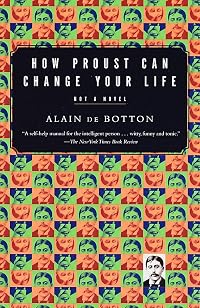
Born in Zurich, Switzerland on December 20, 1969, Alain de Botton was educated at Cambridge University, England, and now divides his time between London and Washington, D.C. With the publication of his first novel, Essays in Love, de Botton quickly became one of the most talked about British novelists of the 1990s. Although the basic plot of show more Essays in Love (published in the U.S. as On Love) is a rather typical love story, de Botton presents it in a unique and humorous way. De Botton's other novels include The Romantic Movement: Sex, Shopping and the Novel, which is written in a similar style to Essays on Love, and Kiss and Tell, which follows a would-be biographer as he attempts to write the life story of the first person he encounters. The Course of Love is his latest novel and is on the bestsellers list. Alain de Botton is also the author of How Proust Can Change Your Life: Not a Novel. (Bowker Author Biography) show less
Awards and Honors
Work Relationships
Is contained in
Common Knowledge
- Canonical title
- Essays in Love
- Original title
- Essays in Love
- Alternate titles
- On Love
- Original publication date
- 1993
- People/Characters
- Chloe
- Important places
- London, England, UK
- Related movies
- My Last Five Girlfriends (2009 | IMDb)
- First words
- The longing for a destiny is nowhere stronger than in our romantic life.
- Last words
- (Click to show. Warning: May contain spoilers.)Such lessons appeared all the more relevant when Rachel accepted my invitation for dinner the following week, and the very thought of her began sending tremors through the region the poets have called the heart, tremors that I knew could have meant one thing only - that I had once more begun to fall.
- Original language*
- Englisch
- Disambiguation notice
- Titled Essays in Love (UK publication)
Titled On Love (US publication)
*Some information comes from Common Knowledge in other languages. Click "Edit" for more information.
Classifications
Statistics
- Members
- 2,124
- Popularity
- 9,721
- Reviews
- 34
- Rating
- (3.72)
- Languages
- 15 — Czech, Dutch, English, Finnish, French, German, Greek, Italian, Norwegian, Farsi/Persian, Romanian, Spanish, Swedish, Turkish, Portuguese (Portugal)
- Media
- Paper, Audiobook, Ebook
- ISBNs
- 71
- ASINs
- 7