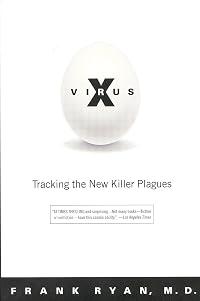
Virus X: Tracking the New Killer Plagues
by Frank Ryan
On This Page
Description
The author takes the reader into the "hot zones" of today's most dangerous outbreaks, then into the research laboratories and hospitals, where he spotlights the scientists and doctors who are risking their lives to contain them. In telling this global story, he uncovers a frightening pattern -- and concludes that new, deadlier diseases are now waiting to emerge. Why do such plagues arise? Where do new viruses come from? Could there be -- will there be -- a Virus X, an incurable virus, as show more lethal as Ebola, spread as easily as the common cold? He has posed these questions to leading virus experts around the world, and here, combined with his own research, he presents a radical theory about the origins of these deadly microbes. Rejecting the assumption that new plagues arise by chance, he sees in them the purposeful programming of powerful evolutionary forces -- a process he calls "aggressive symbiosis." show lessTags
Recommendations




Member Reviews
My reading during the coronavirus pandemic has tended more towards the escapist than the relevant, but this book from 1997, which had been languishing on my TBR shelves for years, kept sitting there giving me looks, like "Don't you think now is the right time to finally read me?" Well, far be it from me to deny a book when it starts doing that. I mean, that way lies madness, right?
And, honestly, somewhat to my surprise I did find that reading about the diseases people were concerned about in the 90s helped to take my mind off the one we're concerned about today. Well, at least until I got to the final chapters, about the threat of future pandemics and our global unpreparedness for them. That inevitably made the anxiety spike a show more little.
Several diseases are covered in a fair amount of depth, including hantavirus, Ebola, and AIDS. The section on AIDS, of course, is particularly dated, but it was actually kind of interesting to see a snapshot of where AIDS research was at the time. And I especially appreciated the detailed discussion of hantavirus, since I knew surprisingly little about that disease or its emergence, despite having lived in New Mexico at the time of the outbreak here in the early 90s.
Later in the book, the author goes into some of his own ideas about emerging viruses. One is the very reasonable-sounding hypothesis that new diseases, since they tend to arise out of contact between humans and animals already carrying a version of the virus, are spurred on by humans encroaching onto or destroying animal habitats and generally wreaking ecological disruption, including via climate change.
His other idea is that viruses which have co-evolved with their hosts (often to the point where they provoke few symptoms in that species) can be viewed as having a genuinely symbiotic relationship with those hosts, and that their ability to mutate to infect other, unprepared species in times of environmental disruption works to their hosts' advantage by attacking competitors or predators. I honestly can't decide whether that way of looking at it is deeply insightful or mildly nuts, but either way it's interesting. show less
And, honestly, somewhat to my surprise I did find that reading about the diseases people were concerned about in the 90s helped to take my mind off the one we're concerned about today. Well, at least until I got to the final chapters, about the threat of future pandemics and our global unpreparedness for them. That inevitably made the anxiety spike a show more little.
Several diseases are covered in a fair amount of depth, including hantavirus, Ebola, and AIDS. The section on AIDS, of course, is particularly dated, but it was actually kind of interesting to see a snapshot of where AIDS research was at the time. And I especially appreciated the detailed discussion of hantavirus, since I knew surprisingly little about that disease or its emergence, despite having lived in New Mexico at the time of the outbreak here in the early 90s.
Later in the book, the author goes into some of his own ideas about emerging viruses. One is the very reasonable-sounding hypothesis that new diseases, since they tend to arise out of contact between humans and animals already carrying a version of the virus, are spurred on by humans encroaching onto or destroying animal habitats and generally wreaking ecological disruption, including via climate change.
His other idea is that viruses which have co-evolved with their hosts (often to the point where they provoke few symptoms in that species) can be viewed as having a genuinely symbiotic relationship with those hosts, and that their ability to mutate to infect other, unprepared species in times of environmental disruption works to their hosts' advantage by attacking competitors or predators. I honestly can't decide whether that way of looking at it is deeply insightful or mildly nuts, but either way it's interesting. show less
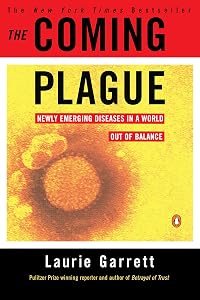
Virus X does exactly what the subtitle claims, tracking the new killer plagues (out of the present and into the future.) It covers the usual suspects; Ebola, Hantavirus, AIDS, etc, and examines how these deadly diseases have recently emerged and what the future holds in a world where so many deadly microbes seem to crop up so often. The author admits in the introduction that the topic has been covered already by the likes of Laurie Garrett with The Coming Plague, and others, but he stubbornly wrote his book anyway.
Really, if you've read The Coming Plague two-thirds of Virus X will feel like a rehashing. In fact, there were some instances where it seemed like the author copied directly from Laurie Garrett's book. The rest is a smattering show more of new material which, although interesting, isn't worth trudging through the rest of the book. While the book did occasionally capture my attention, it seemed a lot of times I was disinterested. There just wasn't enough new information to make the book worthwhile
Ignoring this, Virus X really is a good book. It just isn't anything new. It's one of those books where, if someone told me they were about to read it, I'd nod and tell them it isn't bad. But if someone asked me for a recommendation for a book on the topic, Virus X wouldn't make the list. It's decent, it's readable, but ultimately it's just average. show less
Really, if you've read The Coming Plague two-thirds of Virus X will feel like a rehashing. In fact, there were some instances where it seemed like the author copied directly from Laurie Garrett's book. The rest is a smattering show more of new material which, although interesting, isn't worth trudging through the rest of the book. While the book did occasionally capture my attention, it seemed a lot of times I was disinterested. There just wasn't enough new information to make the book worthwhile
Ignoring this, Virus X really is a good book. It just isn't anything new. It's one of those books where, if someone told me they were about to read it, I'd nod and tell them it isn't bad. But if someone asked me for a recommendation for a book on the topic, Virus X wouldn't make the list. It's decent, it's readable, but ultimately it's just average. show less
Fascinating. Viruses are scary. I mean, really scary. Of things I try not to wish upon people, Ebola is one of those things.
Anyway, this book is really interesting. It goes and describes the rise of a few epidemic viruses. The Sin Nombre Hantavirus from 1993 or so, the Ebola outbreak from 1976, and some others. It goes through some of the cases like a mystery novel. Describing the behind the scenes processes involved in identifying these diseases and how they were transmitted.
I hope to find more books like this.
Anyway, this book is really interesting. It goes and describes the rise of a few epidemic viruses. The Sin Nombre Hantavirus from 1993 or so, the Ebola outbreak from 1976, and some others. It goes through some of the cases like a mystery novel. Describing the behind the scenes processes involved in identifying these diseases and how they were transmitted.
I hope to find more books like this.
Ratings
Members
- Recently Added By
Author Information

7 Works 594 Members
Frank Ryan is the author of the acclaimed books Virus X: Tracking the New Killer Plagues and The Forgotten Plague: How the Battle Against Tuberculosis Was Won and Lost, which the New York Times Book Review chose as a Nonfiction Book of the Year. He lives in Sheffield, England.
Common Knowledge
- Canonical title
- Virus X: Tracking the New Killer Plagues
- Alternate titles
- Virus X
- Original publication date
- 1997
- Epigraph
- I do not know what I may appear to the world;
but to myself I seem to have been only
like a boy playing on the seashore,
and diverting myself in now and then finding
a smoother pebble or a prettier shell ... (show all)than
ordinary, whilst the great ocean of truth lay
all undiscovered before me.
Sir Isaac Newton - Dedication
- For my mother and late father
- First words
- It is July 30, 1994, and outside a relief tent on the crown of a hill, a child's eyes glaze over and in a terrible moment, all the more disturbing for its seeming banality, he dies.
- Blurbers
- Verghes, Abraham; Garrett, Laurie; Behe, Michael J.
Classifications
- Genres
- Nonfiction, Science & Nature, General Nonfiction
- DDC/MDS
- 614.4 — Applied science & technology Medicine & health Epidemics, Poisons, Alternative Medicine Incidence of and public measures to prevent disease
- LCC
- RA643 .R93 — Medicine Public aspects of medicine Public aspects of medicine Public health. Hygiene. Preventive medicine Disease (Communicable and noninfectious) and public
- BISAC
Statistics
- Members
- 207
- Popularity
- 157,812
- Reviews
- 3
- Rating
- (3.95)
- Languages
- Dutch, English, German
- Media
- Paper, Ebook
- ISBNs
- 8
- ASINs
- 2