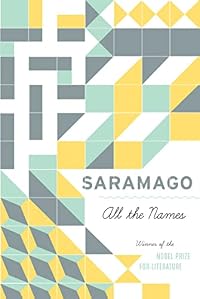
All the Names
by José Saramago
On This Page
Description
From a Nobel Prize winner: "A psychological, even metaphysical thriller that will keep you turning the pages . . . with growing alarm and alacrity." --The Seattle Times A Washington Post Book World Favorite Book of the Year Senhor José is a low-grade clerk in the city's Central Registry, where the living and the dead share the same shelf space. A middle-aged bachelor, he has no interest in anything beyond the certificates of birth, marriage, divorce, and death that are his daily show more routine. But one day, when he comes across the records of an anonymous young woman, something happens to him. Obsessed, Senhor José sets off to follow the thread that may lead him to the woman--but as he gets closer, he discovers more about her, and about himself, than he would ever have wished. The loneliness of people's lives, the effects of chance, the discovery of love--all coalesce in this extraordinary novel that displays the power and art of José Saramago in brilliant form. show lessTags
Recommendations



















Member Reviews
Senhor Jose is a fifty year-old hard-working clerk in the extremely bureaucratic Central Registry. He is unmarried and his only interest outside of work is collecting newspaper clippings about famous people. That is until he becomes obsessed with finding out everything he can about a woman whose card he comes across by accident at work.
There is no explanation for his actions in seeking out the essence of the unknown woman, the rules he breaks, the patterns of his life upended. Unless, love. He demands of his ceiling while lying in bed "Tell me then how I could possibly love a woman I didn't even know and whom I'd never seen?"
After he finds out all he can, Senhor Jose discovers he has an ally from the Central Registry, one who has come show more to realize that humanity cannot be filed away, cannot be compartmented into cards divided by those who are alive and those who are dead. show less
There is no explanation for his actions in seeking out the essence of the unknown woman, the rules he breaks, the patterns of his life upended. Unless, love. He demands of his ceiling while lying in bed "Tell me then how I could possibly love a woman I didn't even know and whom I'd never seen?"
After he finds out all he can, Senhor Jose discovers he has an ally from the Central Registry, one who has come show more to realize that humanity cannot be filed away, cannot be compartmented into cards divided by those who are alive and those who are dead. show less
We've all encountered Senhor José, some of us may even know him; a man so inconsequential he has no family name. Names are his life though, for Senhor José toils five and a half days a week at the Central Registry for Births, Marriages, and Deaths, the place where all life's milestones have been recorded painstakingly on file cards by hand since time immemorial. Divorces are recorded now too in this secular age, but the institutional name remains.
Senhor José's leisure time is spent augmenting the histories of those he feels may become famous. To do this, he surreptitiously brings home records from the Central Registry and copies them onto purloined official forms, then augments these files with newspaper and magazine clippings; a show more harmless enough activity, but not sanctioned.
His home is little more than a stable attached to the great building. This means he can secretly enter and exit at night through a forgotten connecting door. Each morning, however, he must line up on the front steps with all the other workers, who enter by seniority with the Registrar last of all.
One day Senhor José found an ordinary woman's file card accidentally picked up with those of his chosen subjects. He made the daring decision to find out all he could about her. Once launched on this quest, José became more and more daring. He asked for a half hour off one day, his first such request in twenty-five years of working at the Registry. He created a masterful forgery, a letter identifying him and requiring all he questioned to aid him. He stumbled along, always terrified of getting caught, yet going deeper and deeper down his rabbit hole. As he went, this friendless man learned to speak with others, to realize there were areas of chaos in the world. Each night, after writing his findings in a journal, he discussed them with the ceiling above his bed, and pondered the replies.
Anyone who's ever worked in a bureaucracy will recognize the sheer silliness of so much in Senhor José's work world. Every couple of years, The Registry buillt out a new rear wall to accommodate the ever increasing number of file cards for the deceased. Should these be arranged with the most recent dead in front, as these are the cards most likely to be needed; or should they be arranged with the earlier dead in front so that the files don't all need to be moved back with each extension?
Saramago writes with a real fondness for Senhor José, an Everyman of the office. Who else could create such a delightful book around such a character, and successfully liberate him? show less
Senhor José's leisure time is spent augmenting the histories of those he feels may become famous. To do this, he surreptitiously brings home records from the Central Registry and copies them onto purloined official forms, then augments these files with newspaper and magazine clippings; a show more harmless enough activity, but not sanctioned.
His home is little more than a stable attached to the great building. This means he can secretly enter and exit at night through a forgotten connecting door. Each morning, however, he must line up on the front steps with all the other workers, who enter by seniority with the Registrar last of all.
One day Senhor José found an ordinary woman's file card accidentally picked up with those of his chosen subjects. He made the daring decision to find out all he could about her. Once launched on this quest, José became more and more daring. He asked for a half hour off one day, his first such request in twenty-five years of working at the Registry. He created a masterful forgery, a letter identifying him and requiring all he questioned to aid him. He stumbled along, always terrified of getting caught, yet going deeper and deeper down his rabbit hole. As he went, this friendless man learned to speak with others, to realize there were areas of chaos in the world. Each night, after writing his findings in a journal, he discussed them with the ceiling above his bed, and pondered the replies.
Anyone who's ever worked in a bureaucracy will recognize the sheer silliness of so much in Senhor José's work world. Every couple of years, The Registry buillt out a new rear wall to accommodate the ever increasing number of file cards for the deceased. Should these be arranged with the most recent dead in front, as these are the cards most likely to be needed; or should they be arranged with the earlier dead in front so that the files don't all need to be moved back with each extension?
Saramago writes with a real fondness for Senhor José, an Everyman of the office. Who else could create such a delightful book around such a character, and successfully liberate him? show less
Metaphysical Love?
Some books should be read more than once. This is one of them. I cannot remember what I made of it when I bought it at the start of October 2001, just weeks after 9-11, and just before the world changed for ever. The blurb tells me nothing about what drove me to it.
The answer may lie in the line early in the book:
"nothing is as tiring as dealing with abstractions".
Nothing exhausted us as much as the religious abstractions thrust on us as part of the early 21C.
The central registry where Senhor Jose works still uses inkwells and fountain pens. People and documents get lost in its dark regions where the dead lie, there is a rigid and absolute hierarchy. You could be in 19thC Portugal as much as the 1990s. Under cover of show more the inefficiencies, Senhor Jose goes on a benign quest to find a woman whose card he accidentally picked up one day attached to another. Jose is lonely , no family, no lover, no children. He lives a modest life in an old house attached to the central registry where he works. There is a door to the registry and he uses it at night to dig into the paper trail of the unknown woman whose estray index card by chance attaches itself to Jose's life and becomes his world.
What drives him? His loneliness, the loneliness of the woman he pursues? He has connected with someone he may never meet, chases after her like an obsessing lover, shirks work, gets sick in the pursuit. Can love be metaphysical? Outside the bounds of nature? It's always outside the bounds of logic, so why not?
Small acts of kindness and respect for others permeate this novel. The Registrar, a total authoritarian suddenly shows mercy and kindness to Jose, a junior clerk of 50 years of age. A shepherd changes the name plates at the central cemetery, a place that replicates the function of the registry almost identically, only it is a repository of the dead, where everyone is heading, anyway. His reason, nothing expresses respect like mourning a stranger, he says.
The dead and the living are one. Senhor Jose barely exists, until he pursues his quest. The unknown woman does not exist as she neither speaks, nor appears. Yet we know her life as a kind of parallel to Senhor Jose. They are suited to each other. Despite the age difference, she is 36.
Love is human, as is respect, and our isolation from one another. We sit side by side in this world like index cards in the registry, clerks at a desk and corpses in a cemetery. Connecting is the hard part. show less
Some books should be read more than once. This is one of them. I cannot remember what I made of it when I bought it at the start of October 2001, just weeks after 9-11, and just before the world changed for ever. The blurb tells me nothing about what drove me to it.
The answer may lie in the line early in the book:
"nothing is as tiring as dealing with abstractions".
Nothing exhausted us as much as the religious abstractions thrust on us as part of the early 21C.
The central registry where Senhor Jose works still uses inkwells and fountain pens. People and documents get lost in its dark regions where the dead lie, there is a rigid and absolute hierarchy. You could be in 19thC Portugal as much as the 1990s. Under cover of show more the inefficiencies, Senhor Jose goes on a benign quest to find a woman whose card he accidentally picked up one day attached to another. Jose is lonely , no family, no lover, no children. He lives a modest life in an old house attached to the central registry where he works. There is a door to the registry and he uses it at night to dig into the paper trail of the unknown woman whose estray index card by chance attaches itself to Jose's life and becomes his world.
What drives him? His loneliness, the loneliness of the woman he pursues? He has connected with someone he may never meet, chases after her like an obsessing lover, shirks work, gets sick in the pursuit. Can love be metaphysical? Outside the bounds of nature? It's always outside the bounds of logic, so why not?
Small acts of kindness and respect for others permeate this novel. The Registrar, a total authoritarian suddenly shows mercy and kindness to Jose, a junior clerk of 50 years of age. A shepherd changes the name plates at the central cemetery, a place that replicates the function of the registry almost identically, only it is a repository of the dead, where everyone is heading, anyway. His reason, nothing expresses respect like mourning a stranger, he says.
The dead and the living are one. Senhor Jose barely exists, until he pursues his quest. The unknown woman does not exist as she neither speaks, nor appears. Yet we know her life as a kind of parallel to Senhor Jose. They are suited to each other. Despite the age difference, she is 36.
Love is human, as is respect, and our isolation from one another. We sit side by side in this world like index cards in the registry, clerks at a desk and corpses in a cemetery. Connecting is the hard part. show less
I find José Saramago to be one of the greatest writers I’ve come across. His writing style complements his sense of humour and humanity, and the way he weaves his stories out of the sometimes comical, sometimes absurd, often both, and of the everyday comings and goings of people, results in his hands in strong prose, acute sense of humanity and overall entertaining literature.
That said, All the Names (1997) was, for some reason, a bit of a letdown. I did appreciate the play with catalogues, identity and search of self, and I think the parts of the book that had our narrator play detective against the regulations straight out of Gilliam’s Brazil (1985) were fantastic literature. But something I couldn’t connect with, and found show more myself losing the way at some point, and couldn’t find back.
The overall feeling that remains after perhaps four months is that it could have been shorter, which is strange since I've never felt Saramago to meander or beat around the bush. It won’t be until sometime when I’ll give it another try, but maybe I simply read it at the wrong time.
6 October,
2014 show less
That said, All the Names (1997) was, for some reason, a bit of a letdown. I did appreciate the play with catalogues, identity and search of self, and I think the parts of the book that had our narrator play detective against the regulations straight out of Gilliam’s Brazil (1985) were fantastic literature. But something I couldn’t connect with, and found show more myself losing the way at some point, and couldn’t find back.
The overall feeling that remains after perhaps four months is that it could have been shorter, which is strange since I've never felt Saramago to meander or beat around the bush. It won’t be until sometime when I’ll give it another try, but maybe I simply read it at the wrong time.
6 October,
2014 show less
José Saramago has a distinct writing style, featuring long sentences, no speech marks, and very few paragraph breaks. If he was a lesser writer, this would become tedious, but he is an exemplary writer, so it never does. In fact, this style makes for an astonishing sense of proximity to the characters and narrative. This novel follows a clerk called Senhor José and is told almost entirely from his perspective; the reader is in his shoes and in his head. I found this extremely effective and powerful. Although relatively little in terms of incident occurs throughout the book, it has a texture and intensity that makes it totally compelling. The story demonstrates that an unassuming character like Senhor José has a fascinating and show more complex inner life, which interacts with the rest of the world in unexpected ways.
I found 'All the Names' to be curiously comforting. It reminds the reader of the importance of simple and undramatic human experiences and interactions, much needed in a culture that prizes the loud, dramatic, big, and expensive. I am curious as to whether other people took a similar message from the novel, as I suspect the character and priorities of the reader would shape their interpretation. Perhaps to some Senhor José could be seen as a tragic, lonely figure with a pitifully narrow life? I saw him as admirable and sympathetic in his focus, dedication, and contentment.
Saramago won the Nobel Prize for Literature for very good reasons. I also highly recommend his novel 'Blindness', which is devastating and magnificent. In this, the central conceit takes precedence, whereas 'All the Names' has a more subtle appeal, to my mind. show less
I found 'All the Names' to be curiously comforting. It reminds the reader of the importance of simple and undramatic human experiences and interactions, much needed in a culture that prizes the loud, dramatic, big, and expensive. I am curious as to whether other people took a similar message from the novel, as I suspect the character and priorities of the reader would shape their interpretation. Perhaps to some Senhor José could be seen as a tragic, lonely figure with a pitifully narrow life? I saw him as admirable and sympathetic in his focus, dedication, and contentment.
Saramago won the Nobel Prize for Literature for very good reasons. I also highly recommend his novel 'Blindness', which is devastating and magnificent. In this, the central conceit takes precedence, whereas 'All the Names' has a more subtle appeal, to my mind. show less
In an unnamed country, in an unnamed city, Senhor José works at the Central Registry. The Registry is the repository for records of the important events in the lives of the city's citizenry. A card is created upon someone's birth, then marriage and maybe divorce are added, and finally death. Senhor José is a lowly clerk in this maze of bureaucracy, and he endlessly transcribes vital information onto people's cards every day. One day he finds himself drawn to a random card and he sets out to find the woman it belongs to.
"Kafkaesque" is a word I've seen used to describe Saramago's vision of the Central Registry, and it's appropriate. The office itself is drawn with a sense of overwhelming scale, dark corners, tottering stacks of show more records. The chain of command is rigid - clerks speak when spoken to, and their job mainly consists of making sure they do enough work that the people above them have proportionally less to do. The all-powerful Registrar is a character shrouded in secrecy.
Reading Saramago, you have to acclimate yourself to his miles-long sentences and his tendency to have entire conversations pass during those sentences with nothing more than commas to separate the speakers. Although it makes for difficulty quoting and difficulty finding a place to put the book down sometimes, it does often engage you because things can go from the sublime to the absurd and back again before you get to the end of his sentence. I think this book is one you have to be a bit patient with, but it is rewarding for those who stick with it.
Recommended for: Kafka fans, people who like untangling knots
Quote: "He had before him the file and the card, he also had the thirteen school reports, the same name repeated thirteen times, twelve different images of the same face, one of them repeated, but each and every one of them dead in the past, already dead before the woman they later became had died, old photographs are very deceiving, they give us the illusion thatwe are alive in them, and it's not true, the person we are looking at no longer exists, and if that person could see us, he or she would not recognise him- or herself in us, Who's that looking at me so sadly, he or she would say." show less
"Kafkaesque" is a word I've seen used to describe Saramago's vision of the Central Registry, and it's appropriate. The office itself is drawn with a sense of overwhelming scale, dark corners, tottering stacks of show more records. The chain of command is rigid - clerks speak when spoken to, and their job mainly consists of making sure they do enough work that the people above them have proportionally less to do. The all-powerful Registrar is a character shrouded in secrecy.
Reading Saramago, you have to acclimate yourself to his miles-long sentences and his tendency to have entire conversations pass during those sentences with nothing more than commas to separate the speakers. Although it makes for difficulty quoting and difficulty finding a place to put the book down sometimes, it does often engage you because things can go from the sublime to the absurd and back again before you get to the end of his sentence. I think this book is one you have to be a bit patient with, but it is rewarding for those who stick with it.
Recommended for: Kafka fans, people who like untangling knots
Quote: "He had before him the file and the card, he also had the thirteen school reports, the same name repeated thirteen times, twelve different images of the same face, one of them repeated, but each and every one of them dead in the past, already dead before the woman they later became had died, old photographs are very deceiving, they give us the illusion thatwe are alive in them, and it's not true, the person we are looking at no longer exists, and if that person could see us, he or she would not recognise him- or herself in us, Who's that looking at me so sadly, he or she would say." show less
A história de um obscuro arquivista cujo hobby é colecionar recortes de jornal sobre pessoas famosas. Protagonizando uma espécie de enredo kafkiano às avessas, ele abandona seu labirinto de papéis e seus hábitos de retidão, movido pela obsessão de encontrar uma mulher desconhecida.
Todos os nomes é a história de um modesto escriturário da Conservatória Geral do Registo Civil, o Sr. José, cujo hobby é colecionar recortes de jornal sobre pessoas famosas. Um dia sua curiosidade acabará se concentrando num recorte que o acaso põe diante dele: a mulher focalizada ali não é célebre, mas o escriturário desejará conhecê-la a todo custo. Abandonando seus hábitos de retidão, ele estará disposto a cometer pequenos delitos show more para alcançar o que deseja: pequenas mentiras que darão à vida uma intensidade desconhecida.
Numa espécie de enredo kafkiano às avessas, o pequeno burocrata enrodilha-se na imprecisão das informações que ele mesmo acumula e acaba forçado a ganhar o mundo, a deixar os meandros de seu arquivo monumental, em busca de dados que, em última instância, mantenham alguma fidelidade à vida. show less
Todos os nomes é a história de um modesto escriturário da Conservatória Geral do Registo Civil, o Sr. José, cujo hobby é colecionar recortes de jornal sobre pessoas famosas. Um dia sua curiosidade acabará se concentrando num recorte que o acaso põe diante dele: a mulher focalizada ali não é célebre, mas o escriturário desejará conhecê-la a todo custo. Abandonando seus hábitos de retidão, ele estará disposto a cometer pequenos delitos show more para alcançar o que deseja: pequenas mentiras que darão à vida uma intensidade desconhecida.
Numa espécie de enredo kafkiano às avessas, o pequeno burocrata enrodilha-se na imprecisão das informações que ele mesmo acumula e acaba forçado a ganhar o mundo, a deixar os meandros de seu arquivo monumental, em busca de dados que, em última instância, mantenham alguma fidelidade à vida. show less
Members
- Recently Added By
Lists

Best Contemporary Literary Fiction (Around the Last 30 Years)
388 works; 122 members

magic realism novels
44 works; 10 members

Pleasant Surprises: Books That Exceeded Our Expectations
418 works; 143 members

Five star books
1,755 works; 108 members

SHOULD Read Books!
354 works; 9 members

Bureaucracies
25 works; 2 members

Books Read in 2019
4,052 works; 108 members

Canon de la narrativa universal del s. XX (cicutadry)
499 works; 3 members
Author Information

235+ Works 53,066 Members
José Saramago was born on November 16, 1922. He spent most of his childhood on his parent's farm, except while attending school in Lisbon. Before devoting himself exclusively to writing novels in 1976, he worked as a draftsman, a publisher's reader, an editor, translator, and political commentator for Diario de Lisboa. He is indisputably show more Portugal's best-known literary figure and his books have been translated into more than 25 languages. Although he wrote his first novel in 1947, he waited some 35 years before winning critical acclaim for work such as the Memorial do Convento. His works include The Year of the Death of Ricardo Reis, The Stone Raft, Baltasar and Blimunda, The History of the Siege of Lisbon, The Gospel According to Jesus Christ, and Blindness. At age 75, he was awarded the Nobel Prize for Literature in 1998 for his work in which "parables sustained by imagination, compassion and irony, continually enables us to apprehend an elusory reality." He died from a prolonged illness that caused multiple organ failure on June 18, 2010 at the age of 87. (Bowker Author Biography) show less
Some Editions
Awards and Honors
Series
Belongs to Publisher Series
Work Relationships
Is contained in
Common Knowledge
- Canonical title
- All the Names
- Original title
- Todos os Nomes
- Original publication date
- 1997
- People/Characters
- Senhor José
- Important places
- Portugal
- Epigraph
- You know the name you were given,
you do not know the name that you have.
'The book of certainties.' - Dedication
- For Pilar
- First words
- Encima del marco de la puerta hay una chapa metálica y estrecha.....
Above the door frame is a long, narrow plaque of enamelled metal. - Quotations*
- Meneer Joses besluit kwam twee dagen later bij hem op. Over het algemeen zeggen we van een besluit niet dat het opkomt, mensen maken zich zo druk om hun identiteit, hoe vaag die ook mag zijn, en hun autoriteit, hoe weinig ze ... (show all)daar ook van mogen hebben, dat ze liever doen alsof ze hebben nagedacht alvorens de stap te zetten, alsof ze de voors en tegens hebben afgewogen, alsof ze alle mogelijkheden en alternatieven in hun overweging hebben meegenomen en na zware mentale arbeid ten slotte hun besluit hebben genomen.
Welbeschouwd nemen wij geen beslissingen, maar nemen beslissingen ons. Het bewijs hiervoor is dat ons hele leven een aaneenschakeling is van de meest uiteenlopende handelingen, die we verrichten zonder ze stuk voor stuk te la... (show all)ten voorafgaan door een periode van denken, peinzen, rekenen, met aan het einde daarvan, en geen moment eerder, de conclusie dat de tijd rijp is voor het besluit om te gaan lunchen, een krant te kopen, op zoek te gaan naar een onbekende vrouw. - Last words
- (Click to show. Warning: May contain spoilers.)Se ató una punta del hilo al tobillo y avanzó hacia la oscuridad.
(Click to show. Warning: May contain spoilers.)He tied the end of the thread around his ankle and set off into the darkness. - Blurbers
- Daniels, Anthony; Hills, C A R; Berger, John
- Original language
- Portuguese
*Some information comes from Common Knowledge in other languages. Click "Edit" for more information.
Classifications
- Genres
- General Fiction, Fiction and Literature
- DDC/MDS
- 869.342 — Literature & rhetoric Spanish Literature Literatures of Portuguese and Galician languages Portuguese fiction 20th Century 1945-1999
- LCC
- PQ9281 .A66 .T6313 — Language and Literature French, Italian, Spanish and Portuguese literatures Portuguese literature Individual authors, 1961-2000
- BISAC
Statistics
- Members
- 3,282
- Popularity
- 5,169
- Reviews
- 73
- Rating
- (3.95)
- Languages
- 20 — Catalan, Danish, Dutch, English, Finnish, French, German, Greek, Hebrew, Hungarian, Italian, Korean, Norwegian (Bokmål), Romanian, Russian, Serbian, Spanish, Swedish, Turkish, Portuguese (Portugal)
- Media
- Paper, Audiobook, Ebook
- ISBNs
- 77
- ASINs
- 16