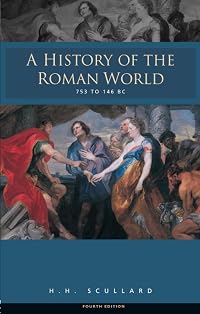
A History of the Roman World 753-146 BC
by H. H. Scullard
On This Page
Description
This definitive study from the author of From the Gracchi to Nero, examines the period from the foundation of Rome to the fall of Carthage. An accessible introduction to these centuries of change, this book will also be useful as context for those studying later developments in Roman history.Tags
Recommendations









Member Reviews
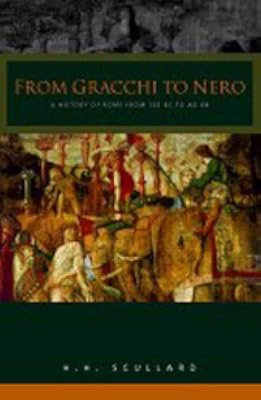
Scullard is a long time favorite. I have read From the Gracchi to Nero a couple of times. Cary and Scullard, A History of Rome (3rd ed.) was the textbook for the Roman history class that I had in college. Somehow I never got around to reading this one until now. After a chapter on prehistoric Rome, Scullard begins with regal Rome and continues to the end of the Third Punic War and the destruction of Carthage in 146 BC. He divides the book into four sections: Rome and Italy, Rome and Carthage, Rome and the Mediterranean, and Roman Life and Culture. The first three sections cover the history proper chronologically and by region. This necessitates some duplication and cross referencing. Scullard focuses almost entirely on traditional show more political and military history in these sections. The fourth and final section covers everyday life and culture by topic: family, the city itself, law, literature, religion, etc. It is a nice survey that succinctly explains the basics of Roman culture before the Gracchi.
Scullard is generally clear and engaging. He takes inscriptions and archaeology into account, but tends to stick to the traditional Roman accounts when there is no compelling reason to do otherwise (the most sensible course). Although Scullard knew the sources and the scholarship of his time thoroughly and provides extensive notes, there have been a number of developments since. A couple of examples. He recounts the traditional version of the destruction of Carthage: burning it, ploughing it under, sowing it with salt. That's what I learned in school. Only it turns out there is absolutely no ancient evidence for the salting, and the first references to it date from the nineteenth century. A good story that should be true and isn't. Another: he refers (no less than three times) to the Praeneste Fibula as one of the earliest examples of archaic Latin to survive, supposedly from ca. 650 BC. Also what I learned in a survey of Latin lit in college. But since Scullard wrote there has been a serious challenge to its authenticity; the jury is still out but many now believe it to be a nineteenth-century forgery. The dangers of reading an older book. But Scullard is informative and often entertaining; he gets a lot more right than not. show less
Scullard is generally clear and engaging. He takes inscriptions and archaeology into account, but tends to stick to the traditional Roman accounts when there is no compelling reason to do otherwise (the most sensible course). Although Scullard knew the sources and the scholarship of his time thoroughly and provides extensive notes, there have been a number of developments since. A couple of examples. He recounts the traditional version of the destruction of Carthage: burning it, ploughing it under, sowing it with salt. That's what I learned in school. Only it turns out there is absolutely no ancient evidence for the salting, and the first references to it date from the nineteenth century. A good story that should be true and isn't. Another: he refers (no less than three times) to the Praeneste Fibula as one of the earliest examples of archaic Latin to survive, supposedly from ca. 650 BC. Also what I learned in a survey of Latin lit in college. But since Scullard wrote there has been a serious challenge to its authenticity; the jury is still out but many now believe it to be a nineteenth-century forgery. The dangers of reading an older book. But Scullard is informative and often entertaining; he gets a lot more right than not. show less
I did not read all of this, but most and the parts necessary for the curriculum I am working on. Easy read, clear, detailed, and well written.
I did not read all of this, but most and the parts necessary for the curriculum I am working on. Easy read, clear, detailed, and well written.
"2012-10-26 12:00:00"
Ratings
Members
- Recently Added By
Lists

r/History Recommended Reading List
603 works; 12 members
Author Information

20+ Works 2,032 Members
H. H. Scullard (1903-1983) taught at New College Oxford from 1935 to 1939 before becoming Professor of Ancient History at King's College London. His many books include the Oxford Classical Dictionary and From the Gracchi to Nero, which is also in the Routledge Classics series.
Series
Belongs to Publisher Series
Common Knowledge
- Original publication date
- 1935; Second edition, 1951; Third edition, 1961
- People/Characters
- Aemilius Paulus; Antiochus III the Great (241? to 287 BC/BCE); Marcus Claudius Marcellus; Scipio Africanus; Scipio Aemilianus; Eumenes II (show all 15); Flaminius; Hannibal; Hasdrubal; Hiero; Masinissa of Numidia; Philip V of Macedon; Perseus, King of Macedon; Polybius; Cato the Elder
- Important places
- Capua, Campania, Italy; Carthage, Tunis, Tunisia; Illyria (West Balkan Peninsula); Macedonia, Greece; Rome, Italy; Sagunto, Valencia, Spain (as Saguntum) (show all 8); Sardinia, Italy; Roman Empire
- First words
- Preface -- In this volume I have attempted to provide an up-to-date account of the Roman world from earliest times until the Age of the Great Conquests.
Introduction -- The two crowning achievements wrought by the Roman People during the period covered by this volume were the unification of Italy and the founding of an overseas Empire.
Classifications
- Genres
- History, Nonfiction, General Nonfiction
- DDC/MDS
- 937.02 — History & geography History of ancient world (to ca. 499) Italian Peninsula to 476 and adjacent territories to 476 Republic 509-31 B.C.
- LCC
- DG231 .S35 — History of Europe, Asia, Africa and Oceania City History of Italy Ancient Italy. Rome to 476 History By period Kings and Republic, 753-27 B.C.
- BISAC
Statistics
- Members
- 254
- Popularity
- 127,975
- Reviews
- 5
- Rating
- (4.06)
- Languages
- English, Italian
- Media
- Paper, Ebook
- ISBNs
- 14
- ASINs
- 6