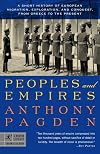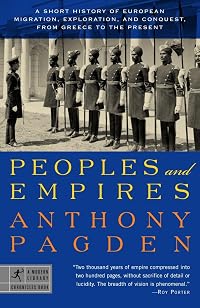
Peoples and Empires: A Short History of European Migration, Exploration, and Conquest, from Greece to the Present
by Anthony Pagden
On This Page
Description
Cambridge professor and renowned historian Anthony Pagden covers a vast subject in a compact package with Peoples and Empires. This wide-ranging and intellectually stimulating work examines the origins and history of the West with terse, efficient prose. With a captivating narration by Robert O'Keefe, listeners will find this work enjoyable and utterly absorbing.Tags
Recommendations









Member Reviews
Anthony Pagden begins his history with the ancient Greeks, who saw themselves as 'extreme voyagers'. They were explorers, they lived in many different places and they were witnesses to one of the most decisive turning points in human history: the moment when the nomadic life gave way to one which was agricultural, city-dwelling and settled. He then moves on to consider the Romans, who transformed migration into a form of domination and sought to impose 'civility' - that is, the lifestyle and laws of the city - upon all whom they conquered. The book culminates in an account of the great European overseas migrations, and the consequences of the initial encounters between 'civilised' Europeans and 'barbarian' aborigines, the dramatic show more effects of which are still felt acutely today. Drawing upon literary, anthropological and historical sources from throughout Europe, PEOPLES AND EMPIRES tells the stories of the great movement of peoples in European history. show less
Peoples and Empires
Anthony Pagden
December 26, 2011
A small format book from the Modern Library Chronicles series. This is an extended essay on the empires of the West, from Alexander the Great to the British Empire. Is it true that the age of western empires is done?
Regarding the Portugese exploration of Africa and the route to the east in the 15th century, Pagden writes that the peoples of Senagal turned poisoned arrows on the assilants. "It is often forgotten that in the first encounter between a European colonizing power and an African people, the Europeans were soundly defeated."
"Nationalism is the idea that all peoples have separate, distinct, and indisoluble features, that each is united by a common language and a common culture show more and lives under a single, and indigenous, ruler"
Regarding the origin of anti-semitism in Nazi Germany:
"…the German philologist Max Muller, who was a professor of Sanskrit at Oxford in the 1860s and 1870s, developed Jones' ideas into a theory that provided the "Aryans" with a common racial heritage, a complex migratory history, and an ancestral home in southern Russia"
"…what Sigmund Freud once so tellingly called "the narcissism of small differences" show less
Anthony Pagden
December 26, 2011
A small format book from the Modern Library Chronicles series. This is an extended essay on the empires of the West, from Alexander the Great to the British Empire. Is it true that the age of western empires is done?
Regarding the Portugese exploration of Africa and the route to the east in the 15th century, Pagden writes that the peoples of Senagal turned poisoned arrows on the assilants. "It is often forgotten that in the first encounter between a European colonizing power and an African people, the Europeans were soundly defeated."
"Nationalism is the idea that all peoples have separate, distinct, and indisoluble features, that each is united by a common language and a common culture show more and lives under a single, and indigenous, ruler"
Regarding the origin of anti-semitism in Nazi Germany:
"…the German philologist Max Muller, who was a professor of Sanskrit at Oxford in the 1860s and 1870s, developed Jones' ideas into a theory that provided the "Aryans" with a common racial heritage, a complex migratory history, and an ancestral home in southern Russia"
"…what Sigmund Freud once so tellingly called "the narcissism of small differences" show less
Neste livro é evidente um excesso de anglismo e de visão anglófila. Além disso, faz muitas afirmações que não justifica. Sobre o mundo não anglófono deixou os estudos incipientes, resultando conclusões inexactas. Afinal, a melhor parte é a introdução, onde não refere factos, ficando-se pelo plano teórico.
Mar 31, 2021Portuguese (Portugal)
Ratings
Members
- Recently Added By
Author Information

28+ Works 1,498 Members
Anthony Pagden is Harry C. Black Professor of History at the Johns Hopkins University. (Bowker Author Biography)
Some Editions
Series
Belongs to Publisher Series
Common Knowledge
- Canonical title
- Peoples and Empires: A Short History of European Migration, Exploration, and Conquest, from Greece to the Present
- Original title
- Peoples and Empires: A Short History of European Migration, Exploration, and Conquest, from Greece to the Present
Classifications
Statistics
- Members
- 350
- Popularity
- 90,597
- Reviews
- 3
- Rating
- (3.50)
- Languages
- 5 — Chinese, Dutch, English, Portuguese, Spanish
- Media
- Paper, Audiobook, Ebook
- ISBNs
- 14
- ASINs
- 4