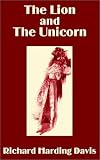
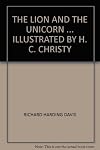
The Lion and the Unicorn
by Richard Harding Davis
On This Page
Description
This 1899 collection of short stories includes the title story as well as four others: "On the Fever Ship," "The Man with One Talent," "The Vagrant," and "The Last Ride Together." These exciting tales of adventure are chilling, whether set on a Cuban battlefield or in the smoke-filled back rooms of Washington, D.C.Tags
Recommendations















Member Reviews
Not bad, not exciting. A collection of short stories; many of them are romances (boy meets girl, trouble, HAE). Each was pleasant to read (ok, _most_ of them were pleasant to read), none stand out in my memory. The Picture was interesting, though I hope his experiment doesn't put him off all women, and it was amusing how he could surprise himself with her words - with what he thought would be her words. The one about Cuba was depressing. The last one, about the young man who ran away, was headed for bland sweetness - then took an abrupt turn into nearly-depressing. But he made a good choice at the end. I wish, though, that he didn't so casually dismiss what he'd built - it wasn't all he could do, but it wasn't despicable. The Fever show more Dream was another with very striking language. I enjoyed reading it, and I'm completely uninterested in reading it again. I might look for more by Davis, but I'd avoid another collection like this one - one after another blurs into dullness, for me. show less
Members
- Recently Added By
Author Information

98+ Works 1,256 Members
Author and journalist Richard Harding Davis was born in Philadelphia on April 18, 1864. After studying at Lehigh and Johns Hopkins universities, he became a reporter and in 1890, he was the managing editor of Harper's Weekly. On assignments, he toured many areas of the world and recorded his impressions of the American West, Europe, and South show more America in a series of books. As a foreign correspondent, he covered every war from the Greco-Turkish to World War I and published several books recording his experiences. In 1896, he became part of William Randolph Hearst's unproven plot to start the Spanish-American War in order to boost newspaper sales when Hearst sent him and illustrator Frederick Remington to cover the Cuban rebellion against Spanish rule. In Cuba, Davis wrote several articles that sparked U.S. interest in the struggles of the Cuban people, but he resigned when Hearst changed the facts in one of his stories. Davis was aboard the New York during the bombing of Mantanzas, which gave the New York Herald a scoop on the war. As a result, the U.S. Navy prohibited reporters from being aboard any U.S. ships for the rest of the Cuban conflict. Davis was captured by the German Army in 1914 and was threatened with execution as a spy. He eventually convinced them he was a reporter and was released. He is considered one of the most influential reporters of the yellow journalist era. He died in Mount Kisco, New York on April 11, 1916. (Bowker Author Biography) show less
Common Knowledge
- Original publication date
- 1899
Classifications
Statistics
- Members
- 48
- Popularity
- 626,221
- Reviews
- 1
- Rating
- (3.00)
- Languages
- English
- Media
- Paper, Ebook
- ISBNs
- 22
- ASINs
- 8