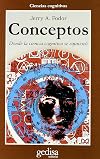
Concepts: Where Cognitive Science Went Wrong
by Jerry A. Fodor
108 Members (4.00)
On This Page
Description
Renowned philosopher Fodor presents an original theory of the basic constituents of thought in this first volume of the Oxford Cognitive Science Series. He argues for an atomistic theory of concepts and demolishes rival theories.Tags
Recommendations





















Member Reviews
Members
- Recently Added By
Author Information

36+ Works 1,691 Members
Jerry A. Fodor was born Jerome Alan Fodor in New York City on April 22, 1935. He received a bachelor's degree in philosophy from Columbia University and a Ph.D. in philosophy from Princeton University. He taught at the Massachusetts Institute of Technology from 1959 to 1986, the City University of New York Graduate Center from 1986 to 1988, and show more Rutgers University from 1988 until his death, when was the State of New Jersey professor of philosophy there. He was one of the world's foremost philosophers of mind. He wrote several books including The Structure of Language written with Jerrold J. Katz, The Language of Thought, The Modularity of Mind, Concepts: Where Cognitive Science Went Wrong, The Mind Doesn't Work That Way, and What Darwin Got Wrong written with Massimo Piattelli-Palmarini. He died from complications of Parkinson's disease and a recent stroke on November 29, 2017 at the age of 82. (Bowker Author Biography) show less
Series
Belongs to Publisher Series
Common Knowledge
- Canonical title
- Concepts: Where Cognitive Science Went Wrong
- Original title
- Concepts: Where Cognitive Science Went Wrong
- Original publication date
- 1998
- Epigraph
- Chorus: Zuruck!
Tamino: . . . Zuruck?
Da seh ich noch ein Tur,
Vielleicht find ich den Eingang hier.
—The Magic Flute - Dedication
- for Janet, KP and Anthony; nuclear family
- First words
- Preface
Actually, I'm a little worried about the subtitle. There is already a big revisionist literature about what's wrong with cognitive science, devoted to throwing out, along with the baby: the bath, the bath towe... (show all)l, the bathtub, the bathroom, many innocent bystanders, and large sections of Lower Manhattan.
1 Philosophical Introduction: The Background
Theory
My topic is what concepts are. Since I'm interested in that question primarily as it arises in the context of
‘representational’ theories of mind (RTMs), a ... (show all)natural way to get started would be for me to tell you about RTMs and about how they raise the question what concepts are. I could then set out my answer, and you could tell me, by return, what you think is wrong with it. The ensuing discussion would be abstract and theory laden, no doubt; but, with any luck, philosophically innocent. - Original language
- English
Classifications
Statistics
- Members
- 108
- Popularity
- 301,528
- Rating
- (4.00)
- Languages
- English, Italian, Spanish
- Media
- Paper, Ebook
- ISBNs
- 6
- ASINs
- 1