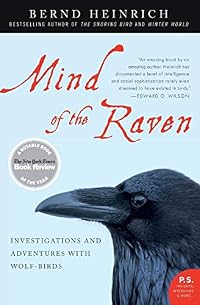
Mind of the Raven: Investigations and Adventures with Wolf-Birds
by Bernd Heinrich
On This Page
Description
Bernd Heinrich involves us in his quest to get inside the mind of the raven. But as animals can only be spied on by getting quite close, Heinrich adopts ravens, thereby becoming a "raven father," as well as observing them in their natural habitat. He studies their daily routines, and in the process, paints a vivid picture of the ravens' world. At the heart of this book are Heinrich's love and respect for these complex and engaging creatures, and through his keen observation and analysis, we show more become their intimates too. Heinrich's passion for ravens has led him around the world in his research. Mind of the Raven follows an exotic journey-from New England to Germany, and from Montana to Baffin Island in the high Arctic-offering dazzling accounts of how science works in the field, filtered through the eyes of a passionate observer of nature. Each new discovery and insight into raven behavior is thrilling, at once lyrical and scientific. show lessTags
Recommendations







Member Reviews
This is one of those books I thoroughly enjoyed but I'm not sure that I would give to others. It's a book about exactly what the title says -- an investigation into the thought processes of ravens, based largely on studies the Heinrich made of both wild ravens he has studied, as well as a number of raven pairs he raised.
It's not primarily a narrative, nor is it really written for the layperson, although I think it is written for the serious birder. Heinrich assumes his readers don't need to be convinced that his enthusiasm for the species is warranted, and he doesn't bother to justify either his own interest or his assumption that his readers share it. Presumably, that's why they are reading his book in the first place: because they show more are into ravens.
Instead, the book is all about methodology: what hypothesis needs to be tested, and how he does the testing, and what the results confirm or disprove. Do ravens recognize their own eggs by their color? When and why do they hide caches of food? When are strangers tolerated and when not? Do ravens follow wolves and why? Can they problem solve? How much of the problem solving is conscious and how much is just learned behavior?
There is a fair amount of the obsessive scientist to the book that I, for one, found appealing -- at one point he freeze-dries his own scalp with dry ice to see if it will work as a form of freeze-branding. He eats bumblebees to see what they taste like and to see if he'll get stung (he has a theory that ravens find the taste of bumble bees repugnant).
And being an obsessive scientist, he questions everything. He is diligent in picking apart what we see, what we think we see, what motivations we ascribe to a raven, and what can actually be proved. The whole last part of the book, which deals with conscious thought and intention and the reported ability of the raven to plan, deliberately and consciously, for the future -- is really pretty fascinating. It made me think about the nature of thinking, to be honest.
But he's all about the experimental method and the proof. He's not interested in turning his ravens into characters for the reader to become emotionally invested in even though it is clear all of them have what we'd call "personalities." Case in point -- the section where he's trying to determine just how much problem solving is present involves a lengthy description of several ravens and various rocks and pieces of meat dangling on strings. The experiment is repeated multiple times with controlled variations (sometimes, he crosses the strings! whoa!), and, when his write up is rejected by a scientific journal, he repeats this experiment not once, not twice, but something like six different times in order to confront objections his peers have made about his assumptions. We, the readers, get to read about every step of the process. It was awesome.
The end result? I did not start out reading the book being particularly interested in ravens, but damn if I'm not interested now. And Heinrich's general approach to life -- endlessly curious, relentlessly questioning everything he sees -- driven to test his assumptions. Well, in our current age of "fake news" and science hoaxes and social-media-powered conspiracies, I think Heinrich, and the scientists like him, might be a kind of quiet superhero. show less
It's not primarily a narrative, nor is it really written for the layperson, although I think it is written for the serious birder. Heinrich assumes his readers don't need to be convinced that his enthusiasm for the species is warranted, and he doesn't bother to justify either his own interest or his assumption that his readers share it. Presumably, that's why they are reading his book in the first place: because they show more are into ravens.
Instead, the book is all about methodology: what hypothesis needs to be tested, and how he does the testing, and what the results confirm or disprove. Do ravens recognize their own eggs by their color? When and why do they hide caches of food? When are strangers tolerated and when not? Do ravens follow wolves and why? Can they problem solve? How much of the problem solving is conscious and how much is just learned behavior?
There is a fair amount of the obsessive scientist to the book that I, for one, found appealing -- at one point he freeze-dries his own scalp with dry ice to see if it will work as a form of freeze-branding. He eats bumblebees to see what they taste like and to see if he'll get stung (he has a theory that ravens find the taste of bumble bees repugnant).
And being an obsessive scientist, he questions everything. He is diligent in picking apart what we see, what we think we see, what motivations we ascribe to a raven, and what can actually be proved. The whole last part of the book, which deals with conscious thought and intention and the reported ability of the raven to plan, deliberately and consciously, for the future -- is really pretty fascinating. It made me think about the nature of thinking, to be honest.
But he's all about the experimental method and the proof. He's not interested in turning his ravens into characters for the reader to become emotionally invested in even though it is clear all of them have what we'd call "personalities." Case in point -- the section where he's trying to determine just how much problem solving is present involves a lengthy description of several ravens and various rocks and pieces of meat dangling on strings. The experiment is repeated multiple times with controlled variations (sometimes, he crosses the strings! whoa!), and, when his write up is rejected by a scientific journal, he repeats this experiment not once, not twice, but something like six different times in order to confront objections his peers have made about his assumptions. We, the readers, get to read about every step of the process. It was awesome.
The end result? I did not start out reading the book being particularly interested in ravens, but damn if I'm not interested now. And Heinrich's general approach to life -- endlessly curious, relentlessly questioning everything he sees -- driven to test his assumptions. Well, in our current age of "fake news" and science hoaxes and social-media-powered conspiracies, I think Heinrich, and the scientists like him, might be a kind of quiet superhero. show less
I think this one wasn't quite what I was expecting when I picked it up. I was excited to learn what there might be to know about ravens, but this often feels as much or more like a book about the experience of studying ravens as about the birds themselves. Or even about the difficulty of studying ravens, since they are skittish, highly individual, extremely smart, frequently unpredictable, and often impossible for even experienced humans to tell apart. Still, the author has a lot of very interesting things to say about the birds, both tame and wild, that he spent time with, about his observations of their behavior and what it might mean, and, at the end of the book, also some speculative thoughts about what it means for an animal to be show more "conscious" and whether ravens qualify. I found it a bit dry in places, but surprisingly exciting in others, and ultimately well worth reading, as it does do a good job of conveying just why ravens are so cool, so fascinating, and still so mysterious.
Rating: I went back and forth on this a bit, but despite finding it a little bit of an uneven read, I think I'm going to have to give it 4/5. show less
Rating: I went back and forth on this a bit, but despite finding it a little bit of an uneven read, I think I'm going to have to give it 4/5. show less
Although this book's research is based primarily on anecdotes, the work contributes significantly to the body of knowledge about ravens. Ravens are one of the most intelligent birds, and their extreme shyness coupled with strong observational skills, quick learning abilities, infallible memories, and a knack for improvisation, make observing and recording their behaviors challenging at best. The author gives examples of his observations of ravens in Alaska, Yellowstone, and Maine, and of ravens he raises from hatchlings to breeding pairs. Observations from other scientists and amateur observers are also included, most of which provide empirical data that set a foundation for future research into this fascinating corvid.
Did you know show more that ravens may live 50 years or more? That they mate for life, but some may have "extra-marital affairs" during mating season without penalty from their spouse? That they may cooperate with wolves, bears, and human hunters by leading the predators to their prey? Inuit hunters have myths about Raven's cooperation with the successful hunter; many of these tales are pooshooed by the scientific community. It's amazing how so much formerly discounted Indigenous knowledge based on anecdotal or mythical information is being scientifically proven.
Heinrich devotes a chapter to a description - and a bit of a rant - about his struggles to be published due to his work not being considered research because of its inability to be replicated. He asks, why can't it be shared with the scientific community with the caveat that more research is needed? Perhaps it's political.
On my drive to work through the Sonoran desert on a reservation, I have observed during the past year, a pair of ravens who hang out in approximately the same location every morning. I have seen them huddled together for warmth, turned sideways like bookends to catch the sun, sharing shade in the summer morning sun, walking along the road and pecking at some dead thing, flying together, and at times single, but then together again after a short time. I'll never look at them the same way I did a year ago. They have become more than a couple of black birds to watch on my way to work. They have become Ravens. show less
Did you know show more that ravens may live 50 years or more? That they mate for life, but some may have "extra-marital affairs" during mating season without penalty from their spouse? That they may cooperate with wolves, bears, and human hunters by leading the predators to their prey? Inuit hunters have myths about Raven's cooperation with the successful hunter; many of these tales are pooshooed by the scientific community. It's amazing how so much formerly discounted Indigenous knowledge based on anecdotal or mythical information is being scientifically proven.
Heinrich devotes a chapter to a description - and a bit of a rant - about his struggles to be published due to his work not being considered research because of its inability to be replicated. He asks, why can't it be shared with the scientific community with the caveat that more research is needed? Perhaps it's political.
On my drive to work through the Sonoran desert on a reservation, I have observed during the past year, a pair of ravens who hang out in approximately the same location every morning. I have seen them huddled together for warmth, turned sideways like bookends to catch the sun, sharing shade in the summer morning sun, walking along the road and pecking at some dead thing, flying together, and at times single, but then together again after a short time. I'll never look at them the same way I did a year ago. They have become more than a couple of black birds to watch on my way to work. They have become Ravens. show less
I have always loved Corvids, particularly crows. My encounters with Ravens are dismally few, but striking. The author managed to capture their intelligence very well. The idea that ravens might actually lead predators TO prey was intriguing to me; especially in light of the near cougar attack related in the book.
Die-hard birders and lovers of corvids will really like this book. If you don't fall into one of those categories, you may still like it, but will probably find parts of it tedious. I really liked it!
Die-hard birders and lovers of corvids will really like this book. If you don't fall into one of those categories, you may still like it, but will probably find parts of it tedious. I really liked it!
Nature writer and researcher Bernd Heinrich describes several years of his experience with ravens. Based mostly in western Maine, he raises ravens from chicks, observes and experiments with wild ravens, and travels to Germany to collaborate with raven researchers there. He observes things such as how his captive-raised ravens interact with wild ravens, what kind and quantity of food adult ravens feed their babies, and if ravens will notice if you add or remove eggs from their nest.
In contrast with the previous book read for my book club, The Truth About Animals, this is 360 pages of excruciating detail about just one animal. I didn't have a problem with anything about it, but it's just a lot. Heinrich's observations are very thorough, show more and he's an excellent science communicator. His prose is easy to read, enjoyable, and never jargon-y. The book was enjoyable to read in small chunks but I had to read it quickly for book club and that was not easy. I skimmed a lot. I think the book does a good job of capturing the tedium of scientific research - trying the same thing or slight variations on a thing over and over again to see if you get a different result. Like the science itself, this can be thrilling if the reader is interested in the particular research topic, but I can't recommend more than skimming if you're not. show less
In contrast with the previous book read for my book club, The Truth About Animals, this is 360 pages of excruciating detail about just one animal. I didn't have a problem with anything about it, but it's just a lot. Heinrich's observations are very thorough, show more and he's an excellent science communicator. His prose is easy to read, enjoyable, and never jargon-y. The book was enjoyable to read in small chunks but I had to read it quickly for book club and that was not easy. I skimmed a lot. I think the book does a good job of capturing the tedium of scientific research - trying the same thing or slight variations on a thing over and over again to see if you get a different result. Like the science itself, this can be thrilling if the reader is interested in the particular research topic, but I can't recommend more than skimming if you're not. show less
A revealing peek into curious corvid behaviors. I found the portions regarding wolf-raven and hunter-raven relationships and "play" behaviors especially interesting. The detailed sketches and photographs are also nice, although printing limitations make many photographs appear darker than desirable. A quality choice for any ornithology, natural science buffs out there.
I don’t know what to think about this book. Would I have liked it more if I’d read the print version instead of listening to the audio? I don’t know, but I suspect … maybe.
Heinrich is a published scientist who studied ravens, so the book is pure behavioural science, no deviations, no asides; all very on-point and full of pure observational research and field studies. I have no complaints about this in theory – it was all very interesting and I can’t remember ever thinking it was getting dull or monotonous. Except that the narrator came very close to making it sound very dull and monotonous. This is why I suspect I’d have liked it more if I’d read it, or if there had a been a different narrator. Norman Dietz was show more competent; maybe even more than competent, as his delivery tried to be lively and was never wooden. But it was also obvious that he’s an older man, whose voice was often gravely and always a bit breathy, and in spite of his obvious efforts to bring the text alive, his voice still gave the narration a slight monotone that was hard to get past.
If I have any complaint about the content itself, it’s only that as a scientist, Heinrich is a bit cold-blooded. While it’s obvious he thoroughly enjoys his ravens and has no problem admitting to often having favorites, his objectivity and efforts to not anthropomorphise means that the ravens’ personalities never really come through. He doesn’t treat them as pets and they are, for the most part, semi-wild, but still, as someone who anthropomorphises everything, I’d have liked to have a better sense of they were as individuals.
I also struggled quite a bit at times with what Heinrich was willing to do in the name of science. While he always fed the ravens using roadkills (apparently ‘fresh’ is as relative a term to a raven as it is to vultures), there were a few studies he did where he blithely sacrificed untold numbers of animals to the ravens – while still alive – just to see how the ravens would react, and in one study he introduced a wild female raven to a tightly knit group of 4 ravens who had grown up together to see how they’d react, which wasn’t a positive experience for the poor caught raven. After a couple of days of witnessing her ostracism, Heinrich went out of town for a day and came back to find her dead from being basically pecked to death. He seemed surprised, but not remorseful, and the whole thing left a sour taste, as I’d have no problem arguing that that little experiment was not only unethical, but valueless from a scientific viewpoint.
Mostly, however, the information was interesting, if a little dated (most of his studies were done in the 90’s). show less
Heinrich is a published scientist who studied ravens, so the book is pure behavioural science, no deviations, no asides; all very on-point and full of pure observational research and field studies. I have no complaints about this in theory – it was all very interesting and I can’t remember ever thinking it was getting dull or monotonous. Except that the narrator came very close to making it sound very dull and monotonous. This is why I suspect I’d have liked it more if I’d read it, or if there had a been a different narrator. Norman Dietz was show more competent; maybe even more than competent, as his delivery tried to be lively and was never wooden. But it was also obvious that he’s an older man, whose voice was often gravely and always a bit breathy, and in spite of his obvious efforts to bring the text alive, his voice still gave the narration a slight monotone that was hard to get past.
If I have any complaint about the content itself, it’s only that as a scientist, Heinrich is a bit cold-blooded. While it’s obvious he thoroughly enjoys his ravens and has no problem admitting to often having favorites, his objectivity and efforts to not anthropomorphise means that the ravens’ personalities never really come through. He doesn’t treat them as pets and they are, for the most part, semi-wild, but still, as someone who anthropomorphises everything, I’d have liked to have a better sense of they were as individuals.
I also struggled quite a bit at times with what Heinrich was willing to do in the name of science. While he always fed the ravens using roadkills (apparently ‘fresh’ is as relative a term to a raven as it is to vultures), there were a few studies he did where he blithely sacrificed untold numbers of animals to the ravens – while still alive – just to see how the ravens would react, and in one study he introduced a wild female raven to a tightly knit group of 4 ravens who had grown up together to see how they’d react, which wasn’t a positive experience for the poor caught raven. After a couple of days of witnessing her ostracism, Heinrich went out of town for a day and came back to find her dead from being basically pecked to death. He seemed surprised, but not remorseful, and the whole thing left a sour taste, as I’d have no problem arguing that that little experiment was not only unethical, but valueless from a scientific viewpoint.
Mostly, however, the information was interesting, if a little dated (most of his studies were done in the 90’s). show less
Members
- Recently Added By
Lists

Recommended Nature Writing
346 works; 180 members

Books Read in 2016
4,666 works; 197 members

One Book, Many Authors
441 works; 40 members

Favorite Animal Non-Fiction
293 works; 144 members
Author Information

24+ Works 6,337 Members
Bernd Heinrich is an acclaimed scientist and the author of numerous books, including the best-selling Winter World, Mind of the Raven, and Why We Run. He writes for numerous periodicals, including the New York Times, the Los Angeles Times, Scientific American, Outside, and Audubon. Among Heinrich's many honors is the 2013 PEN New England Award for show more nonfiction, for Life Everlasting. show less
Some Editions
Awards and Honors
Common Knowledge
- Canonical title
- Mind of the Raven: Investigations and Adventures with Wolf-Birds
- Original publication date
- 1999
- People/Characters
- Bernd Heinrich
- Important places
- Maine, USA; Vermont, USA; Germany; Montana, USA; Baffin Island, Nunavut, Canada
- Dedication
- To Raven characters I have known,
especially to Matt, Munster, Goliath,
Whitefeather, Fuzz, Houdi, and Hook - First words
- I have lived and breathed ravens since a date I will remember: October 29, 1984.
- Last words
- (Click to show. Warning: May contain spoilers.)I've also seen lots of morning stars and sunsets, felt alive in the snow and rain, sensed the cycling of pulsating life and silent death, found new human friendships, forgotten old traumas, and felt passion and peace.
- Blurbers
- Wilson, Edward O.; Quammen, David
Classifications
Statistics
- Members
- 1,275
- Popularity
- 19,063
- Reviews
- 31
- Rating
- (3.95)
- Languages
- English, German, Italian, Polish
- Media
- Paper, Audiobook, Ebook
- ISBNs
- 14
- ASINs
- 6