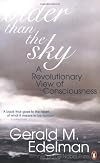
Wider Than the Sky: The Phenomenal Gift of Consciousness
by Gerald M. Edelman
On This Page
Description
How does the firing of neurons give rise to subjective sensations, thoughts, and emotions? How can the disparate domains of mind and body be reconciled? The quest for a scientifically based understanding of consciousness has attracted study and speculation across the ages. In this direct and non-technical discussion of consciousness, Dr. Gerald M. Edelman draws on a lifetime of scientific inquiry into the workings of the brain to formulate answers to the mind-body questions that intrigue show more every thinking person. Concise and understandable, the book explains pertinent findings of modern neuroscience and describes how consciousness arises in complex brains. Edelman explores the relation of consciousness to causation, to evolution, to the development of the self, and to the origins of feelings, learning, and memory. His analysis of the brain activities underlying consciousness is based on recent remarkable advances in biochemistry, immunology, medical imaging, neuroscience, and evolutionary biology, yet the implications of his book extend farther-beyond the worlds of science and medicine into virtually every area of human inquiry. show lessTags
Recommendations














Member Reviews
This is an example of a Nobel prize opening doors that perhaps shouldn't have been - or at least the bouncer should have checked items at the door. As a popular science book, this really doesn't work. It is dry, jargon-laden, unstructured, repetitive, almost devoid of arguments for positions taken, and frankly so full of waffle that this is one of the longest short books I've ever read. And I'm a neuroscience researcher who knows lots about the field, so for a layperson the book must be even more of a disappointment, I fear. There are also two critical problems with the content: the first is Edelman's belief that conscious mental states have no causal role to play in the world. This is a reformulation of the philosopher Kim's view, but show more Kim's position is too black-and-white and overly pessimistic about science. The second critical problem is Edelman's bizarre view that the human brain is not a computer. His reasons are silly and this position is even more strange, given that he has recently published successful computer models of his theory! There are interesting and fashionable aspects of Edelman's overall views of consciousness, hidden away in here, but on the whole this book is poorly written and disappointing. show less
If this is a "simplified, layman's" book on consciousness, as it's advertised to be, then this simple layman's consciousness is just a bit dimmer than the lamps on the stylish cover. It's a slim tome, weighing in at only around 150 pages, and comes complete with a glossary, which I found myself consulting even more frequently than the glossary in "Dune". Even given its brevity and the definitions enclosed, well, this is, to embrace the pun fully, a heady read. Some of this has reentered my cerebral core, but much of it, I fear, bounced off. I have a general idea what he's getting at, but let's just say, after only 150 pages of this stuff, this man's consciousness is gonna experience Miller time.
All that having been said, it would seem show more that this is a currently compelling theory of consciousness, that is introduced in as "friendly" a way as possible. I think a second read would help a lot, it's not a simple topic by any stretch. So hats off to Dr. Edelman for doing an admirable job of introducing this supremely complicated realm of study and theory. show less
All that having been said, it would seem show more that this is a currently compelling theory of consciousness, that is introduced in as "friendly" a way as possible. I think a second read would help a lot, it's not a simple topic by any stretch. So hats off to Dr. Edelman for doing an admirable job of introducing this supremely complicated realm of study and theory. show less
This was a short but highly informative read. Though cursory in explanation and short in extensions, it explains a great deal about how our brains are structured in order to give rise to consciousness. Easily readable in a day, this book is great for introducing the recent developments and paradigms in cognitive neuroscience to a student or laymen interested in testing the waters before diving in.
Shorter and more simply written than this neurobiologist's earlier books, but still rather bewildering.
Mostly restates William James, doesn't really get anyplace.
Mostly restates William James, doesn't really get anyplace.
Very hard reading for constructivism class.
Members
- Recently Added By
Author Information

22 Works 1,574 Members
Gerald M. Edelman is director of the Neurosciences Institute and president of Neuroscience Research Foundation.
Awards and Honors
Series
Belongs to Publisher Series
Classifications
Statistics
- Members
- 332
- Popularity
- 95,249
- Reviews
- 7
- Rating
- (3.58)
- Languages
- 5 — Czech, English, French, German, Italian
- Media
- Paper, Ebook
- ISBNs
- 11
- ASINs
- 1